
An atmospheric study reveals unexpected findings about our largest neighboring planet and the structure of its deep atmosphere.
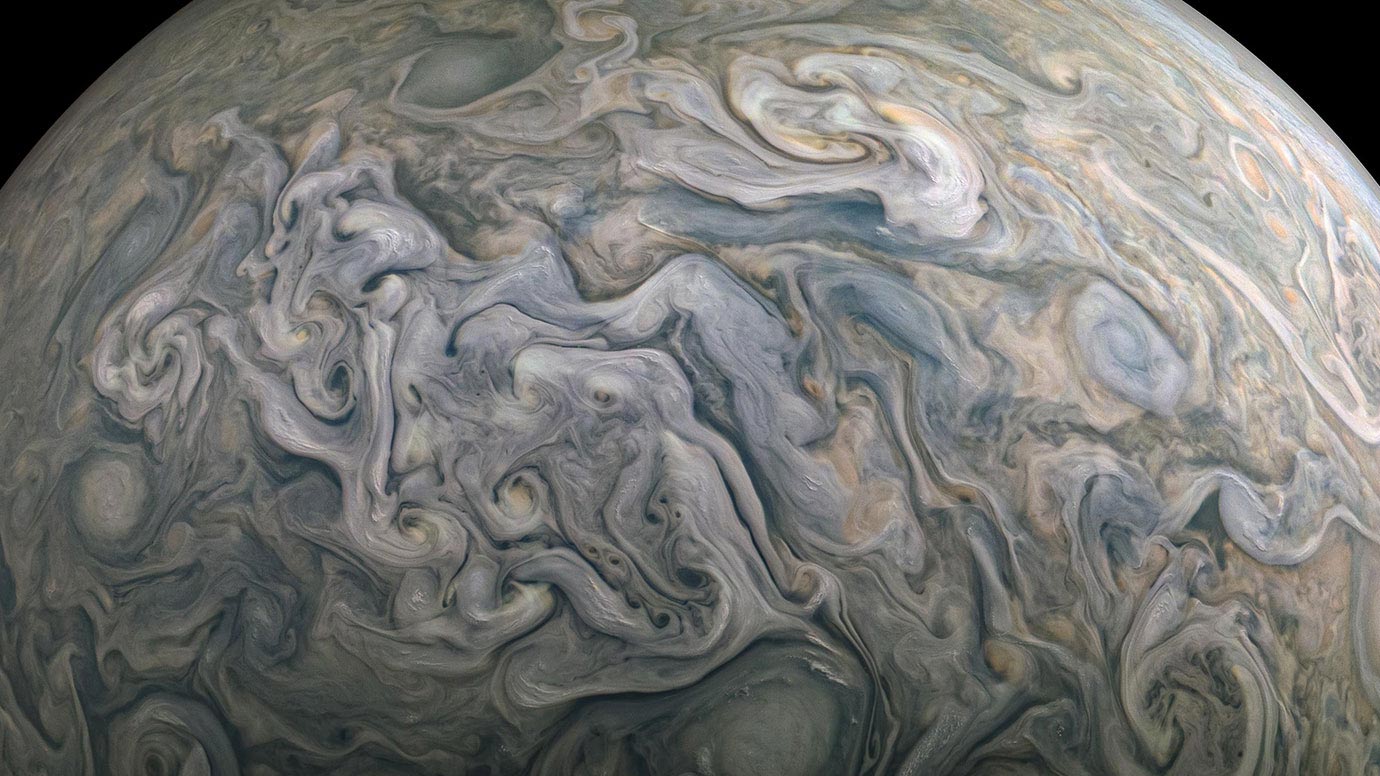
Towering clouds sweep across Jupiter’s surface. Like those on Earth, these clouds contain water, but on the gas giant, they are far denser, forming layers so thick that no spacecraft has yet been able to directly measure what lies below them.
Now, a new study led by scientists at the University of Chicago and NASA’s Jet Propulsion Laboratory offers an unprecedented view beneath those clouds. By building the most detailed atmospheric model of Jupiter so far, the researchers were able to probe the planet’s deep structure in ways that were not previously possible.
One key result helps settle a long-running question about Jupiter’s composition. The team estimates that the planet contains about one and a half times more oxygen than the Sun. That finding provides an important clue for scientists working to understand how Jupiter, and the rest of the solar system’s planets, originally formed.
“This is a long-standing debate in planetary studies,” said Jeehyun Yang, a postdoctoral researcher at UChicago and first author on the paper. “It’s a testament to how the latest generation of computational models can transform our understanding of other planets.”
The study was published in The Planetary Science Journal.
Clouds and chemistry
Astronomers have been aware of Jupiter’s turbulent atmosphere for at least 360 years. Early telescopic observations revealed a strange and persistent feature on the planet’s face, a massive storm that would later become known as the Great Red Spot.
That storm, which is roughly twice the size of Earth, has raged for centuries and is only one part of a planet-wide system of violent winds and towering cloud layers. Jupiter’s entire visible surface is a constantly shifting mosaic of storms.
What remains uncertain is what exists beneath this churning exterior. Jupiter’s clouds are so dense that NASA’s Galileo probe lost contact with Earth as it descended into the planet’s deeper atmosphere in 2003. Today, NASA’s Juno mission studies Jupiter from orbit, gathering data while keeping a safe distance from the crushing depths below.
These measurements from orbit can tell us the components in the upper atmosphere: ammonia, methane, ammonium hydrosulfide, water, and carbon monoxide, among others. Scientists have combined this with knowledge about chemical reactions to build models of Jupiter’s deep atmosphere.
But studies have disagreed about certain points, such as how much water—and thus oxygen—the planet contains. Yang saw an opportunity to apply a new generation of chemical modeling to the knotty question.
The chemistry of Jupiter’s atmosphere is incredibly complex. Molecules travel between the extremely hot conditions deep in the atmosphere and the cooler upper regions, changing phases and rearranging into different molecules, via thousands of different types of reactions. But the behavior of clouds and droplets has to be accounted for, too.
To better capture all these phenomena, Yang worked with a team of scientists to incorporate both chemistry and hydrodynamics into one model—a first.
“You need both,” Yang said. “Chemistry is important, but doesn’t include water droplets or cloud behavior. Hydrodynamics alone simplifies the chemistry too much. So, it’s important to bring them together.”
Elemental questions
Among the findings is a new calculation for how much oxygen Jupiter has. According to their analysis, Jupiter likely has about one and a half times more than the sun.
For decades, scientists have been arguing about this number. A major recent study had put it much lower, at only a third of the sun’s.
But knowing this statistic is particularly relevant for understanding how our solar system formed.
All of the elements that make up planets—and us—are the same stuff that makes up the sun. But there can be differences in the amounts of these materials, and we can use those clues to piece together how the planets must have formed.
For example, did Jupiter form in the same place where it is now, or did it form closer or further away and drift over time? Clues can come from the fact that much of the oxygen in the planet is bound up in water, which will freeze—and behave differently—if it’s too far away from the warmth of the sun. Ice is easier for planets to accumulate than water vapor.
In turn, knowing more about which conditions create which kinds of planets can help us as we search for habitable planets beyond our own solar system.
The model also suggested that Jupiter’s atmosphere likely circulates up and down much more slowly than was long believed.
“Our model suggests the diffusion would have to be 35 to 40 times slower compared to what the standard assumption has been,” said Yang. For example, it would take a single molecule several weeks to move through one layer of the atmosphere, rather than hours.
“It really shows how much we still have to learn about planets, even in our own solar system,” Yang said.
Reference: “Coupled 1D Chemical Kinetic Transport and 2D Hydrodynamic Modeling Supports a Modest 1–1.5× Supersolar Oxygen Abundance in Jupiter’s Atmosphere” by Jeehyun Yang, Ali Hyder, Renyu Hu and Jonathan I. Lunine, 8 January 2026, The Planetary Science Journal.
DOI: 10.3847/PSJ/ae28d5
Funding: NASA, Caltech-Jet Propulsion Laboratory.
Never miss a breakthrough: Join the SciTechDaily newsletter.
Follow us on Google and Google News.