
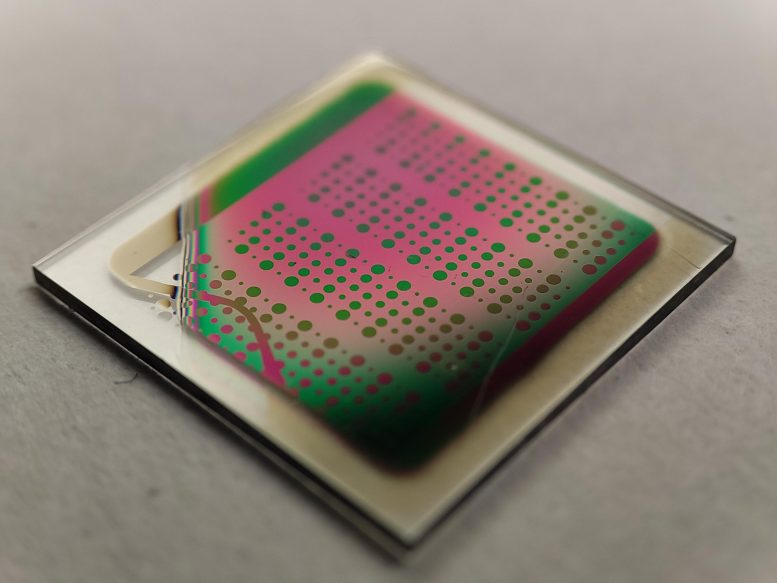
Researchers at TU Wien (Vienna) have developed a groundbreaking oxygen-ion battery, which boasts exceptional durability, eliminates the need for rare elements, and solves the problem of fire hazards.
Lithium-ion batteries, while commonplace in today’s world – powering everything from electric vehicles to smartphones – aren’t necessarily the optimal solution for all applications. Researchers at TU Wien have made a breakthrough by creating an oxygen-ion battery that offers several significant advantages. While it may not match the energy density of lithium-ion batteries, its storage capacity doesn’t diminish irreversibly over time, making it capable of an exceptionally long lifespan as it can be regenerated.
Moreover, the fabrication of oxygen-ion batteries doesn’t require scarce elements and involves non-combustible materials. The innovative battery concept has already led to a patent application, filed in collaboration with partners in Spain. These oxygen-ion batteries could provide an outstanding solution for large-scale energy storage systems, such as those required to hold electrical energy from renewable sources.
Ceramic Materials as a New Solution
“We have had a lot of experience with ceramic materials that can be used for fuel cells for quite some time,” says Alexander Schmid from the Institute for Chemical Technologies and Analytics at TU Wien. “That gave us the idea of investigating whether such materials might also be suitable for making a battery.”
The ceramic materials that the TU Wien team studied can absorb and release doubly negatively charged oxygen ions. When an electric voltage is applied, the oxygen ions migrate from one ceramic material to another, after which they can be made to migrate back again, thus generating electric current.
“The basic principle is actually very similar to the lithium-ion battery,” says Prof. Jürgen Fleig. “But our materials have some important advantages.” Ceramics are not flammable – so fire accidents, which occur time and again with lithium-ion batteries, are practically ruled out. In addition, there is no need for rare elements, which are expensive or can only be extracted in an environmentally harmful way.
“In this respect, the use of ceramic materials is a great advantage because they can be adapted very well,” says Tobias Huber. “You can replace certain elements that are difficult to obtain with others relatively easily.” The prototype of the battery still uses lanthanum – an element that is not exactly rare but not completely common either. But even lanthanum is to be replaced by something cheaper, and research into this is already underway. Cobalt or nickel, which are used in many batteries, are not used at all.
High Life Span
But perhaps the most important advantage of the new battery technology is its potential longevity: “In many batteries, you have the problem that at some point the charge carriers can no longer move,” says Alexander Schmid. “Then they can no longer be used to generate electricity, the capacity of the battery decreases. After many charging cycles, that can become a serious problem.”
The oxygen-ion battery, however, can be regenerated without any problems: If oxygen is lost due to side reactions, then the loss can simply be compensated for by oxygen from the ambient air.
The new battery concept is not intended for smartphones or electric cars, because the oxygen-ion battery only achieves about a third of the energy density that one is used to from lithium-ion batteries and runs at temperatures between 200 and 400 °C. The technology is, however, extremely interesting for storing energy.
“If you need a large energy storage unit to temporarily store solar or wind energy, for example, the oxygen-ion battery could be an excellent solution,” says Alexander Schmid. “If you construct an entire building full of energy storage modules, the lower energy density and increased operating temperature do not play a decisive role. But the strengths of our battery would be particularly important there: the long service life, the possibility of producing large quantities of these materials without rare elements, and the fact that there is no fire hazard with these batteries.”
Reference: “Rechargeable Oxide Ion Batteries Based on Mixed Conducting Oxide Electrodes” by Alexander Schmid, Martin Krammer and Jürgen Fleig, 25 January 2023, Advanced Energy Materials.
DOI: 10.1002/aenm.202203789
Never miss a breakthrough: Join the SciTechDaily newsletter.
Follow us on Google and Google News.
4 Comments
The article mentions an operating temperature of between 200 and 400 degrees C, but it is unclear whether these operating temperatures are generated internally during the charge/discharge cycle, or if the battery must be heated to these operating temperatures from an external source. If the latter, then how does this additional energy consumption to maintain operating temperatures affect the overall efficiency of the battery system?
Sorry I didn’t find the reply button til later!
Yeah, theyr talking about it needing an operating temp from 200-400, and I checked the abstract and the temps seemed higher.
At least we could also bake a cake with the swme oven?
Well, keeping a garage roof area lined with drywall and also insulated sub-enclosures is a neat way to keep ya’ home batteries from going missing. Not sure of the mechanics for getting day heat into it in winter, or the oxygen vent stack, but it’s a mite safer than lading LiPO4 cell modules up and forgetting those, right?
In answer, since I’ve worked with similar fuel cells (but not sealed ion cells), I’m certain the solid electrolyte components operate at the 200-400 C temperature. It might be the discharge will generate heat, but yes, it has to be heated.
I’d be more interested in understanding why anyone could decontaminate an oxidized cell by … adding oxygen.