

Scientists have uncovered a new way rogue planetary-mass objects (PMOs) may form—not as failed stars or ejected planets, but through violent cosmic encounters.
High-resolution simulations reveal that when circumstellar disks in young star clusters collide, their gravitational forces create “tidal bridges” of gas, which collapse into PMOs. This explains why so many of these free-floating objects exist and why they often come in pairs.
A New Formation Theory: Violent Disk Interactions
A new study published today (February 26) in Science Advances offers fresh insight into the origins of free-floating planetary-mass objects (PMOs) — celestial bodies with masses between those of planets and stars.
An international team of astronomers, led by Dr. Hongping Deng from the Shanghai Astronomical Observatory, used advanced simulations to propose a novel explanation for how these mysterious objects form. Their findings suggest that PMOs emerge through violent interactions between circumstellar disks in young star clusters, rather than from traditional planetary or stellar formation processes.
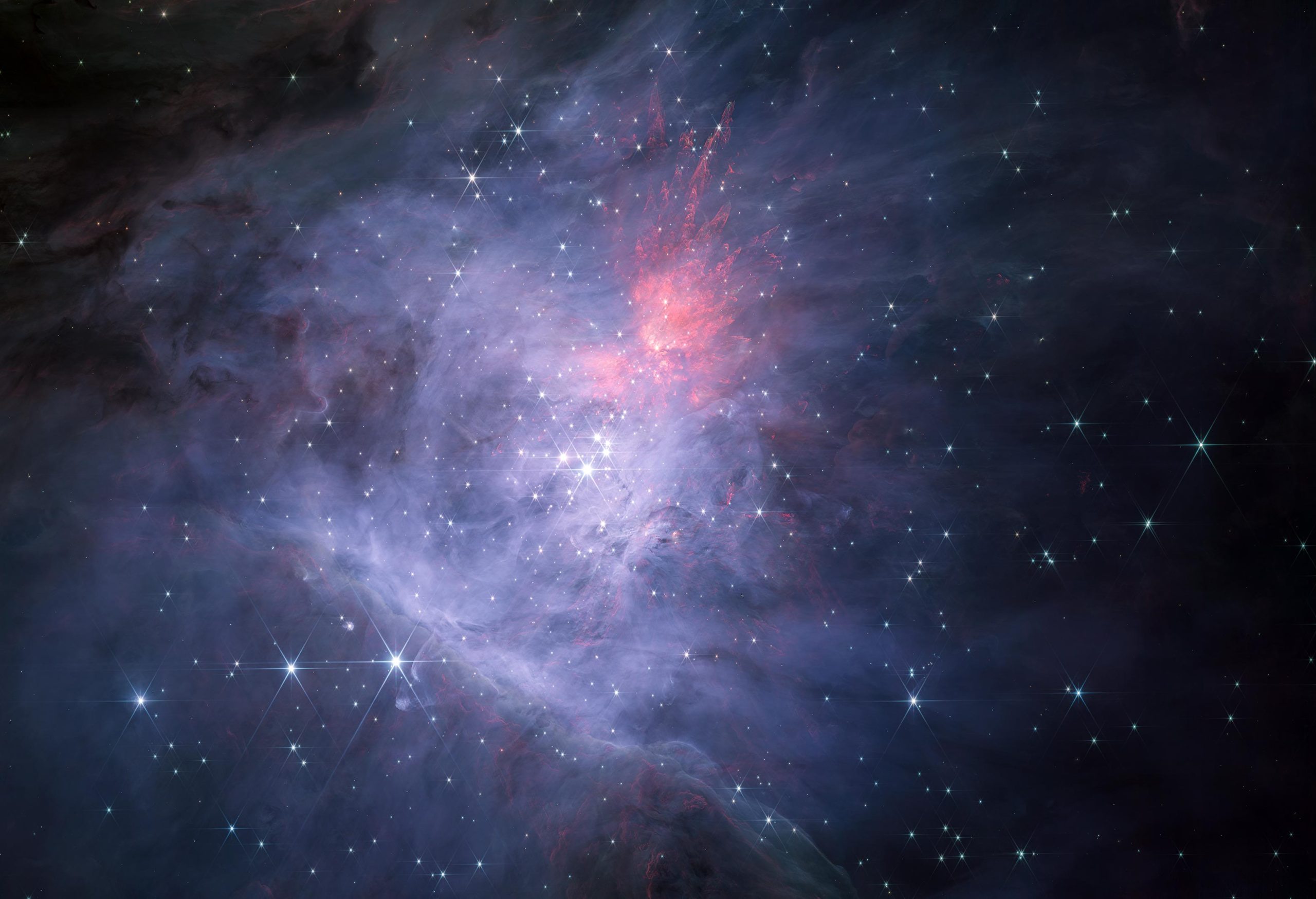
The Mystery of Rogue Planetary-Mass Objects
PMOs are cosmic wanderers, drifting through space without orbiting a star. These objects have masses below 13 times that of Jupiter and are commonly found in young star clusters like the Trapezium Cluster in Orion. While scientists have long observed them, their origins have remained uncertain.
Previous theories suggested that PMOs were either failed stars or planets that had been ejected from their home systems. However, these explanations struggle to account for the large number of PMOs, their frequent occurrence in binary pairs, and their synchronized movement with stars in their clusters. The new study provides a compelling alternative, reshaping our understanding of how these starless worlds come to exist.
“PMOs don’t fit neatly into existing categories of stars or planets,” said Dr. Deng, corresponding author of the study. “Our simulations show they likely form through a completely different process—one tied to the chaotic dynamics of young star clusters.”
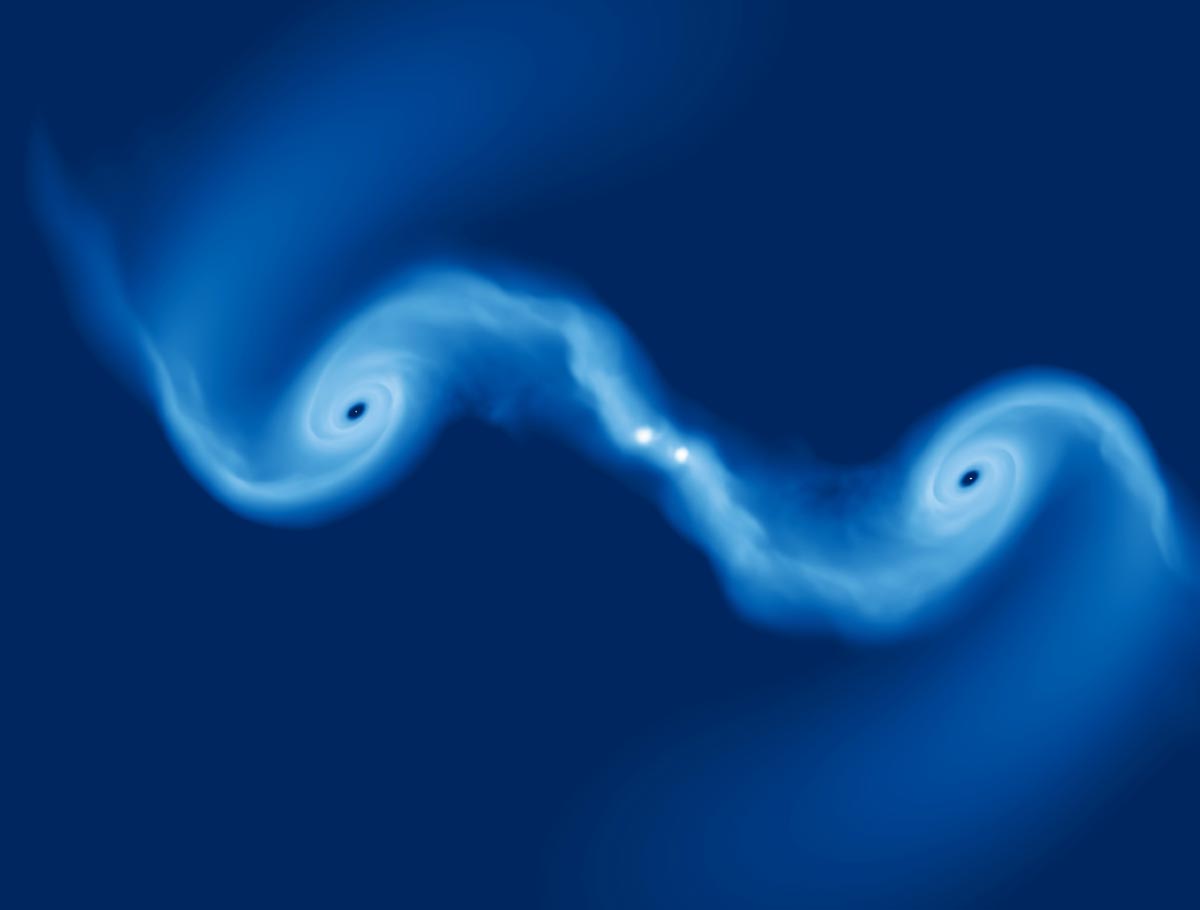
A Cosmic Tug-of-War: How Disks Collide to Create PMOs
Using high-resolution hydrodynamic simulations, the researchers recreated close encounters between two circumstellar disks—rotating annuli of gas and dust surrounding young stars. When these disks collide at speeds of 2–3 km/s and distances of 300–400 astronomical units (AU), their gravitational interactions stretch and compress gas into elongated “tidal bridges.”
These tidal bridges eventually collapse into dense filaments, which further fragment into compact cores. When these filaments reach a critical mass, they produce PMOs with masses of about ten times that of Jupiter. The simulations also revealed that up to 14% of PMOs form in pairs or triplets, with 7–15 AU separations, explaining the high rate of PMO binaries in some clusters. Frequent disk encounters in dense environments like the Trapezium Cluster could generate hundreds of PMOs, explaining the observed overabundance.
Why PMOs Are Unique
PMOs are distinct in their formation. Unlike ejected planets, they move in sync with the stars in their host clusters and inherit material from the outer regions of circumstellar disks. This results in a unique composition, with PMOs reflecting the metal-poor outskirts of these disks, where heavy elements are scarce. Many PMOs also retain gas disks up to 200 AU in diameter, suggesting the potential for lunar or even planetary formation around these rogue objects.
“This discovery partly reshapes how we view cosmic diversity,” said co-author Prof. Lucio Mayer from the University of Zurich, “PMOs may represent a third class of objects, born not from the raw material of star-forming clouds or via planet-building processes, but rather from the gravitational chaos of disk collisions.”
Looking Ahead
The team, including researchers from the University of Hong Kong, the Shanghai Astronomical Observatory, the University of California Santa Cruz, and the University of Zurich, plan further studies to explore the chemical makeup and disk structures of PMOs. Upcoming research on PMOs in various clusters will consolidate the theory of their formation and population properties.
Reference: “Formation of free-floating planetary mass objects via circumstellar disk encounters” by Zhihao Fu, Hongping Deng, Douglas N. C. Lin and Lucio Mayer, 26 February 2025, Science Advances.
DOI: 10.1126/sciadv.adu6058
Never miss a breakthrough: Join the SciTechDaily newsletter.
Follow us on Google and Google News.