
Close Menu
    Facebook X (Twitter) Instagram
    SciTechDaily
    • Biology
    • Chemistry
    • Earth
    • Health
    • Physics
    • Science
    • Space
    • Technology
    Facebook X (Twitter) Pinterest YouTube RSS
    SciTechDaily
    Home»Space»When Disks Collide: The Violent Birth of Rogue Planets
    Space

    When Disks Collide: The Violent Birth of Rogue Planets

    By University of ZurichMarch 14, 2025No Comments4 Mins Read
    Facebook Twitter Pinterest Telegram LinkedIn WhatsApp Email Reddit
    Share
    Facebook Twitter LinkedIn Pinterest Telegram Email Reddit
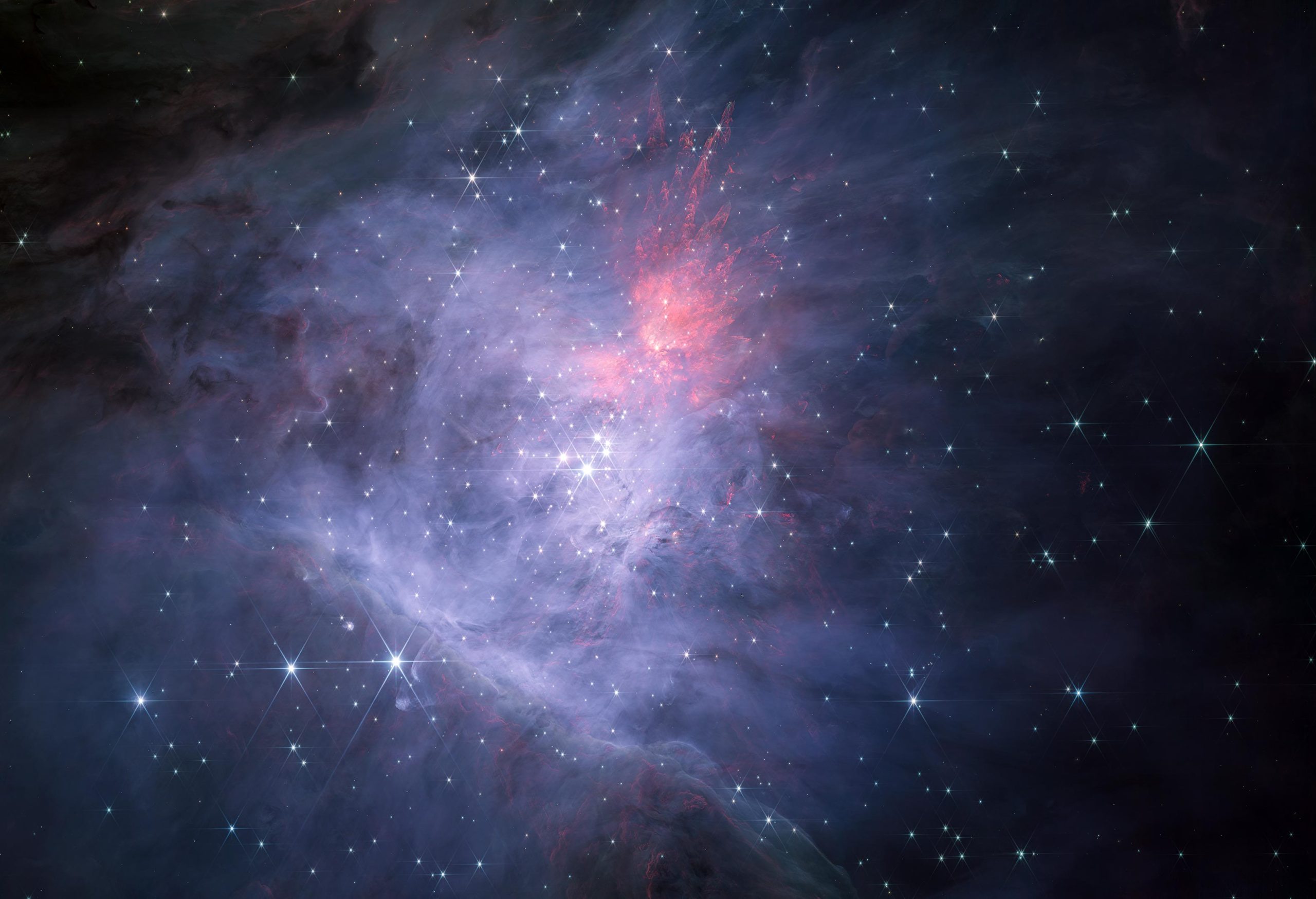
    Orion Nebula in Webb NIRCam Short-Wavelength Channel Aligned
    Image of the inner Orion Nebula and Trapezium Cluster by James Webb Space Telescope. This one-million-year-old star-forming region contains thousands of new stars and hundreds of planetary mass objects floating freely in the nebula, not orbiting stars. Credit: NASA, ESA, CSA / Science leads and image processing: M. McCaughrean, S. Pearson

    How do rogue planetary-mass objects, celestial bodies that fall between planets and stars in size, come into existence?

    An international team of astronomers, including researchers from the University of Zurich, has tackled this mystery using advanced simulations. Their findings reveal that these elusive objects are closely tied to the turbulent interactions within young star clusters, where chaotic gravitational forces and disk collisions play a key role in their formation.

    Cosmic Nomads: The Mystery of Planetary-Mass Objects

    Planetary-mass objects (PMOs) are cosmic nomads, drifting freely through space without being tied to a star. These objects are smaller than 13 times the mass of Jupiter and have been found in large numbers within young star clusters like the Trapezium Cluster in Orion (see image above). Their origins, however, have long puzzled scientists. Until now, many theories suggested that PMOs were either failed stars or planets that had been ejected from their original solar systems.

    Now, an international team of astronomers, in collaboration with the University of Zurich (UZH), has used advanced simulations to offer a new explanation. Their findings suggest that PMOs can form naturally through the violent interactions between disks of gas and dust surrounding young stars. “PMOs don’t fit neatly into existing categories of stars or planets,” said Lucio Meyer from UZH, corresponding author of the study. “Our simulations show they are probably formed by a completely different process.”

    Binary PMO Formation via Circumstellar Disk Encounters
    The formation of binary PMOs via circumstellar disk encounters. The upper panel shows the density map in a logarithmic scale in a representative simulation. The lower panels enlarge a region to show the evolution of the binary PMOs (white sink particles) and how they emerge within the dense filament created by the encounter. Credit: UZH

    How Disks Collide to Create PMOs

    To test this idea, researchers from the University of Zurich, the University of Hong Kong, the Shanghai Astronomical Observatory, and the University of California Santa Cruz ran high-resolution hydrodynamic simulations. They modeled close encounters between two circumstellar disks – rotating rings of gas and dust that form around young stars. When these disks pass near each other, their gravitational pull distorts the gas, creating long, stretched-out structures known as “tidal bridges.”

    The Birth of Free-Floating Worlds

    The simulations showed that these bridges collapse into dense filaments, which then break apart into compact cores. When the mass of these filaments reaches a critical threshold, they form PMOs, typically with masses around 10 times that of Jupiter. The researchers also found that up to 14% of PMOs form in pairs or small groups, which may explain why some clusters contain a high number of PMO binaries. In star-forming regions like the Trapezium Cluster, where disk encounters are frequent, this process could generate hundreds of PMOs.

    Why PMOs Are Unique

    PMOs form along stars, inheriting material from the outer edges of circumstellar disks. PMOs move in synchrony with the stars in their host cluster, unlike ejected planets. Many PMOs retain gas disks, suggesting the potential for moon or even planet formation around these nomads.

    “This discovery partly reshapes how we view cosmic diversity,” said co-author Lucio Mayer. “PMOs may represent a third class of objects, born not from the raw material of star-forming clouds or via planet-building processes, but rather from the gravitational chaos of disk collisions.”

    Explore Further: Scientists Just Discovered a Violent New Way Rogue Planets Are Made

    Reference: “Formation of free-floating planetary mass objects via circumstellar disk encounters” by Zhihao Fu, Hongping Deng, Douglas N. C. Lin and Lucio Mayer, 26 February 2025, Science Advances.
    DOI: 10.1126/sciadv.adu6058

    Never miss a breakthrough: Join the SciTechDaily newsletter.
    Follow us on Google and Google News.

    Astronomy Astrophysics Nomad Planets Planets University of Zurich
    Share. Facebook Twitter Pinterest LinkedIn Email Reddit

    Related Articles

    Scientists Just Discovered a Violent New Way Rogue Planets Are Made

    A New Way of Forming Planets – A Decades Old Puzzle Solved?

    Two Scientists Have Figured Out What Caused Saturn’s Tilt

    Solar System Formation in Two Steps – Explains Composition and Features of Planets, Asteroids and Meteorites

    A Tale of Planetary Resurrection in a Triple-Star System With a Skewed Configuration

    Striped or Spotted? Planetary Scientists Solve a Brown Dwarf Mystery

    How Stars Form in Nearby Galaxies

    AB Aur: A Rosetta Stone for Planet Formation

    Astronomers Discover Pair of Lonely Exotic Planet-Like Objects Born Like Stars

    Leave A Reply Cancel Reply

    • Facebook
    • Twitter
    • Pinterest
    • YouTube

    Don't Miss a Discovery

    Subscribe for the Latest in Science & Tech!

    Trending News

    Scientists Uncover Potential Brain Risks of Popular Fish Oil Supplements

    Scientists Discover a Surprising Way To Make Bread Healthier and More Nutritious

    After 60 Years, Scientists Uncover Unexpected Brain Effects of Popular Diabetes Drug Metformin

    New Research Uncovers Hidden Side Effects of Popular Weight-Loss Drugs

    Scientists Rethink Extreme Warming After Surprising Ocean Discovery

    Landmark Study Links Never Marrying to Significantly Higher Cancer Risk

    Researchers Discover Unknown Beetle Species Just Steps From Their Lab

    Largest-Ever Study Finds Medicinal Cannabis Ineffective for Anxiety, Depression, PTSD

    Follow SciTechDaily
    • Facebook
    • Twitter
    • YouTube
    • Pinterest
    • Newsletter
    • RSS
    SciTech News
    • Biology News
    • Chemistry News
    • Earth News
    • Health News
    • Physics News
    • Science News
    • Space News
    • Technology News
    Recent Posts
    • Scientists Discover Hidden Pathway Inside Catalysts That Defies Decades of Assumptions
    • Scientists Finally Crack Decades-Old Mystery of “Breathing” Lasers
    • “Like Liquid Metal”: Scientists Create Strange Shape-Shifting Material
    • Early Warning Signals of Esophageal Cancer May Be Hiding in Plain Sight
    • Researchers Have Discovered a THC-Free Cannabis Compound That May Replace Opioids
    Copyright © 1998 - 2026 SciTechDaily. All Rights Reserved.
    • Science News
    • About
    • Contact
    • Editorial Board
    • Privacy Policy
    • Terms of Use

    Type above and press Enter to search. Press Esc to cancel.