

XRISM has uncovered how galaxy clusters evolve—violent mergers create turbulence, preventing hot gas from cooling. This discovery solves a long-standing mystery and provides new insight into cosmic history.
- XRISM’s Advanced X-ray Spectrometer – Using its superior capabilities, XRISM detected oscillating hot gas motion at the center of the Centaurus Cluster for the first time.
- First Direct Evidence of Cluster Mergers – The observed gas movement confirms that galaxy clusters grow through collisions and mergers.
- Solving a Long-Standing Mystery – By directly measuring the velocity of the gas, scientists can better understand the heating mechanism that has puzzled astronomers for decades.
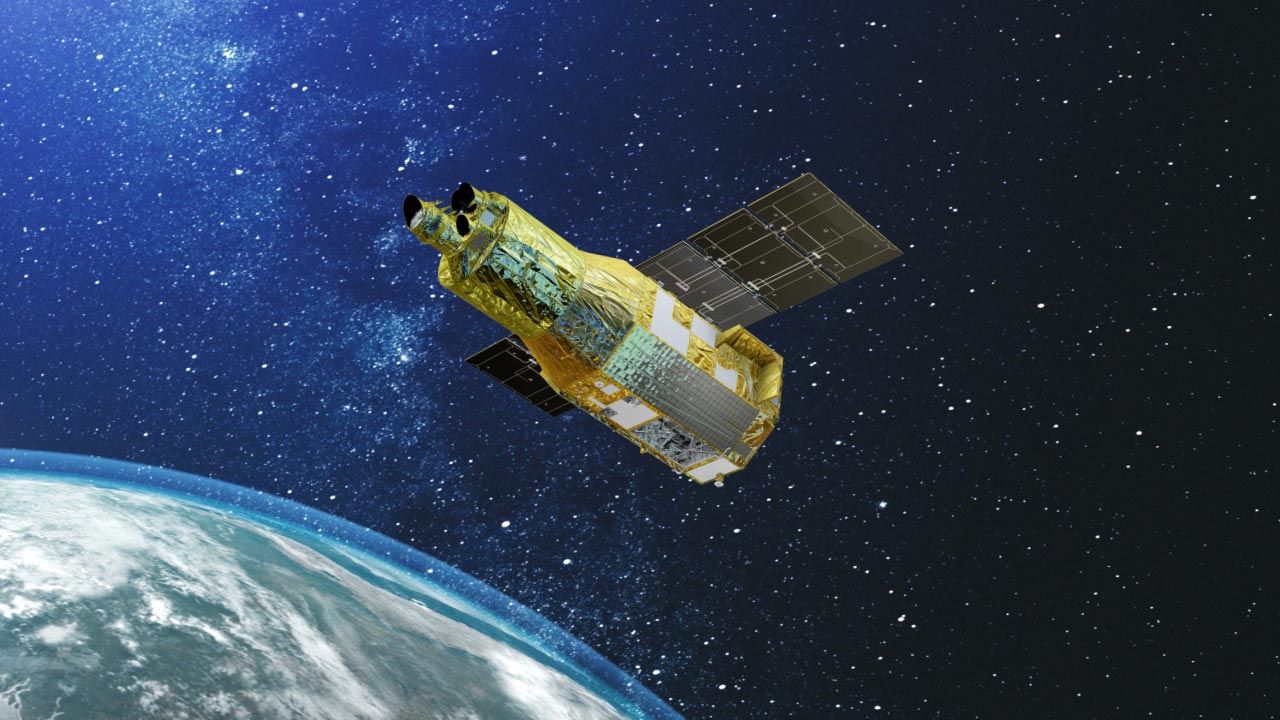
Galaxy Clusters: Cosmic Giants Shaped by Gravity
The Universe is shaped by gravity, which pulls galaxies — huge collections of stars and gas — into even larger structures called galaxy clusters. These clusters are held together by dark matter’s gravitational pull, and within them, gas becomes superheated to tens of millions of degrees. At such extreme temperatures, the gas emits powerful X-rays. Astronomers have long suspected that galaxy clusters grow through repeated mergers and collisions, but direct evidence has been difficult to capture — until now. In a groundbreaking study, XRISM has provided definitive proof of this process at the heart of a galaxy cluster.
The central regions of galaxy clusters are among the brightest X-ray sources in the Universe. In theory, as this intense radiation escapes, the surrounding gas should gradually cool — a process known as radiative cooling. Yet observations show that the gas remains unexpectedly hot, defying expectations and leaving scientists searching for an explanation. One possibility is that gas motion plays a role in maintaining these high temperatures, but until now, instruments lacked the precision to confirm this idea.
Using XRISM, an international research team (the XRISM Collaboration) has precisely measured the movement of hot gas at the core of a galaxy cluster. Their findings reveal that the gas is in motion, “sloshing” back and forth in response to past collisions and mergers with other clusters. These oscillations keep the gas stirred, preventing it from cooling as expected and maintaining the cluster’s high temperatures.
This discovery represents a major breakthrough in our understanding of galaxy formation and cluster evolution. By capturing gas dynamics with unprecedented detail, XRISM has provided new insights into how the Universe’s largest structures continue to evolve.
Tracing the Universe’s Evolution Through Cosmic Collisions
How did the Universe evolve into its current structure after the Big Bang? This fundamental question has driven decades of astronomical research. The Universe is filled with vast cosmic structures. The Solar System is a collection of planets and small Solar System bodies orbiting the Sun, while a galaxy is a vast assembly of stars bound by gravity. However, these structures did not exist from the Universe’s beginning; they gradually formed and grew under the influence of gravity acting on matter. Violent cosmic events, such as collisions and mergers between celestial bodies, shaped our current universe.
The Role of Dark Matter and Superheated Gas
The largest known structures formed through this cosmic evolution are galaxy clusters. These immense conglomerations of galaxies are held together by the powerful gravitational pull of dark matter, an invisible and mysterious substance that makes up most of the Universe’s mass. However, the dark matter and galaxies alone are not the dominant components of these clusters — significant mass exists in the form of gas, composed of hydrogen and helium gas left over from the Big Bang.
As this primordial gas falls into a galaxy cluster, the immense gravitational energy converts it into superheated gas at temperatures of tens of millions of degrees. At such extreme temperatures, the gas emits X-rays, making X-ray observations essential for studying the evolution and dynamics of galaxy clusters. The mass of this hot gas is significantly greater than that of the galaxies themselves, meaning that understanding galaxy clusters requires understanding this high-energy component.
The Puzzle of Persistently Hot Gas
One of the great astrophysical puzzles has been why the hot gas in the center of a galaxy cluster does not cool over time. Theoretically, the gas should gradually lose energy through X-ray emission, cooling down in a process known as radiative cooling. However, previous observations have shown that, contrary to expectations, the gas remains persistently hot. This discrepancy suggests an unknown heating mechanism is at work, preventing the hot gas from cooling as expected. Unraveling this mystery is crucial for understanding the formation and evolution of the Universe’s largest structures.
From December 2023 to January 2024, the research team used XRISM to observe the nearby galaxy cluster, the Centaurus Cluster, located approximately 100 million light-years from Earth. The goal was to investigate the motion of the hot gas in the core of the galaxy cluster.
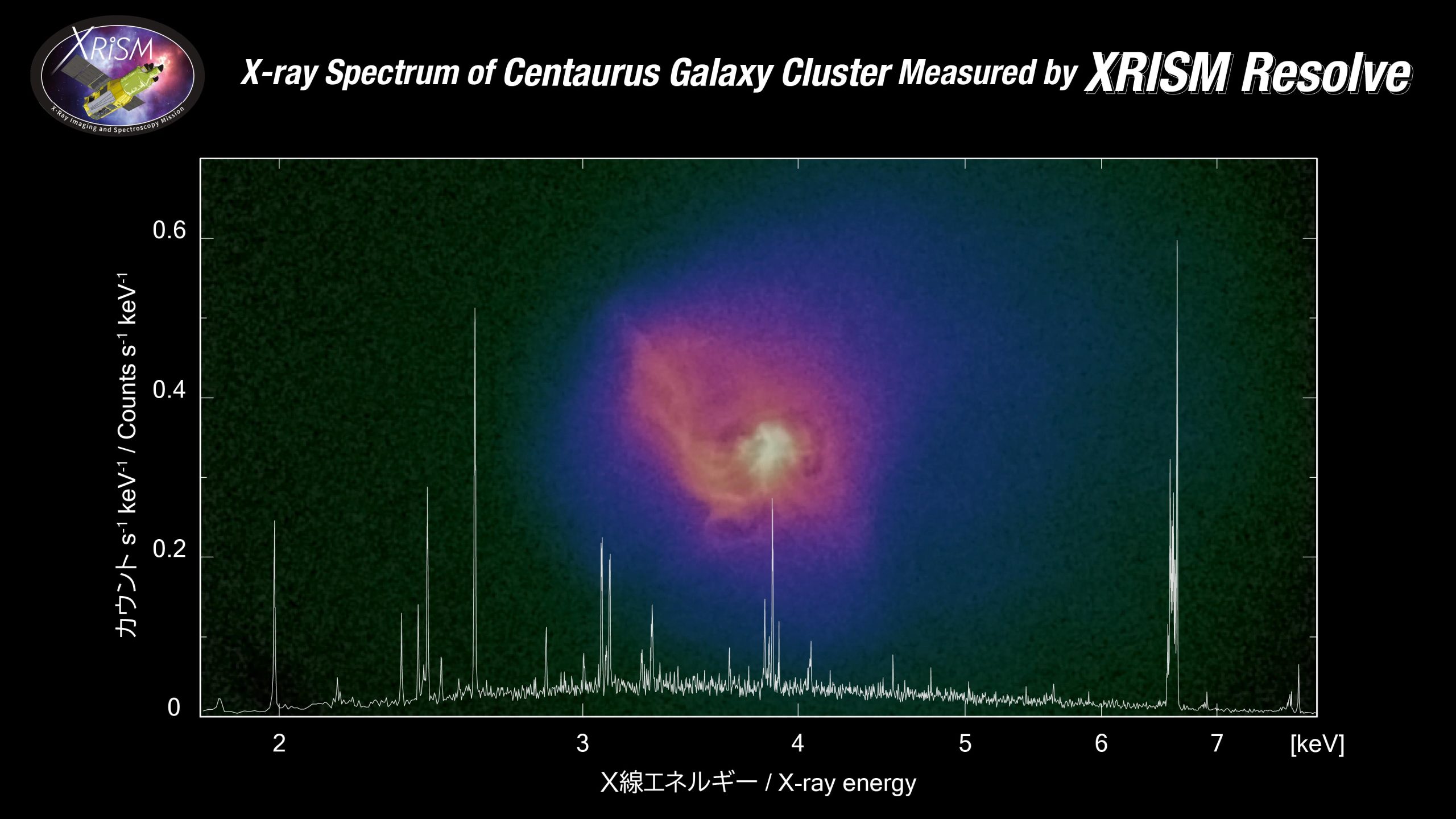
Spectroscopic Breakthrough: Measuring Gas Motion with XRISM
Figure 2 displays the X-ray spectrum of the cluster’s center, captured by Resolve, the cutting-edge soft X-ray spectrometer onboard XRISM. By analyzing this spectrum, the research team aimed to gain deeper insights into how gas moves within the cluster. Precise spectroscopic measurements of emission lines — the sharp, spike-like features in Figure 2 — are essential to study this motion. Resolve achieves an energy resolution about 30 times higher than conventional instruments, making it particularly adept at measuring gas velocity with unprecedented accuracy.
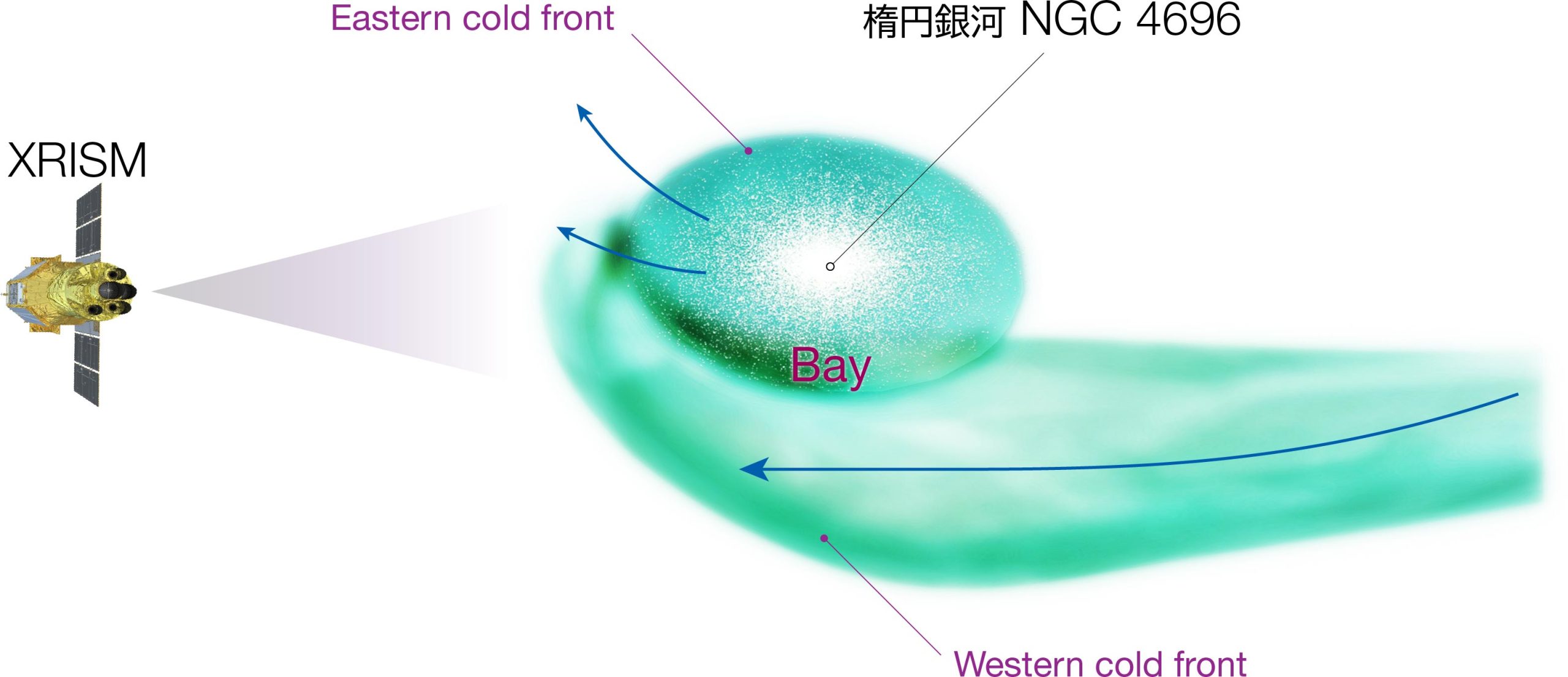
Observations revealed that the hot gas at the center of the Centaurus Cluster flows toward Earth at speeds of 130 to 310 km per second (Figure 3). This oscillating (“sloshing”) motion is believed to stir the surrounding hot gas, preventing it from cooling and maintaining the high temperatures observed in the cluster’s core.
Galaxy Cluster Collisions and Their Lasting Impact
The research team compared XRISM’s observations with numerical simulations and concluded that past collisions and mergers of clusters are responsible for the observed hot gas sloshing. Figure 4 illustrates this mechanism: the Centaurus Cluster has undergone multiple interactions with smaller clusters, and the hot gas in its core is still sloshing due to these past collisions. XRISM’s observations reveal that these motions stir the gas, preventing it from cooling and maintaining the cluster’s high central temperature.

A New Era in Understanding Cosmic Evolution
This research has unveiled the gas motions within a galaxy cluster with unprecedented precision. XRISM’s observations provide direct evidence of how clusters evolve through collisions and mergers, offering a crucial missing piece in our understanding of cosmic history. By capturing the velocity of hot gas in such detail, this study marks a major leap forward in our knowledge of large-scale cosmic evolution. The discovery of these dynamic gas velocities not only deepens our insight into galaxy clusters but also holds the potential to greatly advance our understanding of the formation and evolution of other celestial bodies in the Universe.
Reference: “The bulk motion of gas in the core of the Centaurus galaxy cluster” by XRISM collaboration, 12 February 2025, Nature.
DOI: 10.1038/s41586-024-08561-z
Never miss a breakthrough: Join the SciTechDaily newsletter.
Follow us on Google and Google News.