
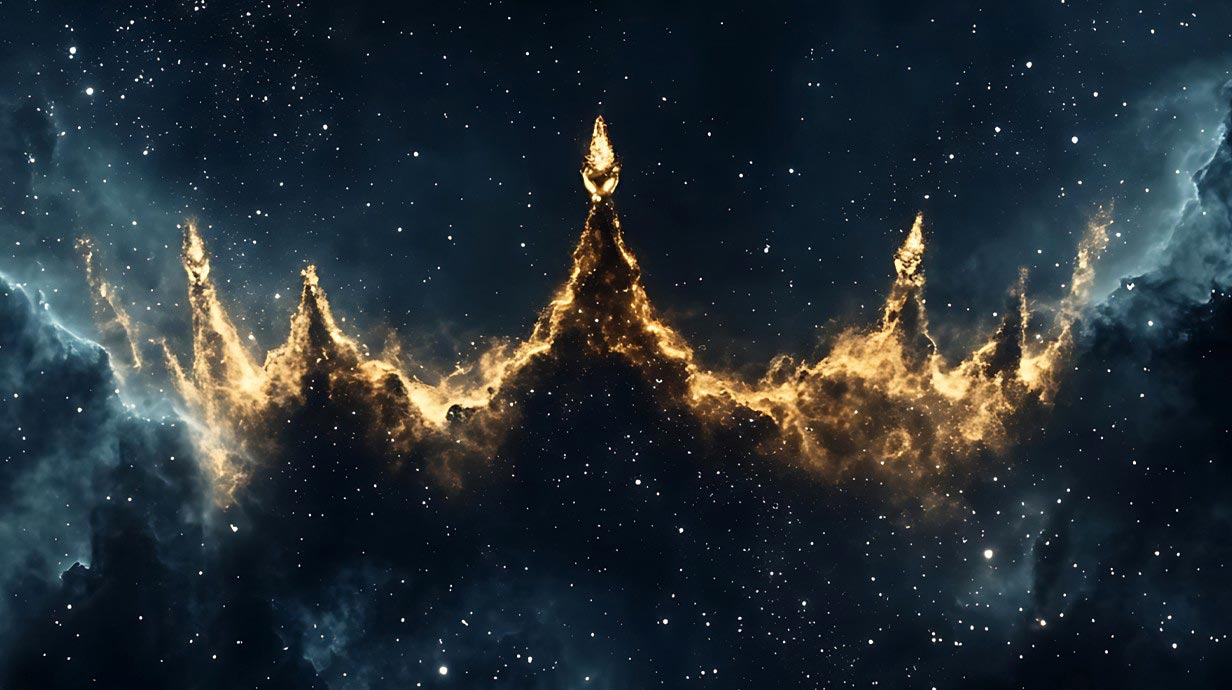
Scientists may have found the hiding place of missing cosmic sulfur—in icy space dust, bound in crown-shaped and chain-like molecules that escape detection.
For years, scientists studying the chemistry of the cosmos have searched for sulfur in space, only to discover that it appears to be far less common than expected. Now, a new investigation may reveal where this life-essential element has been hiding.
A global team of researchers, including Ryan Fortenberry, an astrochemist at the University of Mississippi; Ralf Kaiser, professor of chemistry at the University of Hawaii at Mānoa; and Samer Gozem, a computational chemist at Georgia State University, has published its findings in the journal Nature.
The Mystery of Sulfur in Space
“Hydrogen sulfide is everywhere: it’s a product of coal-fired power plants, it has an effect on acid rain, it changes the pH levels of oceans and it comes out of volcanoes,” Fortenberry said. “If we gain a better understanding of what the chemistry of sulfur can do, the technological commercialization that can come from that can only be realized with a foundation of fundamental knowledge.”
Sulfur ranks as the 10th most abundant element in the universe and plays an essential role in the chemistry of planets, stars, and living things. Yet, when astronomers search for molecular sulfur in space, it is consistently missing in large quantities.
“The observed amount of sulfur in dense molecular clouds is less – compared to predicted gas-phase abundances– by three orders of magnitude,” Kaiser said.
One possible explanation points toward interstellar ice.
Clues Hidden in Interstellar Ice
In the frigid regions between the stars, sulfur atoms can organize themselves into two particularly stable structures. One is octasulfur, in which eight sulfur atoms form crown-like rings. The other is a class of molecules called polysulfanes, in which chains of sulfur atoms are connected by hydrogen atoms. These forms can develop on the surfaces of icy dust grains, effectively locking sulfur away in solid material.
“If you use, for instance, the James Webb Space Telescope, you get a specific signature at specific wavelengths for oxygen and carbon and nitrogen and so forth,” Fortenberry said. “But when you do that for sulfur, it’s out of whack, and we don’t know why there isn’t enough molecular sulfur.
“What this work is showing is that the most common forms of sulfur that we already know about are probably where the sulfur is hiding.”
Kaiser and Fortenberry’s research showed that these sulfur-rich molecules may be abundant in icy regions of interstellar space, giving astronomers a potential road map to solving the sulfur puzzle.
“Laboratory simulations of interstellar conditions such as this study discover possible inventories of sulfur–containing molecules that can be formed on interstellar ices,” Kaiser said. “Astronomers can then utilize the results and look for these polysulfane molecules in the interstellar medium via radio telescopes once sublimed into the gas-phase in star-forming regions.”
Shapeshifting Sulfur’s Elusive Nature
The reason sulfur has been so difficult to find is that the bonds it forms are always changing, going from crowns to chains and a variety of other formulations.
“It never maintains the same shape,” Fortenberry said. “It’s kind of like a virus – as it moves, it changes.”
The researchers’ work identifies possible stable configurations that astronomers can search for in the universe.
Creative Solutions With Cosmic Impact
“The thing that I love about astrochemistry is that it forces you to ask hard questions, then forces you to come up with creative solutions,” Fortenberry said. “And those hard questions and creative solutions can have significant, unintended positive consequences.”
Reference: “Missing interstellar sulfur in inventories of polysulfanes and molecular octasulfur crowns” by Ashanie Herath, Mason McAnally, Andrew M. Turner, Jia Wang, Joshua H. Marks, Ryan C. Fortenberry, Jorge C. Garcia-Alvarez, Samer Gozem and Ralf I. Kaiser, 1 July 2025, Nature Communications.
DOI: 10.1038/s41467-025-61259-2
Never miss a breakthrough: Join the SciTechDaily newsletter.
Follow us on Google and Google News.