
Close Menu
    Facebook X (Twitter) Instagram
    SciTechDaily
    • Biology
    • Chemistry
    • Earth
    • Health
    • Physics
    • Science
    • Space
    • Technology
    Facebook X (Twitter) Pinterest YouTube RSS
    SciTechDaily
    Home»Space»Scientists Predict the Structure and Morphology of the Primordial Magnetic Field
    Space

    Scientists Predict the Structure and Morphology of the Primordial Magnetic Field

    By Dr. Hannelore Hämmerle, Max Planck Institute for AstrophysicsApril 2, 20181 Comment4 Mins Read
    Facebook Twitter Pinterest Telegram LinkedIn WhatsApp Email Reddit
    Share
    Facebook Twitter LinkedIn Pinterest Telegram Email Reddit
    Astrophysicists Calculate the Original Magnetic Field in Our Cosmic Neighbourhood
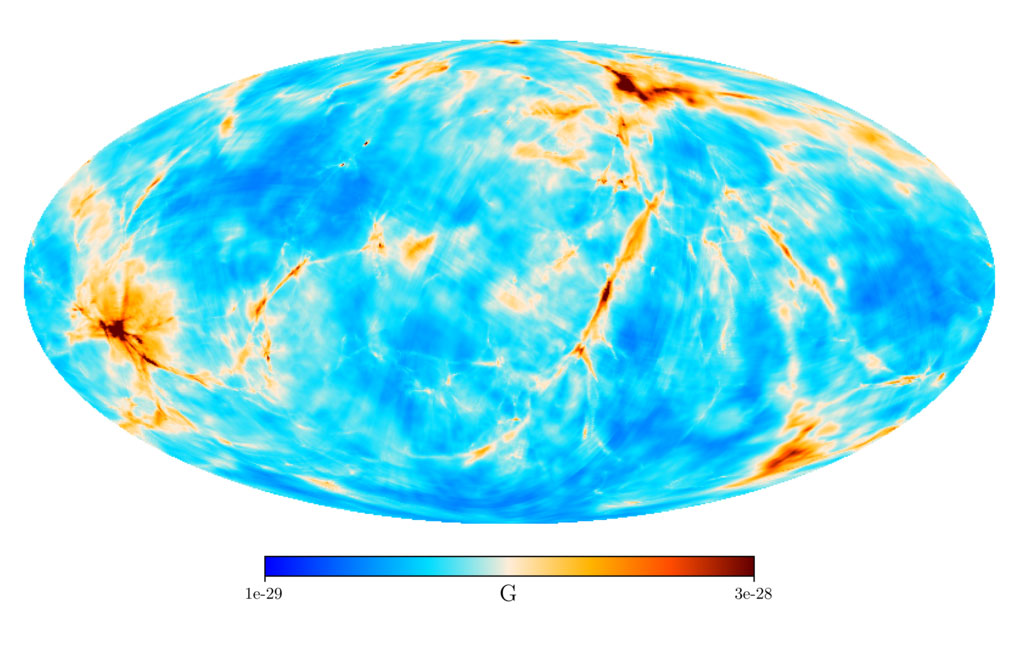
    Glimpse into the unknown: this sky view shows the Harrison magnetic field strength averaged within a sphere with 300 million light years radius around the Earth. The two regions with particularly stronger fields are the Perseus Pisces galaxy cluster (right) and the Virgo cluster (above). Credit: © MPI for Astrophysics

    In the first fractions of a second after the birth of our universe, not only elementary particles and radiation, but also magnetic fields were generated. A team led by the Max Planck Institute for Astrophysics in Garching has now calculated what these magnetic fields should look like today in the universe – in great detail and in 3D.

    The Big Bang is still shrouded in mystery in many respects. Cosmologists use various ways to try and get information about the first moments of our universe. One possibility is cosmic magnetic fields, which were created by the birth of the universe and should have survived to this day.

    In addition to a number of highly speculative mechanisms, which have been proposed for this so-called magnetogenesis, there is a simple plasma-physical effect: the Harrison effect. This must have produced magnetic fields at the Big Bang. Vortex movements in the plasma of the early universe produced electric currents due to friction, thus inducing a magnetic field.

    Knowing the plasma vortices at that early time, one could calculate in detail how these magnetic fields were generated. If one also knew the plasma motions since then, one could calculate what these magnetic fields should look like today.
    Physicists Calculate the Original Magnetic Field in Our Cosmic Neighbourhood
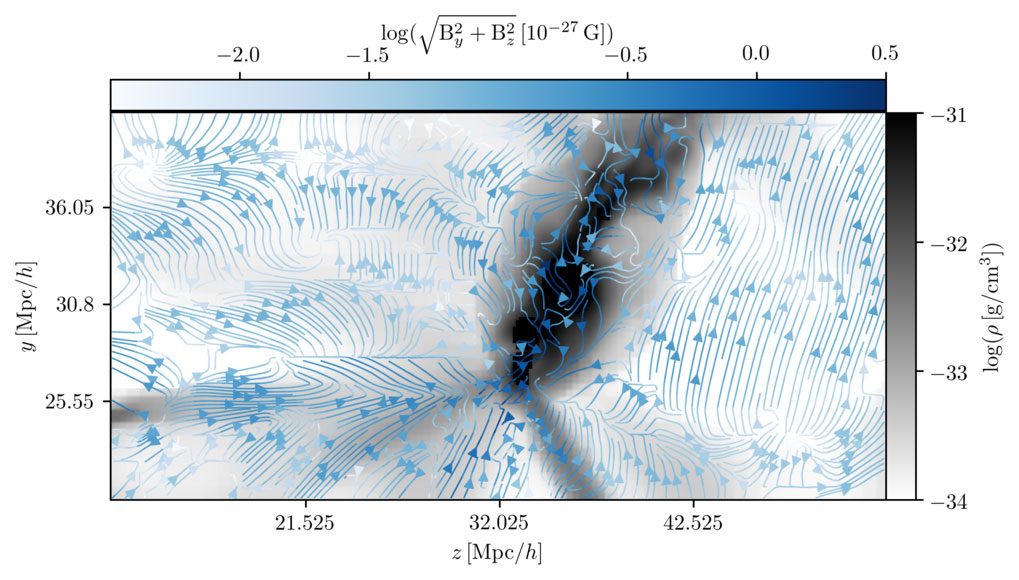
    Cosmic fields: a slice through the Perseus Pisces galaxy cluster in the present Universe with the matter distribution depicted in grey and the blue arrows highlighting the Harrison magnetic field. Credit: © MPI for Astrophysics

    The necessary information is contained in the distribution of the galaxies around us, as this is the result of the motion of matter since the early universe. Today we know the laws leading to the formation of galaxies quite well. This enables us – from today’s galaxy distribution – to trace the evolution of matter distribution quite accurately. With this information, it is possible to predict the magnetic fields generated by the Harrison effect in today’s universe.

    An international team led by the Max Planck Institute for Astrophysics used this logic to calculate today’s remnants of the primordial magnetic fields in our cosmic neighborhood. To this end, the researchers first investigated the distribution of galaxies in our neighborhood and calculated the distribution of matter at the time of the Big Bang. They took into account the Harrison effect and finally translated the fields produced with it back into the present. The scientists were thus able to predict the structure and morphology of the primordial magnetic field in the surrounding 300 million light years.

    Unfortunately, the theory cannot be tested by observation: the calculated magnetic field is 27 orders of magnitude smaller than the Earth’s magnetic field and thus far below the current measurement threshold. These magnetic fields are extremely weak, twenty-seven orders of magnitude smaller than the Earth’s magnetic field. Nevertheless, the very precise predictions for the magnetic field structures viewed from Earth. ) and at known places in the Universe show that we can understand our cosmos with high precision and calculate subtle effects within. And who knows how precisely we will be able to measure magnetic fields in 100 years – Einstein also thought that the gravitational waves he predicted would be too weak to detect.

    Reference: “The primordial magnetic field in our cosmic backyard” by Sebastian Hutschenreuter, Sebastian Dorn, Jens Jasche, Franco Vazza, Daniela Paoletti, Guilhem Lavaux and Torsten A Enßlin, 16 July 2018, Classical and Quantum Gravity.
    DOI: 10.1088/1361-6382/aacde0

    Never miss a breakthrough: Join the SciTechDaily newsletter.
    Follow us on Google and Google News.

    Astronomy Astrophysics Cosmology Max Planck Institute
    Share. Facebook Twitter Pinterest LinkedIn Email Reddit

    Related Articles

    First Direct Image of the Cosmic Web Reveals the Universe’s Hidden Highways

    New Research Reveals the Mystery of Missing Ordinary Matter

    Astronomers Reveal How Stars Reach Masses of More Than a Hundred Times Our Sun

    Results from Ulysses Interstellar Dust Measurements Revealed

    ESO and Hubble Reveal Fast-Moving, Wave-Like Features in the Debris Disk Around AU Microscopii

    XMM-Newton Views Turbulent Events at the Center of the Milky Way

    Rare Quasar Quartet Reveals Massive Structure in Distant Universe

    Astronomers Create 3D Map of the Distant Universe

    Astronomers View Distant Galaxy Powered by Primordial Hydrogen

    1 Comment

    1. Jock Campbeck on April 2, 2018 11:11 am

      Yet another attempt to put some certainty to the “Big Bang” hypothesis falls flat on its face with no definitive conclusions. Surprise, Surprise!

      Reply
    Leave A Reply Cancel Reply

    • Facebook
    • Twitter
    • Pinterest
    • YouTube

    Don't Miss a Discovery

    Subscribe for the Latest in Science & Tech!

    Trending News

    5 Simple Ways To Remember More and Forget Less

    The Atomic Gap That Could Cost the Semiconductor Industry Billions

    Researchers Finally Solve 50-Year-Old Blood Group Mystery

    Scientists Discover “Molecular Switch” That Fuels Alzheimer’s Brain Inflammation

    Trees Emit Tiny Lightning Flashes During Storms and Scientists Finally Prove It

    Pomegranate Compound Could Help Protect Against Heart Disease

    Your Blood Test Might Already Show Alzheimer’s Risk

    Scientists Were Wrong About This Strange “Rule-Breaking” Particle

    Follow SciTechDaily
    • Facebook
    • Twitter
    • YouTube
    • Pinterest
    • Newsletter
    • RSS
    SciTech News
    • Biology News
    • Chemistry News
    • Earth News
    • Health News
    • Physics News
    • Science News
    • Space News
    • Technology News
    Recent Posts
    • Hidden Parasite Found in Popular Portuguese Lake Raises Health Concerns
    • This Simple Trick Can Boost Your Workout Endurance by 20%
    • This Popular Supplement May Interfere With Cancer Treatment, Scientists Warn
    • Scientists Propose Radical New Way To Detect Alien Life – Without Traditional Biosignatures
    • Scientists Just Discovered Light Can Actually Slow Plant Growth
    Copyright © 1998 - 2026 SciTechDaily. All Rights Reserved.
    • Science News
    • About
    • Contact
    • Editorial Board
    • Privacy Policy
    • Terms of Use

    Type above and press Enter to search. Press Esc to cancel.