
Close Menu
    Facebook X (Twitter) Instagram
    SciTechDaily
    • Biology
    • Chemistry
    • Earth
    • Health
    • Physics
    • Science
    • Space
    • Technology
    Facebook X (Twitter) Pinterest YouTube RSS
    SciTechDaily
    Home»Earth»Scientists Probe Earth’s Core To Gain a Better Understanding of Planet Formation
    Earth

    Scientists Probe Earth’s Core To Gain a Better Understanding of Planet Formation

    By SciTechDailyNovember 25, 20111 Comment2 Mins Read
    Facebook Twitter Pinterest Telegram LinkedIn WhatsApp Email Reddit
    Share
    Facebook Twitter LinkedIn Pinterest Telegram Email Reddit
    Scientists Probe Earth's Core
    Scientists find that the Earth’s core may differ from the assumed iron-oxygen mix.

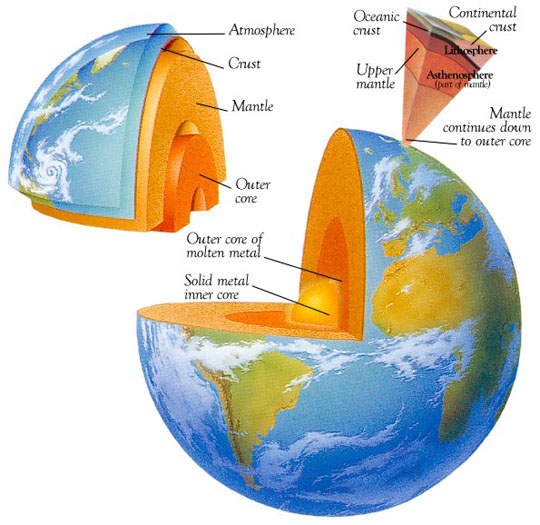
    Scientists discover that the Earth’s core may not be what they originally thought; an iron-oxygen mix. Yes, the liquid outer core of the planet is made of molten iron, but there is something else in there too.

    Based on laboratory tests, the core density is too low to be comprised of just iron, there has to be some other lighter elements in there as well. Scientists originally believed the lighter element was mostly oxygen, the most abundant element on the planet. It turns out they were wrong.

    “We can’t sample the core directly, so we have to learn about it through improved laboratory experiments combined with modeling and seismic data,” explains the Carnegie Institution’s Yingwei Fei.

    Using seismic observations and laboratory models, Fei and his colleagues were able to come to some surprising conclusions. By subjecting mixes of various alloys of iron and lighter materials to seismic shockwave tests while under conditions of temperature and pressure similar to that of the outer core, it turns out that the outer core isn’t an iron-oxygen mix.

    “The research revealed a powerful way to decipher the identity of the light elements in the core. Further research should focus on the potential presence of elements such as silicon in the outer core,” says Fei.

    For now more research has to be done, but it could turn out to be that silicon plays an important role is planet development and formation. The results are published in Nature, the International Weekly Journal of Science.

    Reference: “Evidence for an oxygen-depleted liquid outer core of the Earth” by Haijun Huang, Yingwei Fei, Lingcang Cai, Fuqian Jing, Xiaojun Hu, Hongsen Xie, Lianmeng Zhang and Zizheng Gong, 23 November 2011, Nature.
    DOI: 10.1038/nature10621

    Never miss a breakthrough: Join the SciTechDaily newsletter.
    Follow us on Google and Google News.

    Planets Probe Scientists
    Share. Facebook Twitter Pinterest LinkedIn Email Reddit

    Related Articles

    NASA Finds Earth’s Oxygen Follows a Hidden Magnetic Rhythm

    MIT Scientists Find Traces of Earth Before Earth

    Earth’s First Oceans Were an Acidic Hellscape – Here’s What Happened Next

    From Lava to Life: Unlocking Earth’s Oldest Mysteries

    Ancient Lava Tubes Reveal Hidden Clues to Life Beyond Earth

    Could Earth Have Been Ringed Like Saturn? Scientists Think So

    How Venus is Helping Us Understand Our Own Planet

    Deep Earth Discovery: Fragments of Ancient Planet Found in Mantle

    “A Planet Within a Planet” – Seismologists Peer Into Earth’s Inner Core

    1 Comment

    1. Shawn Q on January 4, 2023 5:16 pm

      The earth’s core also has Lithium number 3 on the periodic table. Lithium is a very light metal.

      Reply
    Leave A Reply Cancel Reply

    • Facebook
    • Twitter
    • Pinterest
    • YouTube

    Don't Miss a Discovery

    Subscribe for the Latest in Science & Tech!

    Trending News

    Stanford Scientists Reverse Age-Related Memory Loss by Targeting the Gut

    James Webb Uncovers the Atmosphere of a Hellish Lava World 41 Light-Years Away

    Could We Have Been Wrong About Fish Oil and Brain Health? New Study Raises Major Questions

    Scientists Say Intermittent Fasting Could Make Weight Loss Easier

    Scientists Just Found a Smiling “Happy-Face” Spider in the Himalayas

    A Colossal Moon Impact May Have Left Ancient Secrets Near Future Artemis Landing Sites

    Earthquake Researchers Discover Dangerous Stress Levels Building Beneath Southern California

    NASA Satellites Spot Rare Underwater Volcano Eruption That Could Create Earth’s Newest Island

    Follow SciTechDaily
    • Facebook
    • Twitter
    • YouTube
    • Pinterest
    • Newsletter
    • RSS
    SciTech News
    • Biology News
    • Chemistry News
    • Earth News
    • Health News
    • Physics News
    • Science News
    • Space News
    • Technology News
    Recent Posts
    • These Two Deadly Viruses Can Look Like the Flu at First
    • Why Some Families Stay Healthy for Decades Longer
    • New Molecule Restores the Brain’s Natural Defenses Against Alzheimer’s
    • Fractional Fermi Sea: Physicists Discover a New Phase of Matter Beyond Established Theory
    • Scientists Finally Solved a Decades-Old Mystery About Water in Nanoscale Spaces
    Copyright © 1998 - 2026 SciTechDaily. All Rights Reserved.
    • Science News
    • About
    • Contact
    • Editorial Board
    • Privacy Policy
    • Terms of Use

    Type above and press Enter to search. Press Esc to cancel.