

Close Menu
    Facebook X (Twitter) Instagram
    SciTechDaily
    • Biology
    • Chemistry
    • Earth
    • Health
    • Physics
    • Science
    • Space
    • Technology
    Facebook X (Twitter) Pinterest YouTube RSS
    SciTechDaily
    Home»Physics»Scientists Provide Vital Clues on How the ‘Heating by Cooling’ Effect Functions
    Physics

    Scientists Provide Vital Clues on How the ‘Heating by Cooling’ Effect Functions

    By Nikolai Brilliantov, University Of LeicesterFebruary 28, 2018No Comments3 Mins Read
    Facebook Twitter Pinterest Telegram LinkedIn WhatsApp Email Reddit
    Share
    Facebook Twitter LinkedIn Pinterest Telegram Email Reddit
    Scientific Phenomenon Explains the Evolution of Dust and Planetary Rings in Space
    Artist impression of aggregating granular gases in space. Professor Nikolai Brilliantov

    A Leicester mathematician has developed a theory to explain ‘heating by cooling,’ where the temperature of a granular gas increases while the total energy drops down – a peculiar phenomenon which can be observed both on Earth and in space.

    Granular gases are one of the few examples where this scientific mystery can be observed. These systems are widely spread in nature in the form of aerosols and smoke on the Earth, or in the form of interstellar dust, planetary rings, and proto-planetary discs in space.

    The stunning ‘heating by cooling’ effect corresponds, in physical terms, to a negative heat capacity. Aggregating granular gases is the second object in the world, after gravitating systems, which manifests this astonishing property.
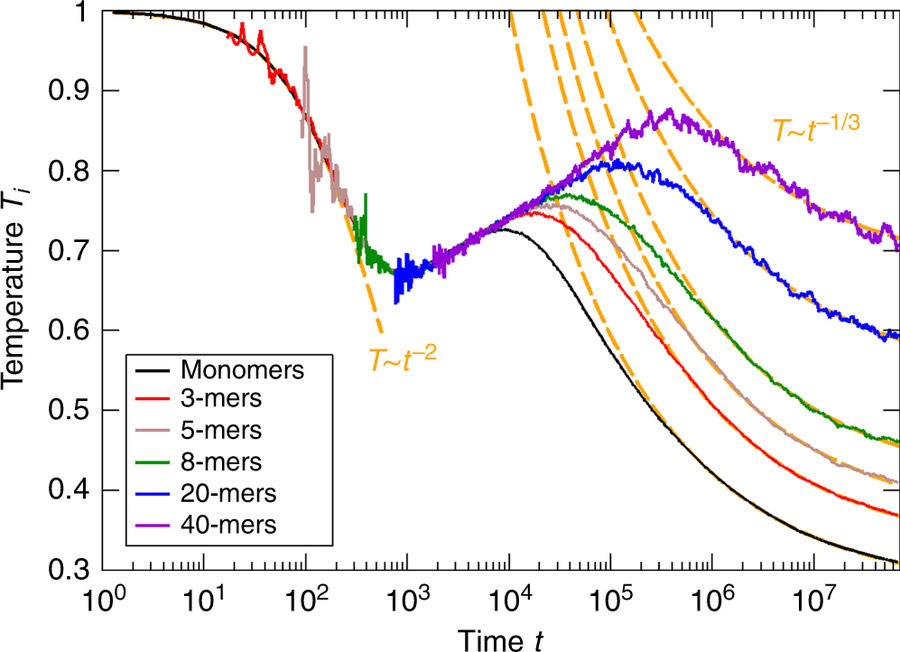
    Increasing Temperature of Cooling Granular Gases
    Partial temperatures of i-mers. Evolution of the partial temperatures, T i, of i-mers for a granular gas of 107 particles for λ1 = λ2 = 4/3, a = 0.1, and ε = 0.99. Initially, the gas of monomers has the temperature, T1(0) = 1. The dashed lines show the limiting cases of a hot gas (regime of non-aggregative cooling) when the temperature follows Haff’s law, T ~ t−2, and cold gas when almost all collisions are aggregative and T ~ t−1/3. Nikolai V. Brilliantov, et al., Nature Communications, doi:10.1038/s41467-017-02803-7

    “From secondary school we are taught that temperature means energy — the higher the temperature, the larger the energy. If a system loses energy, its temperature drops down,” says Professor Nikolai Brilliantov from the University of Leicester’s Department of Mathematics, who led the research. “Surprisingly, this is not always true for granular gases.”

    The international group of scientists has provided a vital clue on how granular gases function and demonstrate this mysterious quality in a paper published in the journal, Nature Communications, where they have built a solid mathematical foundation of the phenomenon.

    They have elaborated a novel mathematical tool – generalized Smoluchowski equations. While classical Smoluchowski equations, which have been known for more than a century, deal with the evolution of agglomerates concentration only, the new equations describe the evolution of the agglomerates temperature as well.
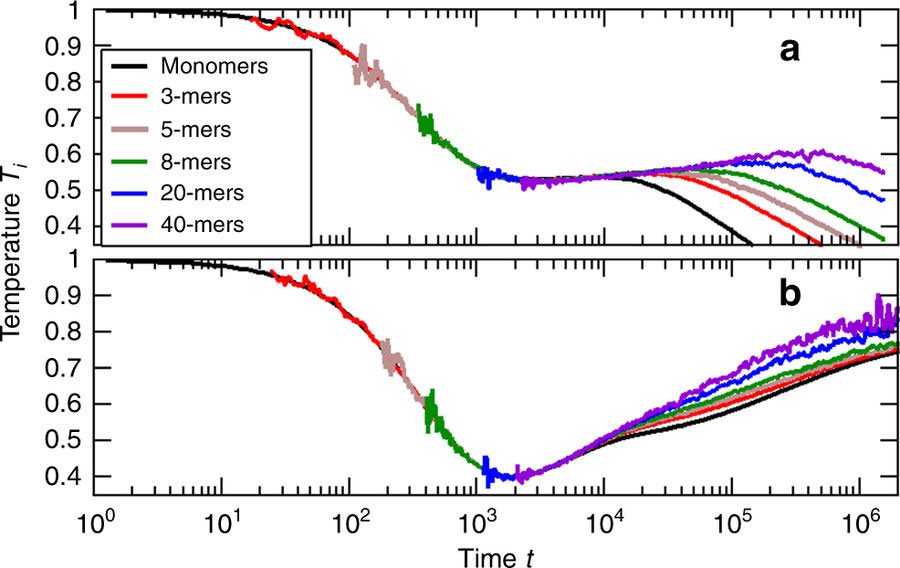
    Scientific Phenomenon Explains the Evolution of Dust and Planetary Rings in Space
    Evolution of temperature for different aggregation mechanisms. The rate of temperature growth in the regime of increasing temperature depends on the aggregation mechanism, quantified by the parameter Λ. This parameter characterizes the dependence of the aggregation barrier on the agglomerate size. a N = 107, ε = 0.99, a = 0.1, Λ = 0.4, thus β = −0.173, see Eq. (21); b same but Λ = 1.6, thus β = −0.941. With increasing value of Λ, the increase of temperature becomes steeper, in agreement with the theoretical predictions, T~t∣β∣T~tβ. Nikolai V. Brilliantov, et al., Nature Communications, doi:10.1038/s41467-017-02803-7

    The direct microscopic modeling of the system, by extensive computer simulations, has confirmed the existence of this surprising regime and other predictions of the theory.

    It has also been shown that, in spite of its peculiarity, ‘heating by cooling’ may be observed for many systems at natural conditions. However, the inter-particle forces have to comply with an important prerequisite – the attraction strength should increase with the agglomerates size.

    “Understanding different regimes of the evolution of aggregating granular gases is important to comprehend numerous natural phenomena where these systems are involved,” adds Professor Brilliantov.

    Reference: “Increasing temperature of cooling granular gases” by Nikolai V. Brilliantov, Arno Formella and Thorsten Pöschel, 23 February 2018,  Nature Communications.
    DOI: 10.1038/s41467-017-02803-7

    Never miss a breakthrough: Join the SciTechDaily newsletter.
    Follow us on Google and Google News.

    Astronomy Mathematics University of Leicester
    Share. Facebook Twitter Pinterest LinkedIn Email Reddit

    Related Articles

    New Research Will Test Our Understanding of How the Universe Works

    Scientists Discover that Gamma-Ray Bursts Behave Differently than Previously Thought

    Astronomers Solve Decades Old Space Mystery

    Breakthrough in Quantum Cryptography Demonstrates “Perfectly Secure” Bit Commitment

    Scientists Reveal Quantum Behavior in Fluid Dynamics

    XMM-Newton Sets New Record for Cosmic X-Ray Sightings

    Study Suggests Auroras Occur Outside Our Solar System

    “Schrödinger’s Hat” Conceals Matter Waves Inside an Invisible Container

    Physicists Predict Properties of Prime Numbers from Freezing Liquids

    Leave A Reply Cancel Reply

    • Facebook
    • Twitter
    • Pinterest
    • YouTube

    Don't Miss a Discovery

    Subscribe for the Latest in Science & Tech!

    Trending News

    Popular Supplement Ingredient Linked to Shorter Lifespan in Men

    Scientists May Have Found a Way To Repair Nerve Damage in Multiple Sclerosis

    “Totally Unexpected” – Scientists Discover Pancreatic Cancer’s Fatal Addiction

    A Strange Quantum Effect May Explain One of Biology’s Greatest Mysteries

    James Webb Telescope Reveals the Universe’s Hidden Cosmic Web in Stunning Detail

    Scientists Identify Simple Supplement That Greatly Reduces Alzheimer’s Damage

    You May Have a Dangerous Type of Cholesterol Even if Your Tests Look Normal

    Your Blood Pressure Reading Could Be Wrong Because of One Simple Mistake

    Follow SciTechDaily
    • Facebook
    • Twitter
    • YouTube
    • Pinterest
    • Newsletter
    • RSS
    SciTech News
    • Biology News
    • Chemistry News
    • Earth News
    • Health News
    • Physics News
    • Science News
    • Space News
    • Technology News
    Recent Posts
    • Leading Climate Scientist Rebuts “Factually Incorrect” US Government Climate Claims
    • You’re Breathing Plastic: Study Finds 4% of City Air Pollution Is Microplastics
    • Cancer Mystery Solved: Scientists Discover How Melanoma Becomes “Immortal”
    • Scientists Uncover Cancer-Fighting Power of Popular Fatty Liver Drug
    • Beyond Pain Relief: Scientists Discover a Protein That Could Stop Osteoarthritis in Its Tracks
    Copyright © 1998 - 2026 SciTechDaily. All Rights Reserved.
    • Science News
    • About
    • Contact
    • Editorial Board
    • Privacy Policy
    • Terms of Use

    Type above and press Enter to search. Press Esc to cancel.