
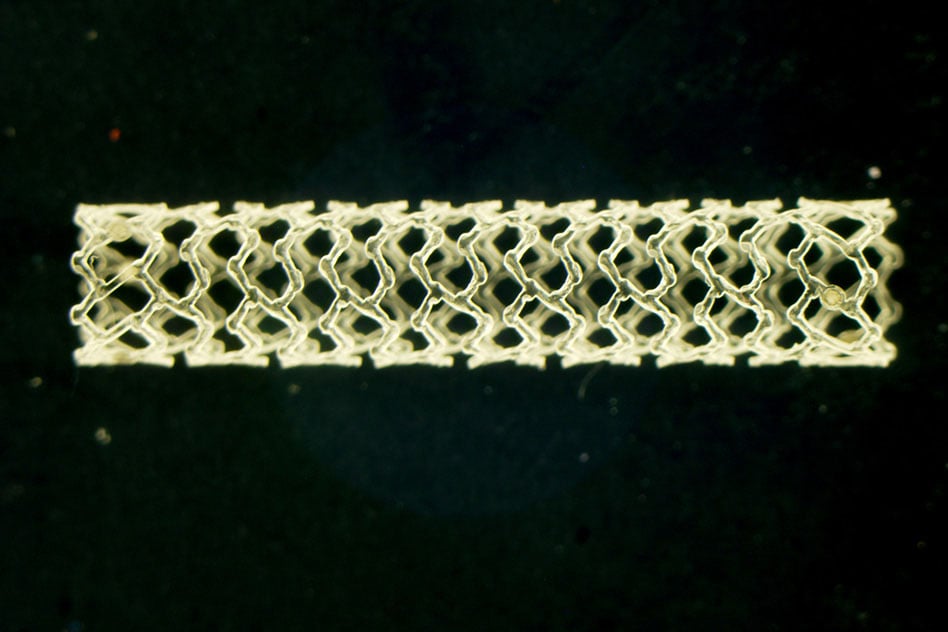
Many patients with heart disease have a metal stent implanted to keep their coronary artery open and prevent blood clotting that can lead to heart attacks. One drawback to these stents is that long-term use can eventually damage the artery.
Several years ago, in hopes of overcoming that issue, a new type of stent made from biodegradable polymers was introduced. Stent designers hoped that these devices would eventually be absorbed by the blood vessel walls, removing the risk of long-term implantation. At first, these stents appeared to be working well in patients, but after a few years these patients experienced more heart attacks than patients with metal stents, and the polymer stents were taken off the market.
MIT researchers in the Institute for Medical Engineering and Science and the Department of Materials Science and Engineering have now discovered why these stents failed. Their study also reveals why the problems were not uncovered during the development process: The evaluation procedures, which were based on those used for metal stents, were not well-suited to evaluating polymer stents.
“People have been evaluating polymer materials as if they were metals, but metals and polymers don’t behave the same way,” says Elazer Edelman, the Thomas D. and Virginia W. Cabot Professor of Health Sciences and Technology at MIT. “People were looking at the wrong metrics, they were looking at the wrong timescales, and they didn’t have the right tools.”
The researchers hope that their work will lead to a new approach to designing and evaluating polymer stents and other types of degradable medical devices.
“When we use polymers to make these devices, we need to start thinking about how the fabrication techniques will affect the microstructure, and how the microstructure will affect the device performance,” says lead author Pei-Jiang Wang, a Boston University graduate student who is doing his Ph.D. thesis with Edelman.
Edelman is the senior author of the paper, which appears in the Proceedings of the National Academy of Sciences the week of February 26. Other authors include MIT research scientist Nicola Ferralis, MIT professor of materials science and engineering Jeffrey Grossman, and National University of Ireland Galway professor of engineering Claire Conway.
Microstructural flaws
The degradable stents are made from a polymer called poly-l-lactic acid (pLLA), which is also used in dissolvable sutures. Preclinical testing (studies done in the lab and with animal models) did not reveal any cause for concern. In human patients the stents appeared stable for the first year, but then problems began to arise. After three years, over 10 percent of patients had experienced a heart attack, including fatal heart attacks, or had to go through another medical intervention. That is double the rate seen in patients with metal stents.
After the stents were taken off the market, the team decided to try to figure out if there were any warning signs that could have been detected earlier. To do this, they used Raman spectroscopy to analyze the microstructure of the stents. This technique, which uses light to measure energy shifts in molecular vibrations, offers detailed information about the chemical composition of a material. Ferralis and Grossman modified and optimized the technique for studying stents.
The researchers found that at the microscopic level, polymer stents have a heterogeneous structure that eventually leads to structural collapse. While the outer layers of the stent have a smooth crystalline structure made of highly aligned polymers, the inner core tends to have a less ordered structure. When the stent is inflated, these regions are disrupted, potentially causing early loss of integrity in parts of the structure.
“Because the nonuniform degradation will cause certain locations to degrade faster, it will promote large deformations, potentially causing flow disruption,” Wang says.
When the stents become deformed, they can block blood flow, leading to clotting and potentially heart attacks. The researchers believe that the information they gained in this study could help stent designers come up with alternative approaches to fabricating stents, allowing them to possibly eliminate some of the structural irregularities.
A silent problem
Another reason that these problems weren’t detected earlier, according to the researchers, is that many preclinical tests were conducted for only about six months. During this time, the polymer devices were beginning to degrade at the microscopic level, but these flaws couldn’t be detected with the tools scientists were using to analyze them. Visible deformations did not appear until much later.
“In this period of time, they don’t visibly erode. The problem is silent,” Edelman says. “But by the end of three years, there’s a huge problem.”
The researchers believe that their new method for analyzing the device’s microstructure could help scientists better evaluate new stents as well as other types of degradable polymer devices.
“This method provides a tool that allows you to look at a metric that very early on tells you something about what will happen much later,” Edelman says. “If you know about potential issues in advance, you can have a better idea of where to look in animal models and clinical models for safety issues.”
The research was funded by Boston Scientific Corporation and the National Institutes of Health.
Reference: “Strain-induced accelerated asymmetric spatial degradation of polymeric vascular scaffolds” by Pei-Jiang Wang, Nicola Ferralis, Claire Conway, Jeffrey C. Grossman and Elazer R. Edelman, 26 February 2018, PNAS.
DOI: 10.1073/pnas.1716420115
Never miss a breakthrough: Join the SciTechDaily newsletter.
Follow us on Google and Google News.