
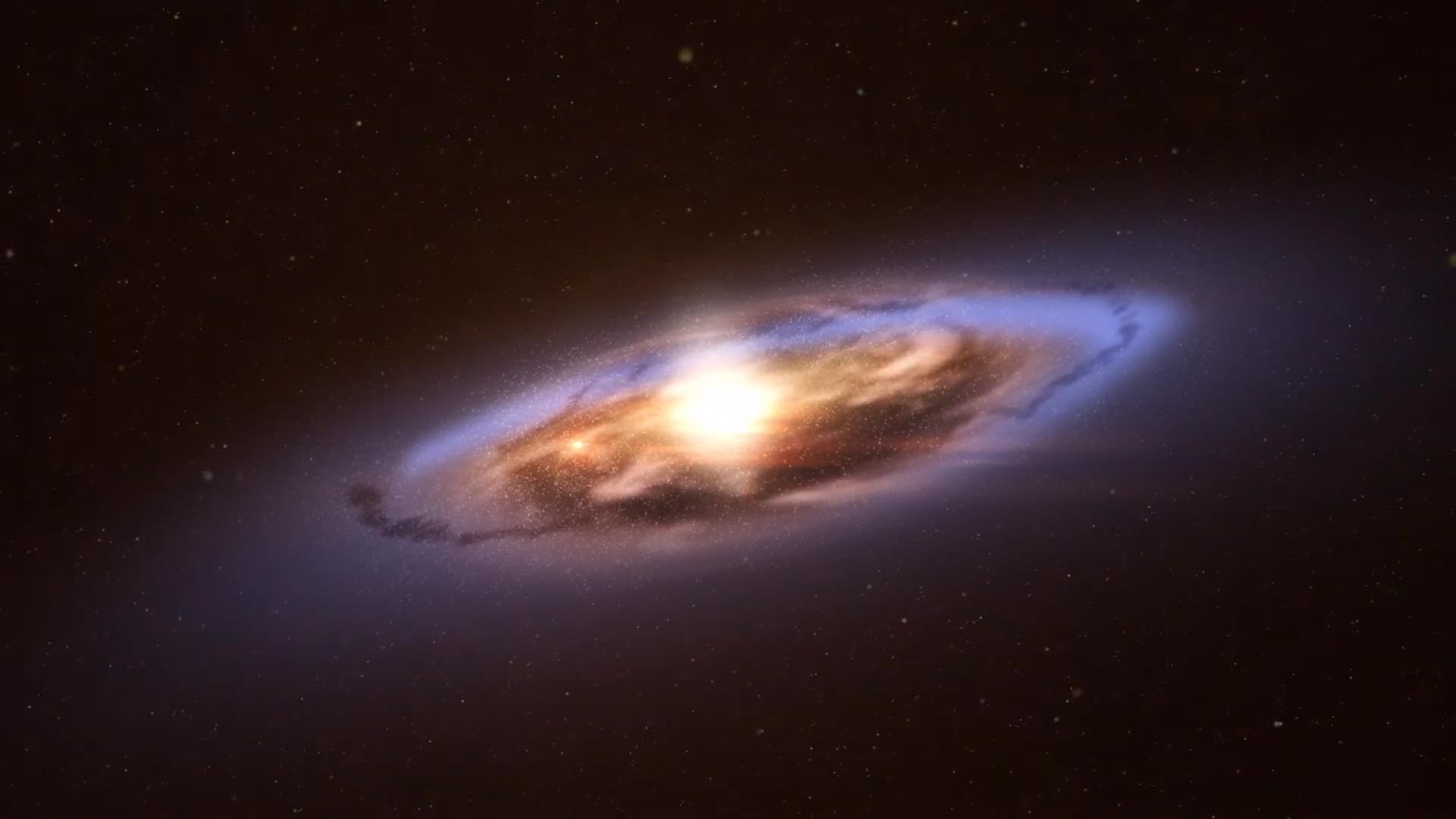
The current rate of star formation at the Galactic Center appears to be lower than in the rest of the Galaxy.
A new study led by Dr. James De Buizer of the SETI Institute and Dr. Wanggi Lim of IPAC at Caltech has uncovered unexpected findings about how quickly massive stars take shape near the center of the Milky Way. Using data collected primarily from NASA’s now-retired SOFIA airborne observatory, the researchers examined three active stellar nurseries, Sgr B1, Sgr B2, and Sgr C, situated in the heart of our Galaxy.
Despite the Galactic Center containing far denser concentrations of gas and dust than other parts of the Milky Way, the formation of massive stars (those more than 8 times the mass of our Sun) appears to occur at a slower pace there.
To investigate further, the team compared these three regions with others of similar size located farther from the center, including areas closer to our solar neighborhood. Their findings confirmed that the rate of new star formation near the Galactic Center is significantly lower than average. Even though the region holds the kind of dense, turbulent clouds that typically give rise to large stars, these environments seem to struggle to produce them.
The study also suggests that these particular areas may not contain enough remaining material to sustain ongoing star formation, implying that they may create only a single generation of stars rather than multiple cycles as seen elsewhere in the Milky Way.
Massive Stars Still Forming—But Slowly
“Recent studies have concluded that star formation is likely depressed near the Galactic Center, and even that there may be no present star formation occurring there,” said De Buizer, lead author of the study. “Since presently-forming massive stars are brightest at long infrared wavelengths, we obtained the highest resolution infrared images of our Galaxy’s central-most star-forming regions. The data show that, contrarily, massive stars are presently forming there, but confirm at a relatively low rate.”
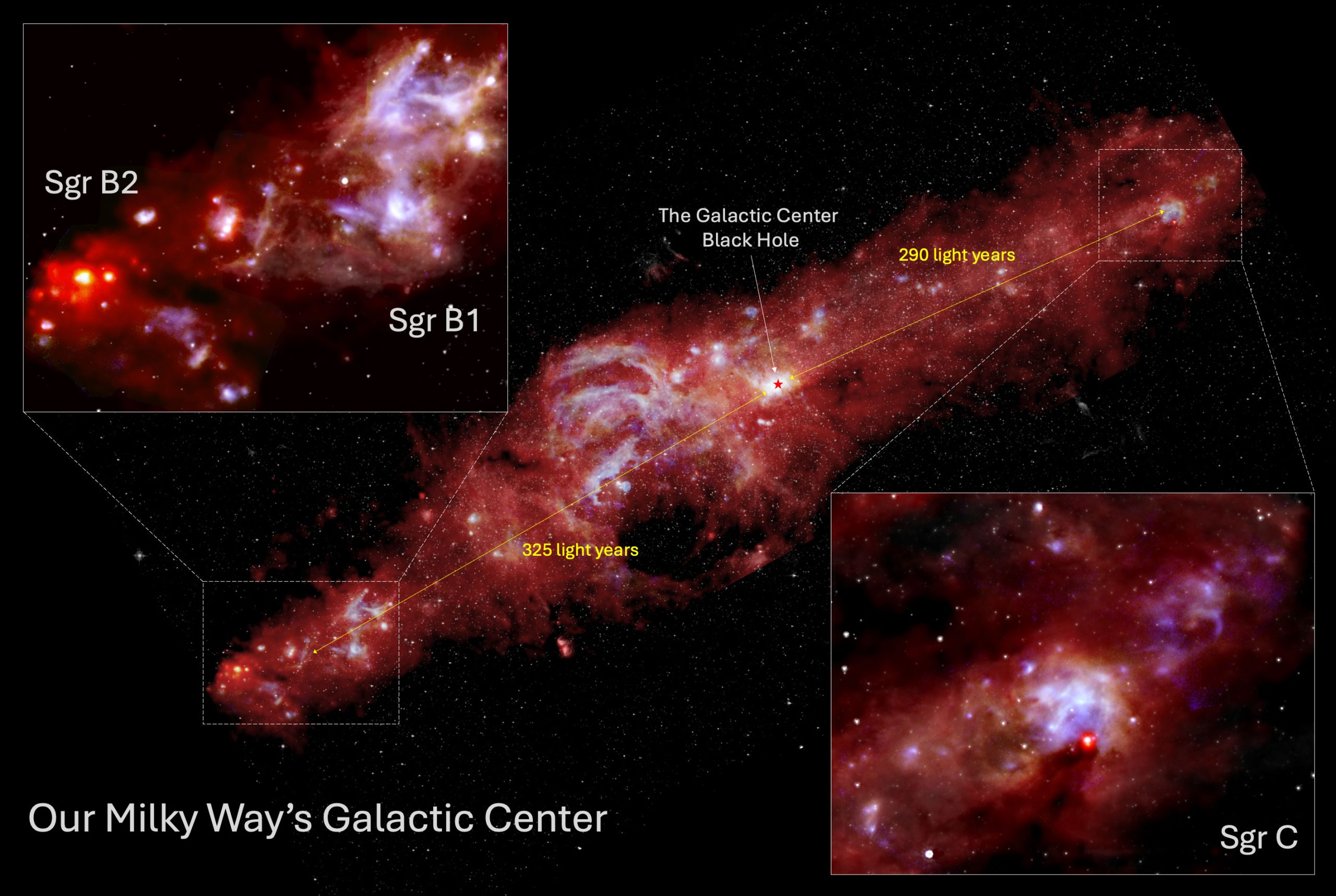
The study suggests that the reason for the slowdown in star formation is due to the extreme conditions in the Galactic Center. These regions orbit swiftly around the black hole at the center of the Galaxy, interacting with older stars and possibly with other material falling toward the black hole. These conditions could inhibit gas clouds from holding together long enough to form stars in the first place and prevent those that do form stars from staying together long enough for continued future star formation.
However, Sgr B2 appears to be the exception. Although its rate of present massive star formation is unusually low, like the other Galactic Center regions studied, it seems to have maintained its reservoir of dense gas and dust, allowing for a future emergent star cluster to be born.
Rethinking the Nature of Giant H II Regions
Traditionally, astronomers have viewed giant H II regions—large clouds of gas, mainly hydrogen, in space like Sgr B1 and Sgr C—as hosts of massive star clusters still embedded in their birth clouds. This study challenges that assumption. The team argues these two regions may not fit the classical definition at all, or they may represent a new, previously unrecognized category of stellar nursery.
Enshrouded in gas and dust that obscure these star-forming regions from view in all but the longest infrared wavelengths, SOFIA’s high-resolution infrared eyes allowed the team to identify more than six dozen presently-forming massive stars within the Galactic Center regions. However, these regions formed fewer stars—and topped out at a lower stellar mass—than the Galactic average.
“These Galactic Center star-forming regions are in many ways very similar to the massive star-forming regions in the relatively calm backwaters of our galaxy,” said Lim. “However, the most massive stars we are finding in these Galactic Center regions, though still remarkably large, fall short in both size and quantity compared to those found in similar regions elsewhere in our Galaxy. Furthermore, such star-forming regions typically hang on to large reservoirs of star-forming material and continue to produce multiple epochs of stars, but that appears to not be the case for these Galactic Center regions.”
Reference: “Surveying the Giant H ii Regions of the Milky Way with SOFIA. VII. Galactic Center Regions Sgr B1, Sgr B2, and Sgr C” by James M. De Buizer, Wanggi Lim, James T. Radomski and Nicole Karnath, 7 April 2025, The Astrophysical Journal.
DOI: 10.3847/1538-4357/adbbd9
Never miss a breakthrough: Join the SciTechDaily newsletter.
Follow us on Google and Google News.