
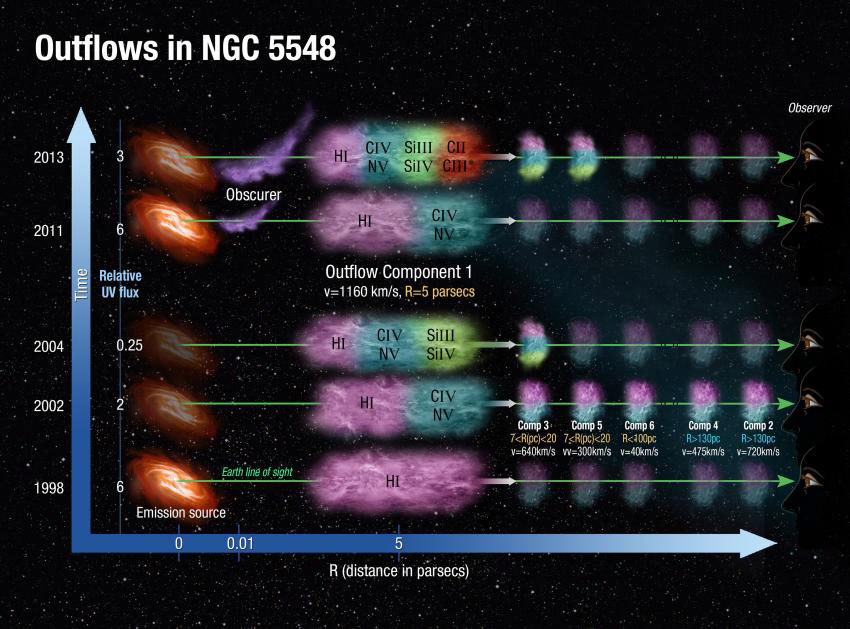
Using a large array of satellites and space observatories, astronomers discovered that winds blowing from a supermassive black hole in NGC 5548 work to obscure observations and X-rays. The research sheds new light on the unexpected behavior of black holes.
Blacksburg, Virginia – An international team of scientists including a Virginia Tech physicist have discovered that winds blowing from a supermassive black hole in a nearby galaxy work to obscure observations and X-rays.
The discovery in Thursday’s issue of Science Express sheds light on the unexpected behavior of black holes, which emit large amounts of matter through powerful, galactic winds.
Using a large array of satellites and space observatories, the team spent more than a year training their instruments on the brightest and most studied of the “local” black holes — the one situated at the core of Type I Seyfert Galaxy NGC 5548.
What they found was a bit of a surprise.
The researchers discovered much colder gas than expected based on past observations, showing that the wind had cooled and that a stream of gas moved quickly outward and blocked 90 percent of X-rays. The observation was the first direct evidence of an obscuration process that — in more luminous galaxies — has been shown to regulate growth of black holes.
By looking at data from different sources, scientists found that a thick layer of gas lay between the galactic nucleus and the Earth blocked the lower energy X-rays often used to study the system, but allowed more energetic X-rays to get through.
Data from the Hubble Space Telescope also showed ultraviolet emissions being partially absorbed by a stream of gas.
A multi-wavelength observational campaign simultaneously looking at an object to decipher its secrets is rare, the researchers said.
“I don’t think anyone has trained so many scopes and put in so much time on a single object like this,” said Nahum Arav, an associate professor of physics with Virginia Tech’s College of Science. “The result is quite spectacular. We saw something that was never studied well before and we also deciphered the outflow in the object. We know far more about this outflow than any studied previously as to where it is and how it behaves in time. We have a physical model that explains all the data we’ve taken of the outflow over 16 years.”
The discovery was made by an international team led by SRON Netherlands Institute for Space Research scientist Jelle Kaastra using the major space observatories of the European Space Agency, NASA, the Hubble Space Telescope, Swift, NuSTAR, Chandra, INTREGRAL, and other satellites and observation platforms.
“These outflows are thought to be a major player in the structure formation of the universe,” Arav said “This particular outflow is comparatively small but because it’s so close we can study it very well and then create a better understanding of how the phenomenon will work in very large objects that do affect the structure formation in the universe.”
“Shadowing” of light from a black hole had not been seen before. With the discovery, scientists were able to decipher the outflow.
“Until now our knowledge of these characteristics was very limited,” Arav said. “Before we were making educated inferences — but now we know. We know the distance of outflow from the center of source, we know the mass of outflow, and we know what causes its observed changes. The shadowing was definitely a surprise —a beautiful phenomenon we were lucky to catch.”
Arav said luck played a part because the effect hadn’t existed before last year.
Over the past two years the shadowing has built up and Arav believes it won’t last much longer than another year or two, but concedes scientists don’t have a full enough observation to say how the shadowing feature is changing in time.
Reference: “A fast and long-lived outflow from the supermassive black hole in NGC 5548” by J.S. Kaastra, G.A. Kriss, M. Cappi, M. Mehdipour, P.-O. Petrucci, K.C. Steenbrugge, N. Arav, E. Behar, S. Bianchi, R. Boissay, G. Branduardi-Raymont, C. Chamberlain, E. Costantini, J.C. Ely, J. Ebrero, L. Di Gesu, F.A. Harrison, S. Kaspi, J. Malzac, B. De Marco, G. Matt, K. Nandra, S. Paltani, R. Person, B.M. Peterson, C. Pinto, G. Ponti, F. Pozo Nuñez, A. De Rosa, H. Seta, F. Ursini, C.P. de Vries, D.J. Walton and M. Whewell, 19 June 2014, Science
DOI: 10.1126/science.1253787
arXiv: 1406.5007
Never miss a breakthrough: Join the SciTechDaily newsletter.
Follow us on Google and Google News.