
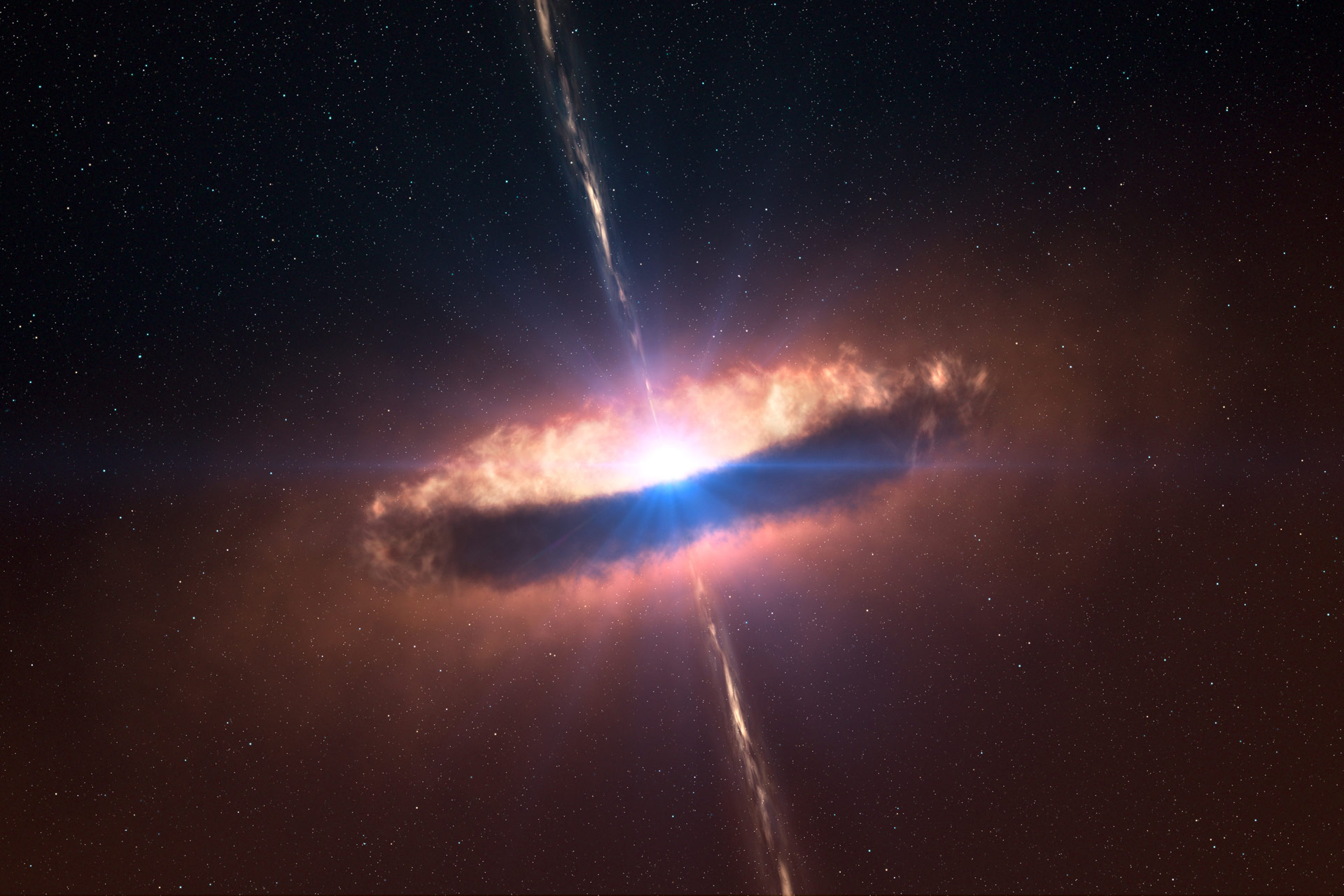
Using laser light and intense magnetic fields, an international team of scientists has simulated astrophysical jets in a laboratory environment for the first time.
Astrophysical jets are counted among our Universe’s most spectacular phenomena: From the centers of black holes, quasars, or protostars, these rays of matter sometimes protrude several light years into space. Now, for the first time ever, an international team of researchers has successfully tested a new model that explains how magnetic fields form these emissions in young stars. Scientists at the Helmholtz-Zentrum Dresden-Rossendorf (HZDR) were part of this research. Their findings have been published in the journal Science. The insights gleaned from this research may even apply to cancer therapy.
Whenever an object in space forms a rotating disc of matter, chances are that it gives rise to a “jet” – a thin, straight emission of matter which emanates from the disc’s center and that looks like a spintop. These structures can be observed especially during the formation of new stars. But understanding how such thin beams are able to form within the disc is something that continues to elude scientists.
Now, HZDR researchers, along with their European, American, and Asian colleagues, have investigated this process in the lab. At LULI – the Laboratoire pour l’Utilisation des Lasers Intenses – in France, scientists hit a plastic sample with laser light which set the electrons at the target’s core in motion, transforming the solid plastic object into conductive plasma. “Think of it as a sort of rapidly expanding hot cloud of electrons and ions. On a small scale, the plasma represents a young star’s accumulation of matter,” explains Professor Thomas Cowan, the study’s co-author and Director of the HZDR Institute of Radiation Physics.
Miniature versions of young stars for the lab
What made the experiment special was the fact that the plasma was exposed to a very powerful pulsed magnetic field. The idea behind it: under a magnetic field’s influence, the normally widely scattered plasma begins to focus, forming a hollow center. This ultimately produces a shockwave, from which a very thin beam starts to project – a jet.
The experiment was set up in such a way as to allow for extrapolation to conditions as they would be encountered in the Universe: within as little as 20 nanoseconds – over 100,000 times faster than a fly flapping its wings – the lab plasma forms structures similar to a young star’s jet in approximately six years. This allowed the researchers to test their model with astronomical observations, which were made possible through space telescopes, in the last two decades. The data were in good agreement. In a jet, for instance, a crossing over of particle streams can occur, which in turn results in the formation of very hot spots. “X-ray measurements of actual jets show these features at the exact same points as our true-to-scale plasma model in the lab,” says Cowan. With its help, the researchers were able to offer a model that, for the first time ever, is capable of explaining the formation of jets solely by way of magnetic fields. Previous approaches had considered the rotation of matter about the young star another influencing factor.
The realization that plasma can be focused in this way may prove a real practical boon in the field of medical engineering. According to Cowan, it’s conceivable that with the help of pulsed magnetic fields, a particularly thin proton beam could be produced for use in radiation therapy. It’s what Florian Kroll, Ph.D. student at the HZDR and one of the study’s co-authors, is investigating.
Special pulse generator designed at the Dresden High Magnetic Field Lab
In order to produce strong pulsed magnetic fields for the experiment, the researchers drew on the expertise at the HZDR’s Dresden High Magnetic Field Lab: “We developed a special pulse generator which allowed our French colleagues to set up powerful magnetic fields within a small, enclosed lab space,” says Dr. Thomas Herrmannsdörfer, head of division at the High Magnetic Field Lab. The generator – just about the size of a wardrobe – is capable of generating currents of up to 300 kiloamperes.
According to Herrmannsdörfer, building such a compact facility was a real technical challenge: “Our electrical engineers came up with some very innovative solutions. This is also helping us now with developing these types of generators for application in industry and medical technology.” Currently, the pulse generator is still located at the French laser lab at Palaiseau near Paris, because beginning in December the Dresden scientists are planning on once again working together with their LULI colleagues.
Reference: “Laboratory formation of a scaled protostellar jet by coaligned poloidal magnetic field” by B. Albertazzi, A. Ciardi, M. Nakatsutsumi, T. Vinci, J. Béard, R. Bonito, J. Billette, M. Borghesi, Z. Burkley, S. N. Chen, T. E. Cowan, T. Herrmannsdörfer, D. P. Higginson, F. Kroll, S. A. Pikuz, K. Naughton, L. Romagnani, C. Riconda, G. Revet, R. Riquier, H.-P. Schlenvoigt, I. Yu. Skobelev, A.Ya. Faenov, A. Soloviev, M. Huarte-Espinosa, A. Frank, O. Portugall, H. Pépin and J. Fuchs, 17 October 2014, Science.
DOI: 10.1126/science.1259694
Never miss a breakthrough: Join the SciTechDaily newsletter.
Follow us on Google and Google News.