
Research links charge mosaics in contact electrification to sequences of sparks, or electrostatic discharges (ESD). This insight could explain CE behaviors in many materials and offer ways to mitigate ESD risks.
Contact electrification (CE) was humanity’s earliest and sole source of electricity until about the 18th century, but its real nature remains a mystery. Today, it is regarded as a critical component of technologies such as laser printers, LCD production processes, electrostatic painting, plastic separation for recycling, and more, as well as a major industrial hazard (damage to electronic systems, explosions in coal mines, fires in chemical plants) due to the electrostatic discharges (ESD) that accompany CE. A 2008 study published in Nature found that in a vacuum, ESDs of a simple adhesive tape are so powerful that they generate enough X-rays to take an X-ray image of a finger.
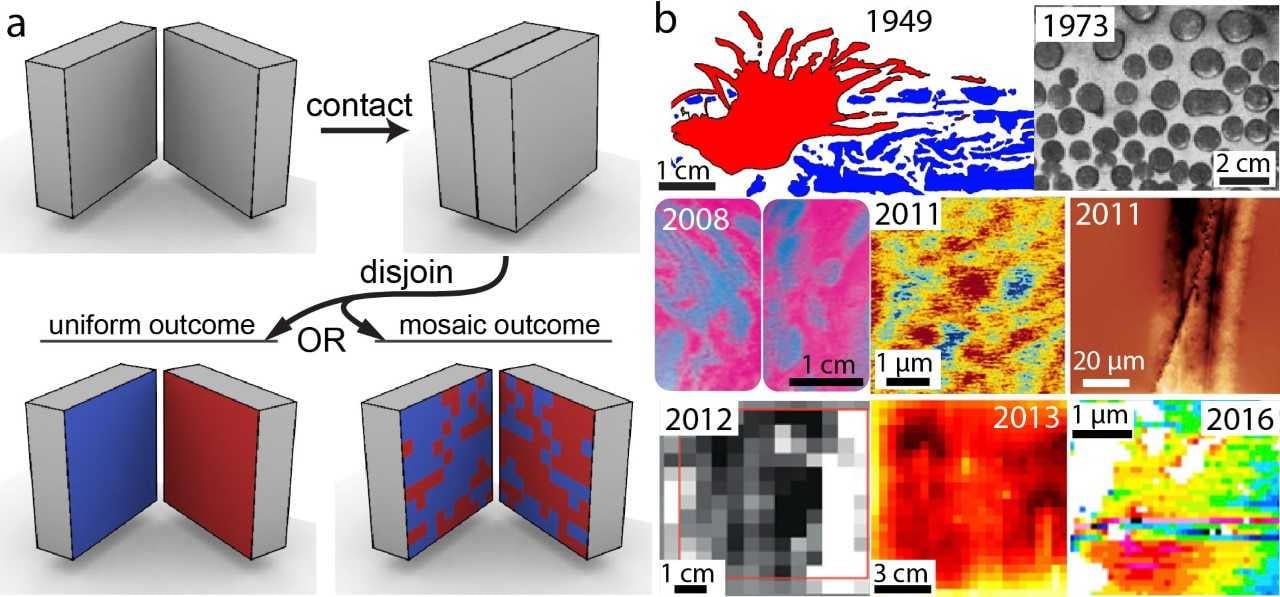
For a long time, it was believed that two contacting/sliding materials charge in opposing and uniform directions. However, after CE, it was discovered that each of the separated surfaces carries both (+) and (-) charges. The formation of so-called charge mosaics was attributed to experiment irreproducibility, inherent inhomogeneities of contacting materials, or the general “stochastic nature” of CE.

A research team, led by Professor Bartosz A. Grzybowski (Department of Chemistry) from the Center for Soft and Living Matter, within the Institute for Basic Science (IBS) at Ulsan National Institute of Science and Technology (UNIST) has investigated the possible sources of charge mosaics for over a decade. The study is expected to help control the potentially harmful electrostatic discharges and was recently published in the journal Nature Physics.
“In our 2011 Science paper, we showed sub-micrometer-scale charge non-uniformity of unknown origin. At that time, our hypothesis was to attribute these (+/-) mosaics to the transfer of microscopic patches of materials between the surfaces being separated. However, over many years of work on the problem, this and related models were simply not holding up, as it was gradually becoming unclear to us (and many other colleagues with whom we discussed) how these microscopic patches can explain even millimeter-scale regions of opposite polarity coexisting on the same surface. Nonetheless, we and the community had no better answer why the (+/-) mosaics are seen at all and over so many length scales,” says Professor Grzybowski.
ESD Sparks and Their Role in Creating Charge Mosaics
In the paper published recently in Nature Physics, the group of Professor Grzybowski shows that charge mosaics are a direct consequence of ESD. The experiments demonstrate that between delaminating materials the sequences of “sparks” are created and they are responsible for forming the (+/-) charge distributions that are symmetrical on both materials.
“You might think that a discharge can only bring charges to zero, but it actually can locally invert them. It is connected with the fact that it is much easier to ignite the ‘spark’ than to extinguish it,” says Dr. Yaroslav Sobolev, the lead author of the paper. “Even when the charges are reduced to zero, the spark keeps going powered by the field of adjacent regions untouched by this spark.”
The proposed theory explains why charge mosaics were seen on many different materials, including sheets of paper, rubbing balloons, steel balls rolling on Teflon surfaces, or polymers detached from the same or other polymers. It also hints at the origin of the crackling noise when you peel off a sticky tape – it might be a manifestation of the plasma discharges plucking the tape like a guitar string. Presented research should help control the potentially harmful electrostatic discharges and bring us closer to a true understanding of the nature of contact electrification, noted the research team.
References:
“Charge mosaics on contact-electrified dielectrics result from polarity-inverting discharges” by Yaroslav I. Sobolev, Witold Adamkiewicz, Marta Siek and Bartosz A. Grzybowski, 8 September 2022, Nature Physics.
DOI: 10.1038/s41567-022-01714-9
“Correlation between nanosecond X-ray flashes and stick-slip friction in peeling tape” by Carlos G. Camara, Juan V. Escobar, Jonathan R. Hird and Seth J. Putterman, 23 October 2008, Nature.
DOI: 10.1038/nature07378
“The mosaic of surface charge in contact electrification” by H. T. Baytekin, A. Z. Patashinski, M. Branicki, B. Baytekin, S. Soh and B. A. Grzybowski, 23 June 2011, Science.
DOI: 10.1126/science.1201512
Never miss a breakthrough: Join the SciTechDaily newsletter.
Follow us on Google and Google News.
8 Comments
Electrical discharges are harmless. Those electrin acceleration methods don’t harm anything
In an alternative scenario, each surface develops a highly non-uniform ‘charge mosaic’ with neighboring domains of opposite charge polarities.That’s because of two bidirectional coupled continuous chaotic systems can produce ordered dynamic changes via superposition.If you are interested, you can browse https://zhuanlan.zhihu.com/p/390071860. Joy your everyday!
We know that this is not clearly correct because of Xerox printing. The Xerox toner provides shades of gray based on the amount of one type of charge.
Believe the problem is in order to measure electrostatic field, a force is created. The presentation of that force disturbed the field.
So it is the field strength measurement that is disturbing the fields’uniforminity. – Buck
There is great harm created with static-electricity. Even water rubbing against each other can create destructive forced.
It’s called lightning. – Buck
I for one, do not understand, but believe ancient history informs us of the desirability of moving water within human settlements. The Alhambra for one, even more ancient waterfalls of the mountain top Peruvian settlements and the Yucatan Penninsula rebuilding including waterfalls.
I can’t help but think that Tesla wrote extensively on this topic in his Colorado Springs lab 1890. And also discovered x-rays in his discharge experiments.
I love Cyamatics and pizoelectricity diffusion domes and cloaking technology, how far can u go in reversing the centrifugal pull of a redefraculating elwire circuit with self inducting absurd downquark trajectory. And when is a top not an isotope ..when it’s all down and , and unders da table 115, 1/137 old tech…. What’s left?
Could this mosaic pattern form because the materials are of a non-uniform density?