
Close Menu
    Facebook X (Twitter) Instagram
    SciTechDaily
    • Biology
    • Chemistry
    • Earth
    • Health
    • Physics
    • Science
    • Space
    • Technology
    Facebook X (Twitter) Pinterest YouTube RSS
    SciTechDaily
    Home»Physics»Scientists Surprised by Lack of Damage After Secondary Impacts
    Physics

    Scientists Surprised by Lack of Damage After Secondary Impacts

    By American Institute of PhysicsJuly 19, 2020No Comments3 Mins Read
    Facebook Twitter Pinterest Telegram LinkedIn WhatsApp Email Reddit
    Share
    Facebook Twitter LinkedIn Pinterest Telegram Email Reddit
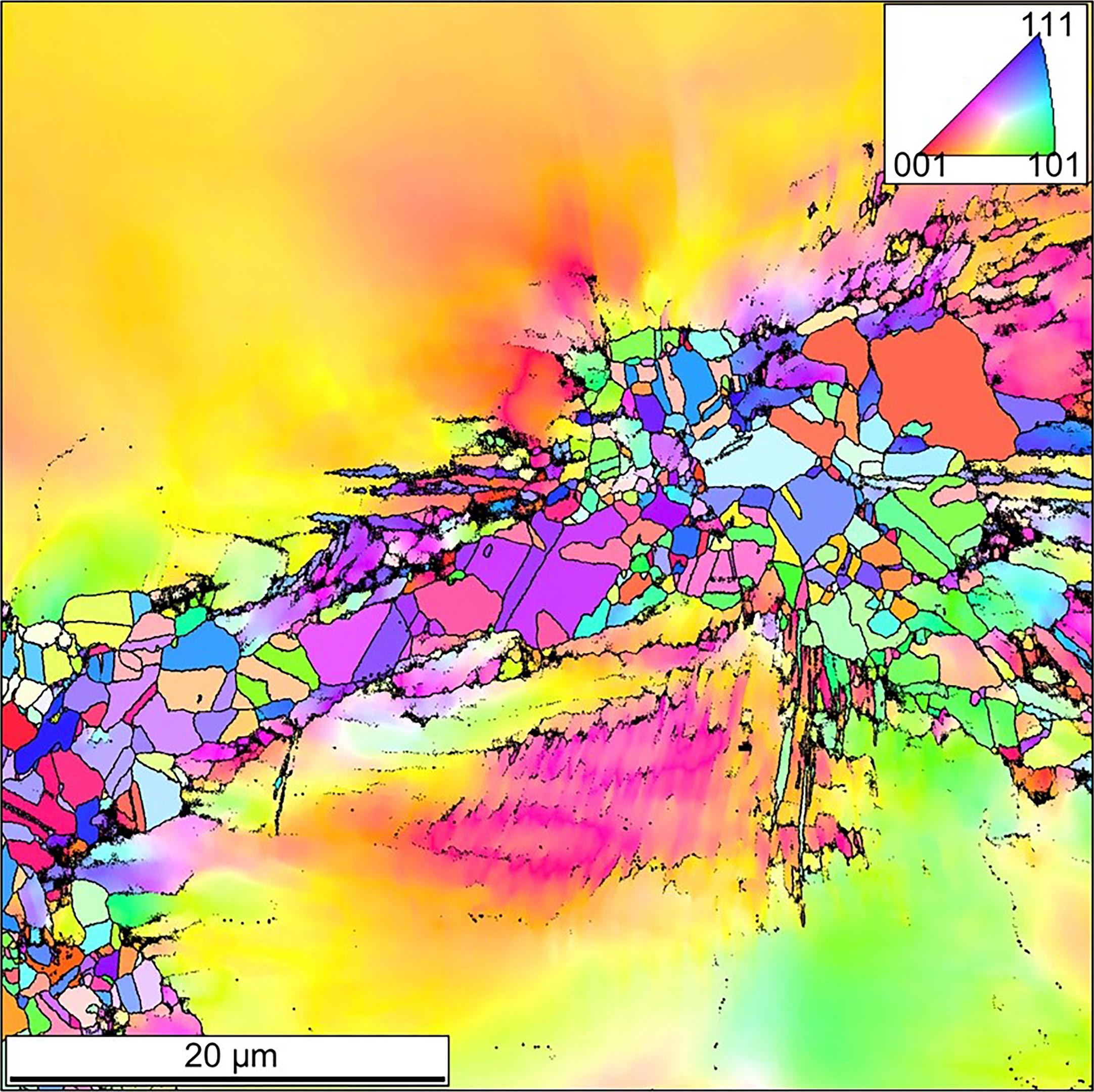
    Crystallographic Orientation Map
    A map showing crystallographic orientation of a region that originally contained a void, which was then subjected to a second shock loading (the shock wave passed from the bottom to the top of the image). The void has been recompacted with enough energy to not only reach a fully dense state, but drive recrystallization at the interface, as demonstrated by the thin band of very small grains. Credit: David Jones

    Study on damage caused by high-velocity impacts provides answers about how materials exposed to secondary shocks recompact.

    When a material is subjected to an extreme load in the form of a shock or blast wave, damage often forms internally through a process called spall fracture.

    Since these types of intense events are rarely isolated, research is needed to know how damaged materials respond to subsequent shock waves — a piece of armor isn’t much use if it disintegrates after one impact.

    To the surprise of researchers, recent experimentation on spall fracture in metals found that, in certain cases, there was an almost complete lack of damage with only a thin band of altered microstructure observed. Usually, under these sorts of conditions, the material would contain hundreds of small voids and cracks.

    In an article for the Journal of Applied Physics, published by AIP Publishing, researchers from Los Alamos National Laboratory narrowed down exactly why the expected damage was missing.

    “Conflicting hypotheses were suggested for the lack of damage. Was there some sort of strengthening occurring, so that damage never nucleated, or was the damage recompacted to a fully dense state by some other loading?” said author David Jones. “By splitting the experiment into two phases — damage formation and recompaction — we could determine which hypothesis was correct.”

    Materials experiencing shock damage at high strain rates from a sudden impact will exhibit significantly different behavior compared to their response under standard, low-rate mechanical testing.

    The researchers used gas-gun flyer-plate impact experiments to first damage samples, and then impact these samples a second time to see how the shock wave interacts with the damage field, which had not been done before. They found a shock stress of just 2 to 3 gigapascal actually recompacted a damaged copper target and created a new bond where the once broken surfaces were brought back together.

    “This research, where careful experiments are used to isolate the strength and damage response of a material under shock loading, helps to reveal how microstructure plays a key role in dynamic response,” said Jones.

    The authors hope the future of shock physics research will involve next-generation free electron X-ray lasers, a game-changing tool.

    “Being able to image in real time these micrometer-scale, microsecond-duration damage events in metals will be a paradigm shift in shock physics diagnostics,” said Jones.

    Reference: “Shock recompaction of spall damage featured” by D. R. Jones, S. J. Fensin, B. M. Morrow, D. T. Martinez and R. S. Hixson, 22 June 2020, Journal of Applied Physics.
    DOI: 10.1063/5.0011337

    Never miss a breakthrough: Join the SciTechDaily newsletter.
    Follow us on Google and Google News.

    American Institute of Physics Materials Science
    Share. Facebook Twitter Pinterest LinkedIn Email Reddit

    Related Articles

    Ancient Arts of Origami and Kirigami Inspire Mechanical Metamaterials

    Natural Plant and Animal Surfaces Inspire Infection-Proof Engineered Implants

    Nanoscientists Develop Blueprint for Next-Generation Computing

    New Insights Into How Superconducting Materials Interact With Magnetic Ones

    Path to Magnetic Vortex RAM Might be More Difficult Than Previously Assumed

    Electron-Electron Interactions are Critical to Graphene’s Extraordinary Properties

    SLAC Scientists Complete Terahertz Experiment

    LCLS Low-Energy Test Just Shy of the 284-Electronvolt Carbon Edge

    High-Energy Radiation is Refracted Setting the Stage for Gamma Optics

    Leave A Reply Cancel Reply

    • Facebook
    • Twitter
    • Pinterest
    • YouTube

    Don't Miss a Discovery

    Subscribe for the Latest in Science & Tech!

    Trending News

    Scientists Discover Bizarre 100-Million-Year-Old Insect With Giant Claws

    Scientists Discover “Good” Gut Microbes That Could Protect Against Autism and ADHD

    Scientists Reveal That Eating Almonds Every Day Could Transform Your Gut, Metabolism, and Appetite

    Scientists May Have Solved Two of Fusion Energy’s Biggest Problems at Once

    Scientists Discover Hidden “Switch” That Burns Fat and Could Treat Bone Disease

    After 50 Years of Mystery, Researchers Identify New Human Blood Group

    Beyond Pain Relief: Scientists Discover a Protein That Could Stop Osteoarthritis in Its Tracks

    Scientists Discover Why Alcohol Prevents the Liver From Healing, Even After You Quit

    Follow SciTechDaily
    • Facebook
    • Twitter
    • YouTube
    • Pinterest
    • Newsletter
    • RSS
    SciTech News
    • Biology News
    • Chemistry News
    • Earth News
    • Health News
    • Physics News
    • Science News
    • Space News
    • Technology News
    Recent Posts
    • Archaeologists Discover Prehistoric Mountain Cave Packed With Mysterious Green Mineral
    • This Common Houseplant Is Secretly Using Advanced Geometry
    • Earth’s Upper Atmosphere Is Cooling Fast and Scientists Finally Know Why
    • 32,000 Olympic Pools of Magma Nearly Erupted Beneath Atlantic Island
    • Scientists May Have Found Dark Matter’s Fingerprint in a Black Hole Collision
    Copyright © 1998 - 2026 SciTechDaily. All Rights Reserved.
    • Science News
    • About
    • Contact
    • Editorial Board
    • Privacy Policy
    • Terms of Use

    Type above and press Enter to search. Press Esc to cancel.