
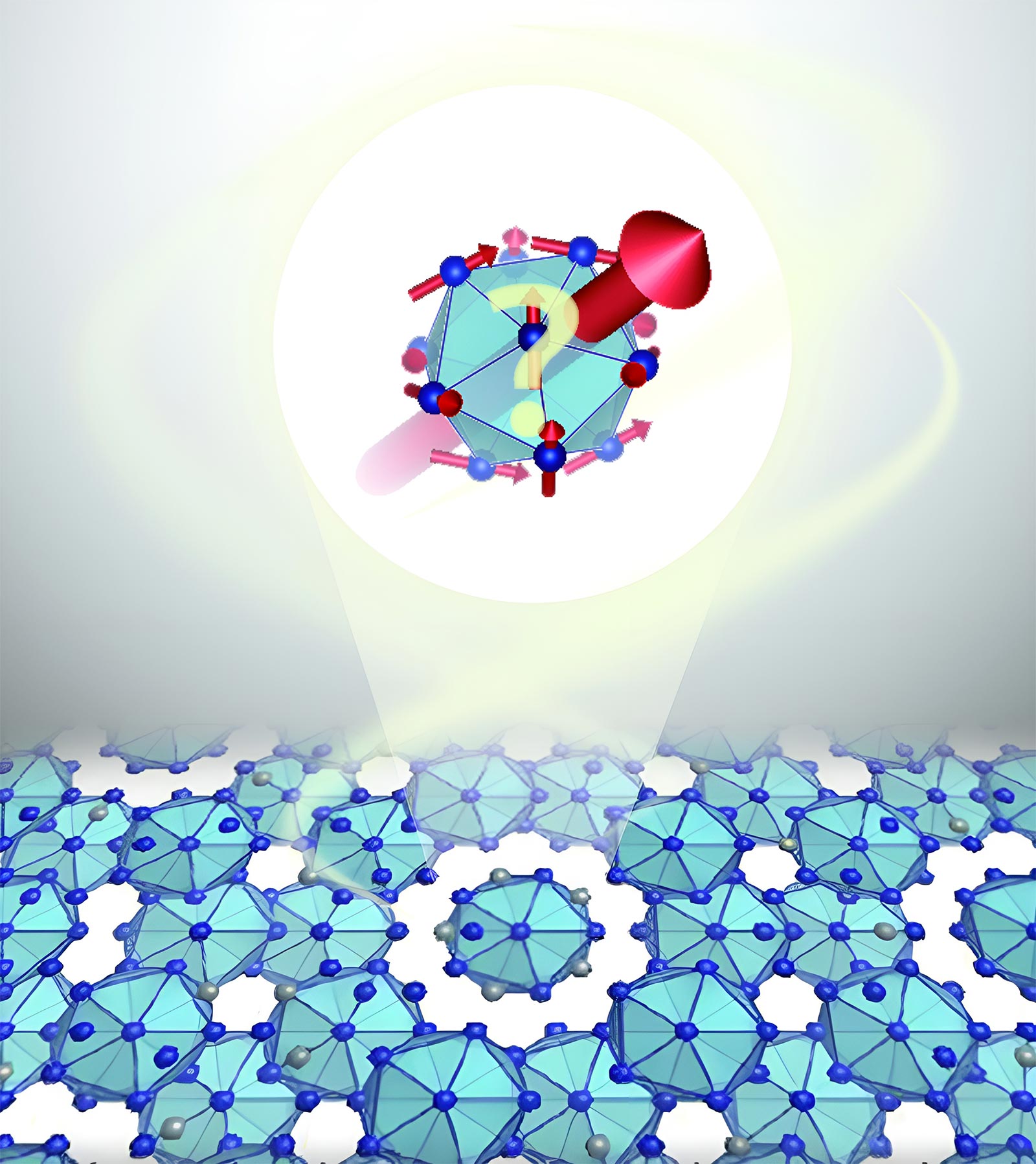
Researchers provide direct evidence that the magnetic properties of the novel icosahedral quasicrystals depend on the electrons-per-atom ratio.
Professor Ryuji Tamura’s team at Tokyo University of Science synthesized a novel icosahedral quasicrystal (i QC) made of gold, gallium, and dysprosium. The new i QC exhibits tunable ferromagnetism and high phase purity, which allows for a more focused study of ferromagnetism in quasicrystals. The study revealed that the balance of magnetic interactions and the presence of exotic magnetic orders in i QCs can be controlled, offering potential advancements in magnetic technologies.
Quasicrystals (QCs) have peculiar structures with interesting atomic arrangements. Although they are similar to crystals from the exterior, at the atomic scale, they lack periodicity despite being ordered. Such structural arrangements confer quasicrystals with symmetries and other special properties that are missing in crystals. In particular, icosahedral QCs (i QCs), which have a special geometric structure, show interesting magnetic properties.
In a recent breakthrough, a research team led by Professor Ryuji Tamura from the Tokyo University of Science (TUS) discovered ferromagnetic order in gold–gallium–gadolinium and gold–gallium–terbium i QCs. However, these i QCs have not been suitable for the further study of ferromagnetism in i QCs because they have also contained a large fraction of the approximant crystal (AC) phase. ACs have a similar structure to QCs, but as they are also magnetic, this interferes with studies on the magnetism of the QC phase alone.
To bridge this gap, Professor Tamura’s team has now synthesized a novel gold–gallium–dysprosium (Au–Ga–Dy) i QC. According to Professor Tamura, “The Au–Ga–Dy i QC is ferromagnetic, highly tunable, and has high phase purity”. The research team, which included Mr. Ryo Takeuchi and Dr. Farid Labib from TUS, has published their findings in the journal Physical Review Letters. This paper has been selected as Editors’ Suggestion.
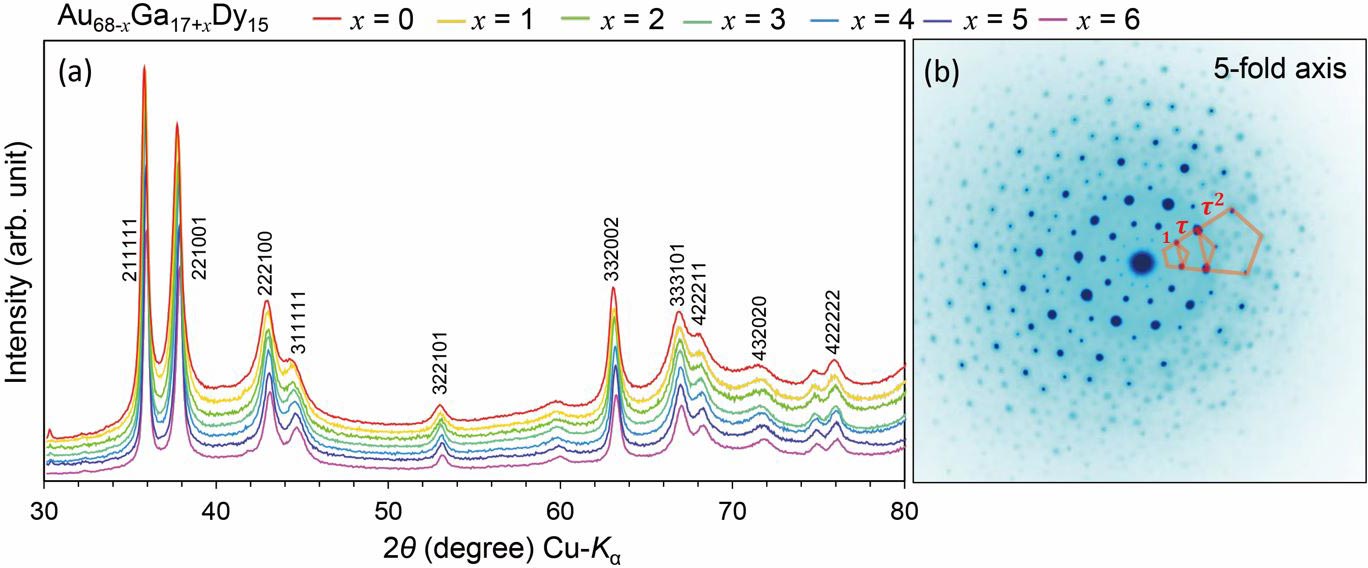
The new i QCs were prepared using mother alloys containing 15% Dy, 62–68% Au, and 23–17% Ga. The mother alloys were synthesized via arc-melting followed by rapid quenching. The resultant i QCs were studied using powder X-ray diffraction, electron microscopy, electron diffraction, and magnetic susceptibility measurements.
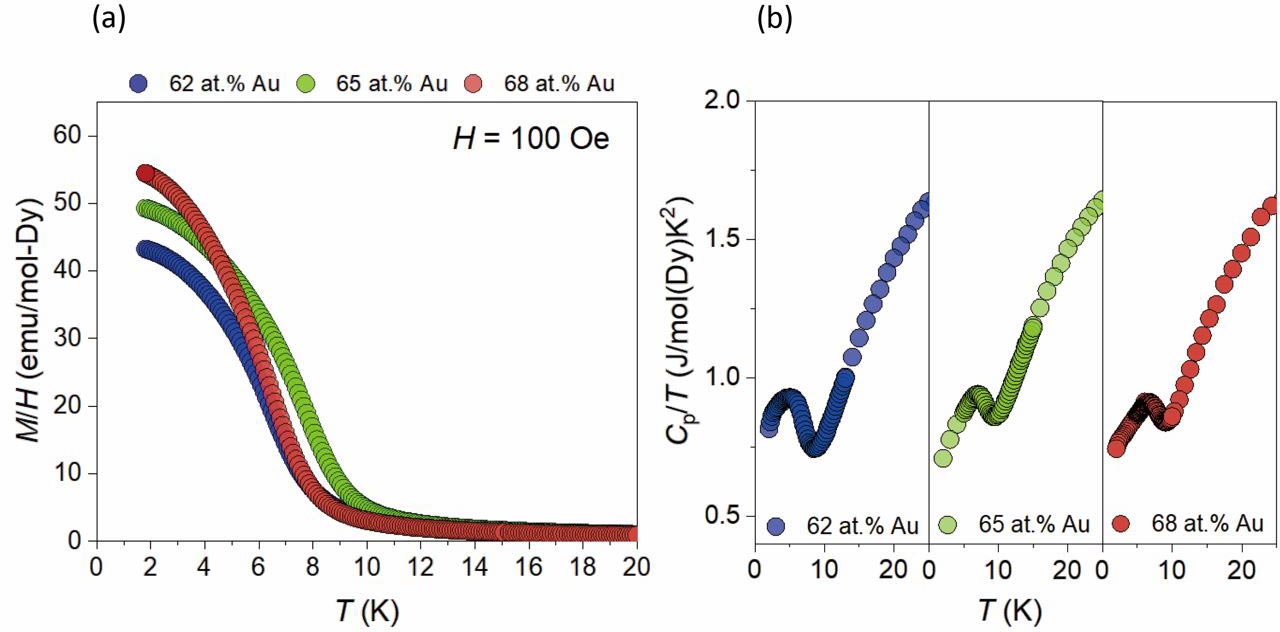
The researchers found that the synthesized i QC was polycrystalline with a highly pure ferromagnetic phase. They were further able to describe the mean-field-like nature of the ferromagnetic transition.
Tuning Magnetic Properties Through Weiss Temperature
The researchers also discovered that the new i QCs exhibit a maximum Weiss temperature, a significant parameter in ferromagnetic transition, at an electrons-per-atom (e/a) ratio of 1.70, which aligns with previous findings for ACs. This discovery demonstrates that the magnetic properties of i QCs can be well-tuned using the Weiss temperature and e/a ratio (a parameter that indicates the variations in the Fermi energy of the i QC). Furthermore, these findings reveal that the balance of ferromagnetic and antiferromagnetic interactions, as well as the presence of exotic magnetic orders, can be tuned in i QCs by shifting the Fermi energy or adjusting the e/a ratio.
“The discovery of pure tunable ferromagnetic quasicrystals has the potential to revolutionize and expand the academic system based on crystals. Applying our findings to current theoretical work in the field, for example, in the realm of non-coplanar spin configurations such as hedgehog and whirling configurations, can lead to various nontrivial physical properties in i QCs, including anomalous and topological Hall effects,” concludes Prof. Tamura.
These findings pave the way toward new frontiers of magnetic materials and advance the development of technologies such as magnetic data storage, spintronics, and magnetic sensors.
Reference: “High Phase-Purity and Composition-Tunable Ferromagnetic Icosahedral Quasicrystal” by Ryo Takeuchi, Farid Labib, Takafumi Tsugawa, Yuto Akai, Asuka Ishikawa, Shintaro Suzuki, Takenori Fujii and Ryuji Tamura, 26 April 2023, Physical Review Letters.
DOI: 10.1103/PhysRevLett.130.176701
This work was supported by Japan Society for the Promotion of Science through Grants-in-Aid for Scientific Research (Grants No. JP19H05817, No. JP19H05818, No. JP19H05819, and No. JP21H01044) and Japan Science and Technology Agency, CREST Grant No. JPMJCR22O3, Japan.
Dr. Ryuji Tamura, a Professor in the Department of Materials Science and Technology at Tokyo University of Science, Japan, studies a variety of materials quasicrystals, approximant crystals, metallic glasses, and permanent magnets. He has published over 160 research papers and secured three patents. Dr. Tamura’s research interests lie in tunable and enhanced magnetic properties in these materials. He has received numerous awards for his contributions, including the Japan Institute of Metals Murakami Young Researcher Award and the Japan Institute of Metals and Materials Meritorious Award. The Hypermaterials Laboratory at Tokyo University of Science features his current research.
Never miss a breakthrough: Join the SciTechDaily newsletter.
Follow us on Google and Google News.