
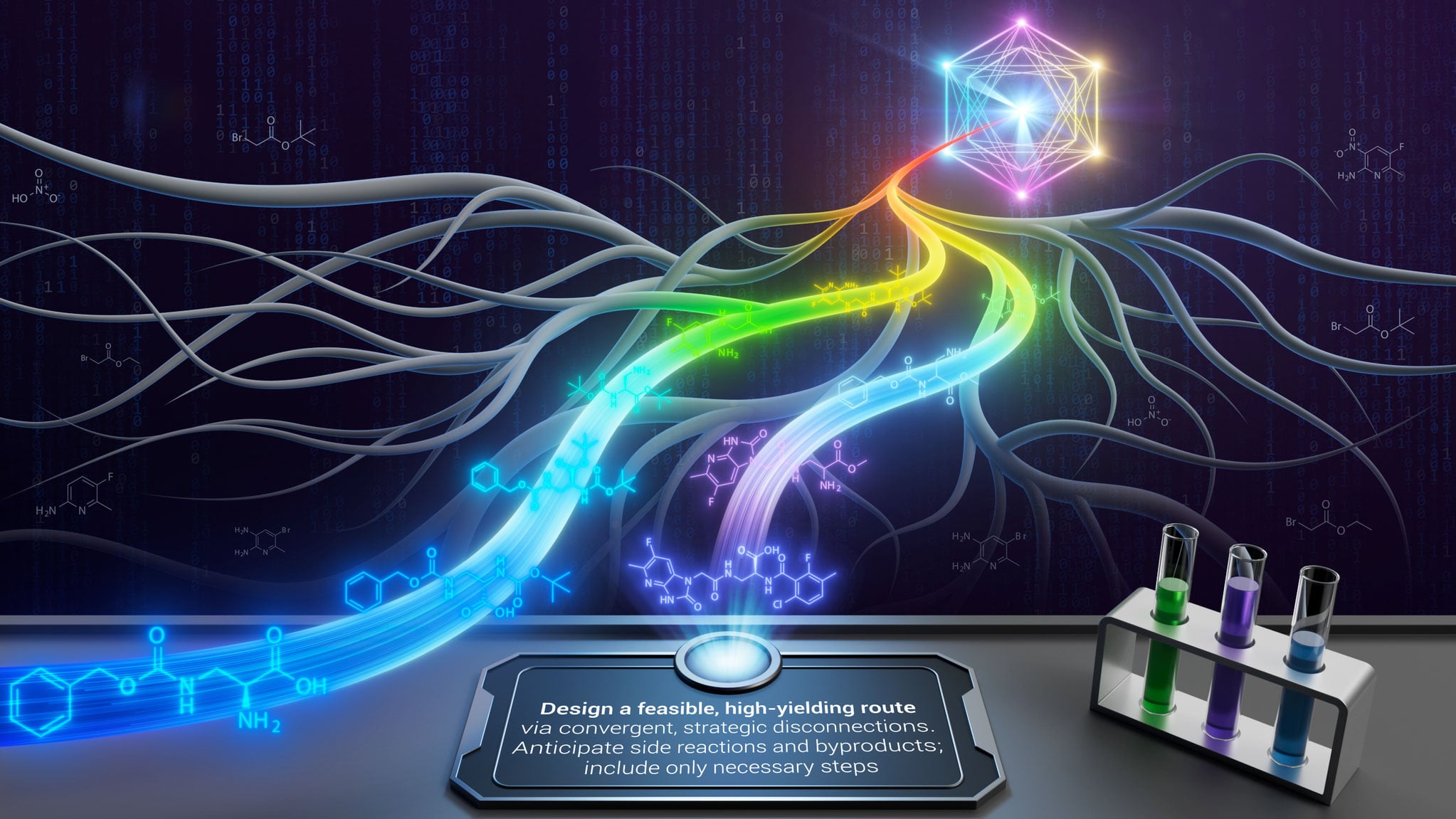
Researchers have developed a framework that interprets chemical strategy as language, opening a new path for AI-assisted discovery.
Designing molecules is one of the most difficult tasks in chemistry. Whether creating new medicines or advanced materials, each compound must be built through a carefully planned sequence of reactions. Mapping out these steps requires both deep technical knowledge and strategic thinking, which is why chemists often spend years developing this expertise.
Two major challenges shape this process. The first is retrosynthesis, where chemists start with a desired molecule and work backward to identify simpler starting materials and possible reaction routes. This involves many decisions, such as when to form rings or how to handle sensitive functional groups. Although computers can search vast “chemical spaces,” they often fall short when it comes to the kind of strategic judgment that experienced chemists apply.
The second challenge involves reaction mechanisms, which explain how reactions proceed step by step through the movement of electrons. Understanding these mechanisms allows scientists to predict new reactions, improve efficiency, and reduce costly trial and error. While current computational tools can generate many possible pathways, they often lack the intuition needed to determine which ones are most realistic.
A New Role for Language Models in Chemistry
A research team led by Philippe Schwaller at EPFL has introduced a different approach that uses large language models (LLMs) as reasoning tools in chemistry. Instead of directly generating chemical structures, these models are used to evaluate and guide existing computational methods.
The system, called Synthegy, combines traditional search algorithms with artificial intelligence that can interpret chemical strategies written in natural language.
“When making tools for chemists, the user interface matters a lot, and previous tools relied on cumbersome filters and rules,” says Andres M Bran, the first author of the Synthegy paper published in Matter. “With Synthegy, we’re giving chemists the power to just talk, allowing them to iterate much faster and navigate more complex synthetic ideas.”
Synthegy starts with a target molecule and a plain language instruction from the user. For instance, a chemist might request that a ring be formed early in the process or that unnecessary protecting groups be avoided. Standard retrosynthesis software then generates many possible reaction routes, which are converted into text and reviewed by the language model.
The system scores each pathway based on how well it matches the user’s goals and explains its reasoning. This makes it easier for researchers to compare options and focus on the most promising strategies. By guiding computational searches with natural language, chemists can better align results with their intended approach.
Understanding Reaction Mechanisms
Synthegy applies a similar method to reaction mechanisms. It breaks reactions down into basic electron movements and explores different possibilities. The language model evaluates each step and steers the process toward mechanisms that are more chemically plausible. It can also incorporate additional details, such as reaction conditions or expert assumptions, in text form.
In synthesis planning tests, Synthegy identified routes that matched complex strategic requirements. In a double blind expert study, 36 chemists produced 368 valid evaluations, and their assessments agreed with the system’s results 71.2 percent of the time on average. The framework can flag unnecessary protecting steps, evaluate reaction feasibility, and highlight more efficient pathways.
Bridging Strategy and Mechanism
Synthegy demonstrates that LLMs can operate across multiple levels of chemical reasoning. They can recognize functional groups, evaluate individual reactions, and assess complete synthetic routes. Larger and more advanced models perform best, while smaller models show more limited ability.
This work suggests a new way for artificial intelligence to support chemistry. By using LLMs as evaluators instead of generators, Synthegy allows chemists to describe their goals in plain language and receive results that reflect their strategy. The approach could speed up drug discovery, improve reaction design, and make advanced computational tools easier to use.
“The connection between synthesis planning and mechanisms is very exciting: we usually use mechanisms to discover new reactions that enable us to synthesize new molecules,” says Andres M Bran. “Our work is bridging that gap computationally through a unified natural language interface.”
Reference: “Redox regulation of neuroinflammatory pathways contributes to damage in Alzheimer’s disease brain” by Lauren N. Carnevale, Piu Banerjee, Xu Zhang, Jazmin Navarro, Charlene K Raspur, Parth Patel, Tomohiro Nakamura, Emily Schahrer, Henry Scott, Nhi Lang, Jolene K. Diedrich, Amanda J. Roberts, John R. Yates and Stuart A. Lipton, 23 April 2026, Cell Chemical Biology.
DOI: 10.1016/j.chembiol.2026.03.017
Funding: Swiss National Science Foundation, NCCR Catalysis, Intel and Merck KGaA AWASES program
Never miss a breakthrough: Join the SciTechDaily newsletter.
Follow us on Google and Google News.