

Far above Earth, scientists are using quantum sensors to listen for the faintest whispers of unseen forces that may weave through the universe.
Scientists are constantly searching for new clues about the hidden forces that may exist beyond the known laws of physics. One promising area of research focuses on exotic boson interactions, hypothetical effects that could reveal previously unknown particles or forces.
These interactions are predicted to take 16 possible forms, most of which depend on the spins of particles, with some also linked to their velocity. When they occur, they may cause extremely small changes in atomic energy levels, producing faint pseudomagnetic fields.
Detecting these subtle signals requires incredibly sensitive instruments. The SQUIRE project aims to take this challenge into space by placing quantum spin sensors aboard the China Space Station. These sensors are designed to detect pseudomagnetic fields that might arise from interactions between their own spins and Earth’s geoelectrons.
By combining the precision of quantum measurement with the unique conditions of space, SQUIRE can overcome a major limitation of ground-based experiments: increasing both relative motion and the number of polarized spins at the same time.
Several factors make space an ideal environment for these measurements.
- The China Space Station travels around Earth at 7.67 km/s, nearly the first cosmic velocity and about 400 times faster than moving sources in laboratory experiments.
- Earth itself acts as a giant natural source of polarized spins. Unpaired geoelectrons in the planet’s crust and mantle, aligned by the geomagnetic field, provide roughly 10⁴² polarized spins—around 10¹⁷ times more than those in common lab materials like SmCo₅.
- The station’s orbit naturally turns potential exotic signals into repeating oscillations. With an orbital period of about 1.5 hours, these signals are modulated to around 0.189 mHz, a very low-frequency range where background noise is minimal compared to ground-based setups.
Unprecedented Sensitivity and Detection Potential
Because of these advantages, even under strict physical limits, the SQUIRE system could detect exotic field strengths up to 20 pT, far beyond the 0.015 pT achievable on Earth. Its sensitivity to velocity-dependent exotic interactions over force ranges greater than 10⁶ m is expected to improve by 6 to 7 orders of magnitude.
Building a space-ready quantum spin sensor is central to the SQUIRE mission. The sensor must maintain extremely high sensitivity and stability in the demanding conditions of space. However, such sensors must also deal with three main challenges: changes in Earth’s magnetic field, vibrations from the spacecraft, and exposure to cosmic radiation.
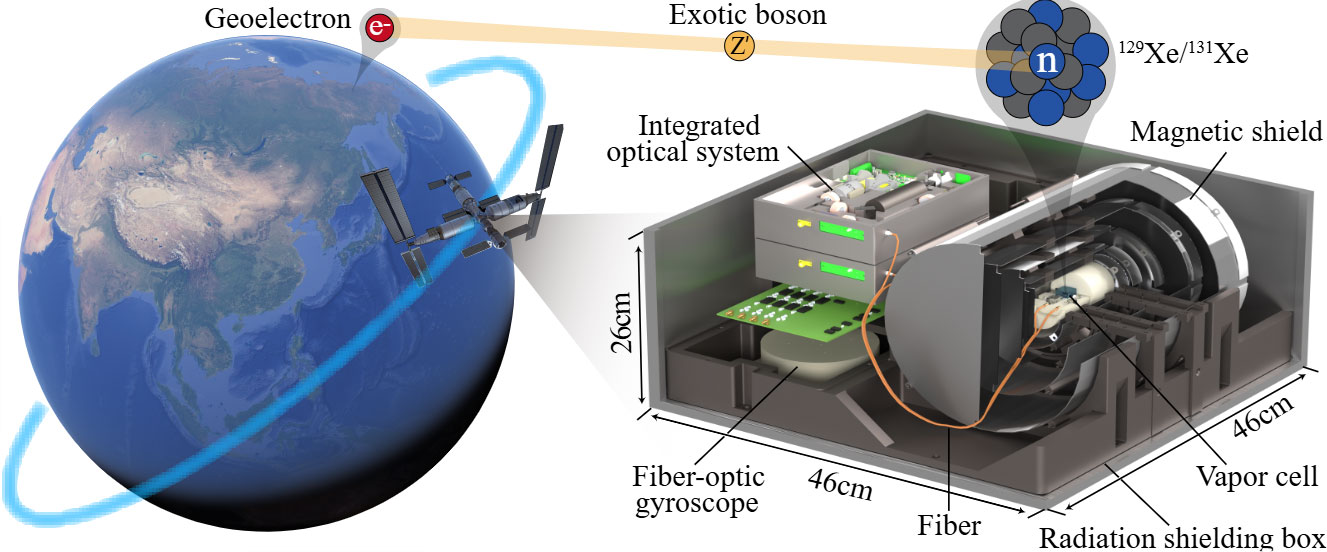
To address these, the SQUIRE team developed a prototype integrating three breakthrough technologies: (i) Dual Noble-Gas Spin Sensor: Using ¹²⁹Xe and ¹³¹Xe isotopes with opposite gyromagnetic ratios, the sensor suppresses common-mode magnetic noise while preserving sensitivity to SSVI signals. This achieves 10⁴-fold magnetic noise suppression, and combined with multi-layer magnetic shielding, reduces geomagnetic fluctuations to sub-femtotesla. (ii) Vibration Compensation Technology: Equipped with a fiber-optic gyroscope, the system actively compensates for platform vibration, reducing noise to a negligible 0.65 fT. (iii) Radiation-Hardened Architecture: A 0.5 cm aluminum enclosure and triple modular redundancy in control circuits mitigate cosmic ray impacts. This ensures functionality even if two of three redundant circuits fail, reducing disruptions to <1 per day.
Integrating these technologies, the SQUIRE prototype achieves a single-shot sensitivity of 4.3 fT @ 1165 s—ideal for detecting SSVI signals with a 1.5-hour period—laying a solid technical foundation for on-orbit high-precision dark matter detection.
Beyond SQUIRE: A Space-Ground Quantum Network
Beyond exotic interaction searches, quantum spin sensors on the China Space Station will enable a wide range of fundamental physics research in space. SQUIRE envisions a “space-ground integrated” quantum sensing network, linking orbital and terrestrial sensors to dramatically enhance sensitivity across multiple dark matter models and beyond-Standard-Model phenomena, including other exotic interactions, Axion halos, and CPT violation probes.
Specifically, high-speed orbital motion enhances coupling between axion halos and nucleon spins, achieving a 10-fold sensitivity improvement over terrestrial direct dark matter searches. As China’s deep space exploration advances, the SQUIRE framework will inspire the use of distant planets (e.g., Jupiter and Saturn, rich in polarized particles) as natural polarized sources, expanding the frontiers of physics exploration on cosmic scales.
Reference: “Quantum sensors in space: unveiling the invisible universe” by Yuanhong Wang, Xingming Huang, Min Jiang, Qing Lin, Wenqiang Zheng, Yuan Sun, Liang Liu, Xinhua Peng, Zhengguo Zhao and Jiangfeng Du, 22 September 2025, National Science Review.
DOI: 10.1093/nsr/nwaf389
Never miss a breakthrough: Join the SciTechDaily newsletter.
Follow us on Google and Google News.
4 Comments
Quantum physics has always fascinated me. Also, the moving of items through time and space. Past, present and future are connected . Think of God who is in the past, present and future. I read there are portals in various places on earth. I also am concerned about overseeking the knowledge of the universe which could cause distrusted anomalies in our world.
What are the Think of God?
Traditional quantum mechanics interprets the solutions of the Dirac equation as point-like particles, whereas TVT posits that it describes the dynamic interactions of topological vortices and anti-vortices in spacetime. The “wave function” in the equation is essentially an order parameter describing the evolution of the vortex structure, with particles and antiparticles viewed as stable emergent states arising from vortex interactions. This perspective provides a geometric picture for negative energy solutions and spin, and questions the applicability of the Dirac equation at extremely high energy scales.
Beyond exotic interaction searches, quantum spin sensors on the China Space Station will enable a wide range of fundamental physics research in space.
VERY GOOD!
Scientists, please think deeply:
1. What is the physical essence of quantum spin?
2. Is quantum spin related to topological spin?
When we pursue the ultimate truth of all things, the space in which our bodies and all things exist may itself be the final and deepest puzzle we need to explore. This is not only the pursuit of physics, but also the most magnificent exploration of the origin of the universe by human reason.
Based on the Topological Vortex Theory (TVT), space is an uniformly incompressible physical entity. Space-time vortices are the products of topological phase transitions of the tipping points in space, are the point defects in spacetime. Point defects do not only impact the thermodynamic properties, but are also central to kinetic processes. They create all things and shape the world through spin and self-organization.
In today’s physics, some so-called peer-reviewed journals—including Physical Review Letters, Nature, Science, and others—stubbornly insist on and promote the following:
1. Even though θ and τ particles exhibit differences in experiments, physics can claim they are the same particle. This is science.
2. Even though topological vortices and antivortices have identical structures and opposite rotational directions, physics can define their structures and directions as entirely different. This is science.
3. Even though two sets of cobalt-60 rotate in opposite directions and experiments reveal asymmetry, physics can still define them as mirror images of each other. This is science.
4. Even though vortex structures are ubiquitous—from cosmic accretion disks to particle spins—physics must insist that vortex structures do not exist and require verification. Only the particles that like God, Demonic, or Angelic are the most fundamental structures of the universe. This is science.
5. Even though everything occupies space and maintains its existence in time, physics must still debate and insist on whether space exists and whether time is a figment of the human mind. This is science.
6. Even though space, with its non-stick, incompressible, and isotropic characteristics, provides a solid foundation for the development of physics, physics must still insist that the ideal fluid properties of space do not exist. This is science.
and go on.
Is this the counterintuitive science they widely promote? Compromising with pseudo academic publications and peer review by pseudo scholars is an insult to science and public intelligence. Some so-called scholars no longer understand what shame is. The study of Topological Vortex Theory (TVT) reminds us that the most profound problems in physics often lie at the intersection of different theories. By exploring these border regions, we can not only resolve contradictions in existing theories but also discover new physical phenomena and application possibilities.
Under the topological vortex architecture, it is highly challenging for even two hydrogen atoms or two quarks to be perfectly symmetrical, let alone counter-rotating two sets of cobalt-60. Contemporary physics and so-called peer-reviewed publications (including Physical Review Letters, Science, Nature, etc.) stubbornly believe that two sets of counter rotating cobalt-60 are two mirror images of each other, constructing a more shocking pseudoscientific theoretical framework in the history of science than the “geocentric model”. This pseudo scientific framework and system have seriously hindered scientific progress and social development.
For nearly a century, physics has been manipulated by this pseudo scientific theoretical system and the interest groups behind it, wasting a lot of manpower, funds, and time. A large amount of pseudo scientific research has been conducted, and countless pseudo scientific papers have been published, causing serious negative impacts on scientific and social progress, as well as humanistic development.
Complexity does not necessarily mean that there is no logical and architectural framework to follow. Mathematics is the language and tool that reveals the motion of spacetime, rather than the motion itself. Although the physical form of spacetime vortices is extremely simple, their interaction patterns are highly complex, and we must develop more and richer mathematical languages to describe and understand them.
The development of the Topological Vortex Theory (TVT) reflects a progression from concrete physical phenomena to abstract mathematical modeling and, ultimately, to interdisciplinary unification. Its core innovation lies in forging the continuous spacetime geometry of general relativity with the discrete interactions of quantum field theory within the same topological dynamical system.
——Excerpted from https://scitechdaily.com/microscope-spacecrafts-most-precise-test-of-key-component-of-the-theory-of-general-relativity/#comment-909171.