
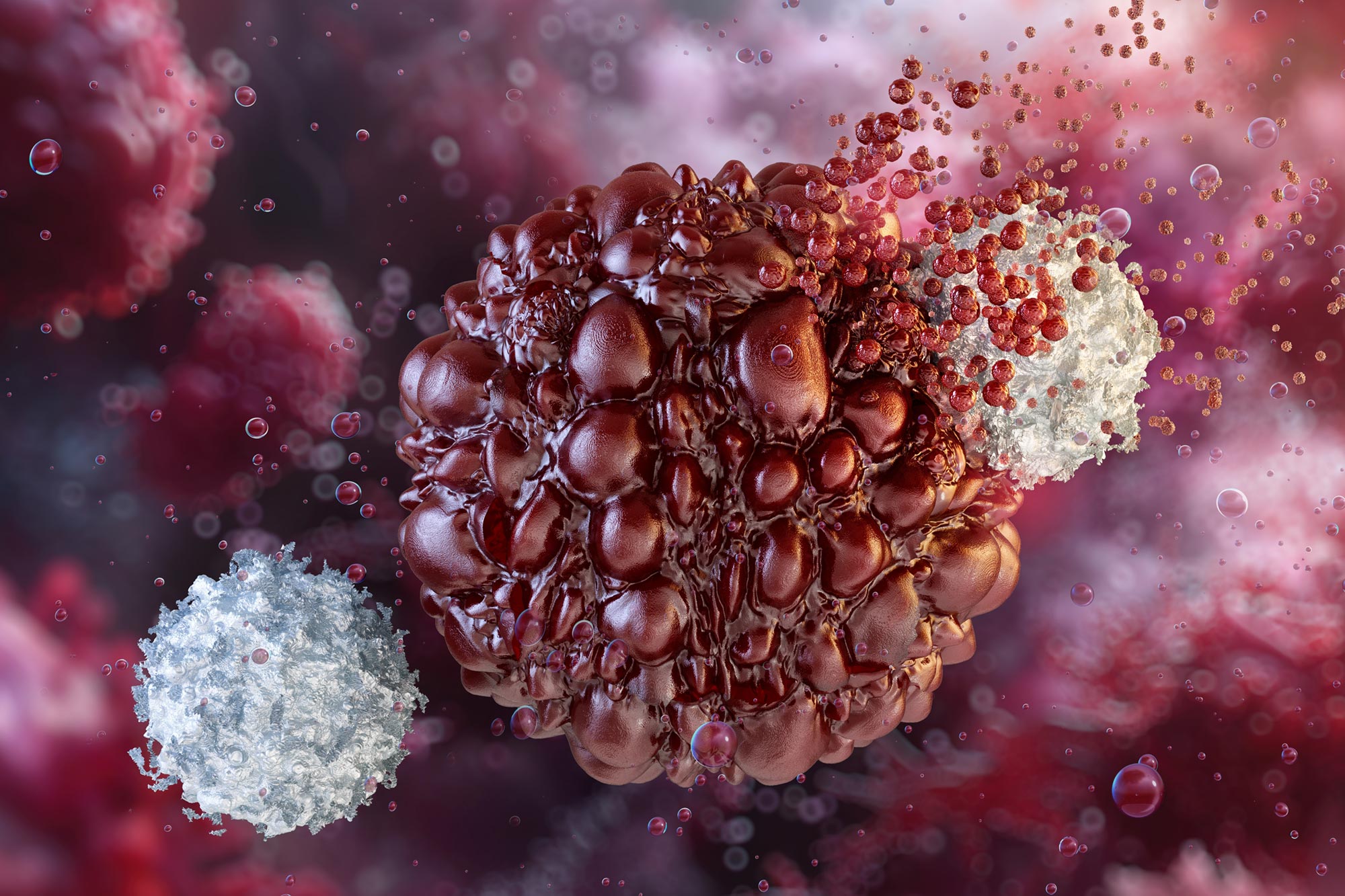
Scientists have found a way to turn cancer’s own immune bodyguards into weapons against it.
Researchers at the Icahn School of Medicine at Mount Sinai have developed an experimental immunotherapy that tackles metastatic cancer in an unexpected way. Rather than attacking cancer cells themselves, the treatment focuses on the cells that surround and shield them.
The findings were published in Cancer Cell, a Cell Press Journal. The therapy was tested in aggressive preclinical models of metastatic ovarian and lung cancer, and the results point to a potential new strategy for treating advanced solid tumors.
Breaking Through Cancer’s Immune Shield
The concept draws inspiration from the Trojan horse. Instead of trying to force its way into tumors, the therapy gains entry by targeting macrophages, immune cells that act as guardians for cancer cells. By disabling these protectors, the treatment opens tumors to an immune attack, allowing the body’s defenses to enter and destroy the cancer.
Metastatic disease accounts for the majority of cancer deaths. Solid tumors such as lung and ovarian cancer have been especially resistant to many current immunotherapies. According to the researchers, one reason is that tumors actively suppress immune activity in their surrounding environment, creating a protective barrier around cancer cells.
“What we call a tumor is really cancer cells surrounded by cells that feed and protect them. It’s a walled fortress,” says lead study author Jaime Mateus-Tique, PhD, a faculty member in Immunology and Immunotherapy at the Icahn School of Medicine at Mount Sinai. “With immunotherapy, we kept running into the same problem—we can’t get past this fortress’s guards. So, we thought: what if we targeted these guards, turned them from protectors to friends, and used them as a gateway to bring a wrecking force within the fortress.”
The Role of Tumor Macrophages
The so-called guards are tumor macrophages. Under normal conditions, macrophages serve as first responders, helping fight infections and repair tissue damage. Inside tumors, however, these cells are reprogrammed to do the opposite. Instead of supporting immune defense, they block it, helping cancer grow and spread.
To counter this, the research team created a therapy designed to remove tumor macrophages while leaving healthy macrophages intact. This shift transforms the tumor environment from immune suppressed to immune active.
Engineering CAR T Cells to Target Support Cells
The approach uses CAR T cells, which are engineered from a patient’s own T cells. Traditionally, CAR T therapies are built to recognize and kill cancer cells directly. For many solid tumors, however, it has been difficult to identify suitable targets on cancer cells themselves. In this case, the team redirected CAR T cells to recognize tumor macrophages instead.
The researchers also modified the CAR T cells to release interleukin-12, a powerful immune activating molecule that stimulates killer T cells. In mice with metastatic lung and ovarian cancers, treatment with the engineered CAR T cells produced striking results. The animals lived months longer, and many were completely cured.
Reshaping the Tumor Microenvironment
To better understand what was happening inside the tumors, the scientists used advanced spatial genomics techniques. Their analysis showed that the therapy reshaped the tumor microenvironment. Immune suppressing cells were reduced, and immune cells capable of attacking cancer were drawn into the tumor.
This change is significant because it makes the therapy ‘antigen-independent’, meaning it does not rely on identifying specific cancer markers. As a result, it could potentially be used against a wide range of cancers, including those that have not responded to other immunotherapies. The same strategy proved effective in both lung and ovarian cancer models, suggesting broader potential, according to the researchers.
“Macrophages are found in every type of tumor, sometimes outnumbering the cancer cells. They’re there because the tumor uses them as a shield,” says senior author Brian Brown, PhD, Director of the Icahn Genomics Institute, Vice Chair of Immunology and Immunotherapy, Associate Director of the Marc and Jennifer Lipschultz Precision Immunology Institute, and Mount Sinai Professor of Genetic Engineering, at the Icahn School of Medicine at Mount Sinai. “What’s so exciting is that our treatment converts these cells from protecting the cancer to killing it. We’ve turned foe into ally.”
Early Stage Results and Next Steps
The researchers caution that studies in humans are still needed to determine whether the therapy will be safe and effective for patients. The findings represent proof of concept rather than a cure.
“This establishes a new way to treat cancer,” says Dr. Brown. “By targeting tumor macrophages, we’ve shown that it can be possible to eliminate cancers that are refractory to other immunotherapies.”
The team is continuing to refine the therapy, focusing on better controlling where and how IL-12 is released within tumors in mouse models. The goal is to maximize anti-cancer effects while maintaining safety as the treatment moves closer to possible human testing. Beyond lung and ovarian cancer, the researchers believe this approach could form the basis of future CAR T therapies that reshape tumors by targeting their support cells instead of cancer cells alone.
Reference: “Armored macrophage-targeted CAR-T cells reset and reprogram the tumor microenvironment and control metastatic cancer growth” by Jaime Mateus-Tique, Ashwitha Lakshmi, Bhavya Singh, Rhea Iyer, Alfonso R. Sánchez-Paulete, Chiara Falcomatà, Matthew Lin, Gvantsa Pantsulaia, Alexander Tepper, Trung Nguyen, Angelo Amabile, Gurkan Mollaoglu, Luisanna Pia, Divya Chhamalwan, Jessica Le Berichel, Hunter Potak, Marco Colonna, Alessia Baccarini, Joshua Brody, Miriam Merad and Brian D. Brown, 22 January 2026, Cancer Cell.
DOI: 10.1016/j.ccell.2025.12.021
The study’s authors, as listed in the journal, are Jaime Mateus-Tique, Ashwitha Lakshmi, Bhavya Singh, Rhea Iyer, Alfonso R. Sánchez-Paulete, Chiara Falcomata, Matthew Lin, Gvantsa Pantsulaia, Alexander Tepper, Trung Nguyen, Angelo Amabile, Gurkan Mollaoglu, Luisanna Pia, Divya Chhamalwan, Jessica Le Berichel, Hunter Potak, Marco Colonna, Alessia Baccarini, Joshua Brody, Miriam Merad, and Brian D. Brown.
The work was supported by NIH grants (U01CA28408, R01CA254104), the Alliance for Cancer Gene Therapy, the Feldman Family Foundation, and the Applebaum Foundation.
Never miss a breakthrough: Join the SciTechDaily newsletter.
Follow us on Google and Google News.
1 Comment
Verygoodandsuportyoursurch