

Close Menu
    Facebook X (Twitter) Instagram
    SciTechDaily
    • Biology
    • Chemistry
    • Earth
    • Health
    • Physics
    • Science
    • Space
    • Technology
    Facebook X (Twitter) Pinterest YouTube RSS
    SciTechDaily
    Home»Technology»Scientists Uncover Game-Changing Fix That Could Extend Battery Life by Over 19 Times
    Technology

    Scientists Uncover Game-Changing Fix That Could Extend Battery Life by Over 19 Times

    By Pohang University of Science & Technology (POSTECH)April 18, 2025No Comments4 Mins Read
    Facebook Twitter Pinterest Telegram LinkedIn WhatsApp Email Reddit
    Share
    Facebook Twitter LinkedIn Pinterest Telegram Email Reddit
    General Battery Energy Storage Concept
    Researchers uncovered a previously unknown degradation mechanism in lithium-ion batteries, caused by a “quasi-conversion reaction” during discharge that forms lithium oxide and accelerates battery wear, especially in high-nickel cathodes.

    Researchers at POSTECH identified a new battery degradation mechanism triggered by deep discharging. Avoiding full discharge significantly extends the life of high-nickel lithium-ion batteries.

    A research team led by Professor Jihyun Hong from the Department of Battery Engineering at POSTECH (Pohang University of Science and Technology), in collaboration with Professor Jongsoon Kim’s group at Sungkyunkwan University, has uncovered a previously unidentified degradation mechanism in lithium-ion batteries. The team includes researchers Seungyun Jeon and Dr. Gukhyun Lim. Their groundbreaking work has been featured as the cover article in Advanced Energy Materials.

    Lithium-ion batteries, widely used in electric vehicles, commonly employ nickel-manganese-cobalt (NMC) ternary cathodes. To lower production costs, the industry has increasingly shifted toward using cathodes with higher nickel content while reducing the proportion of costly cobalt. However, this approach often comes at the expense of battery longevity, as elevated nickel levels are known to reduce the overall cycle life.

    A Focus on the Discharging Process

    Until now, battery performance degradation was primarily attributed to overcharging. However, this explanation failed to account for degradation occurring under seemingly stable voltage conditions. The research team focused on the discharging process—the actual operation of the battery—to solve this mystery.
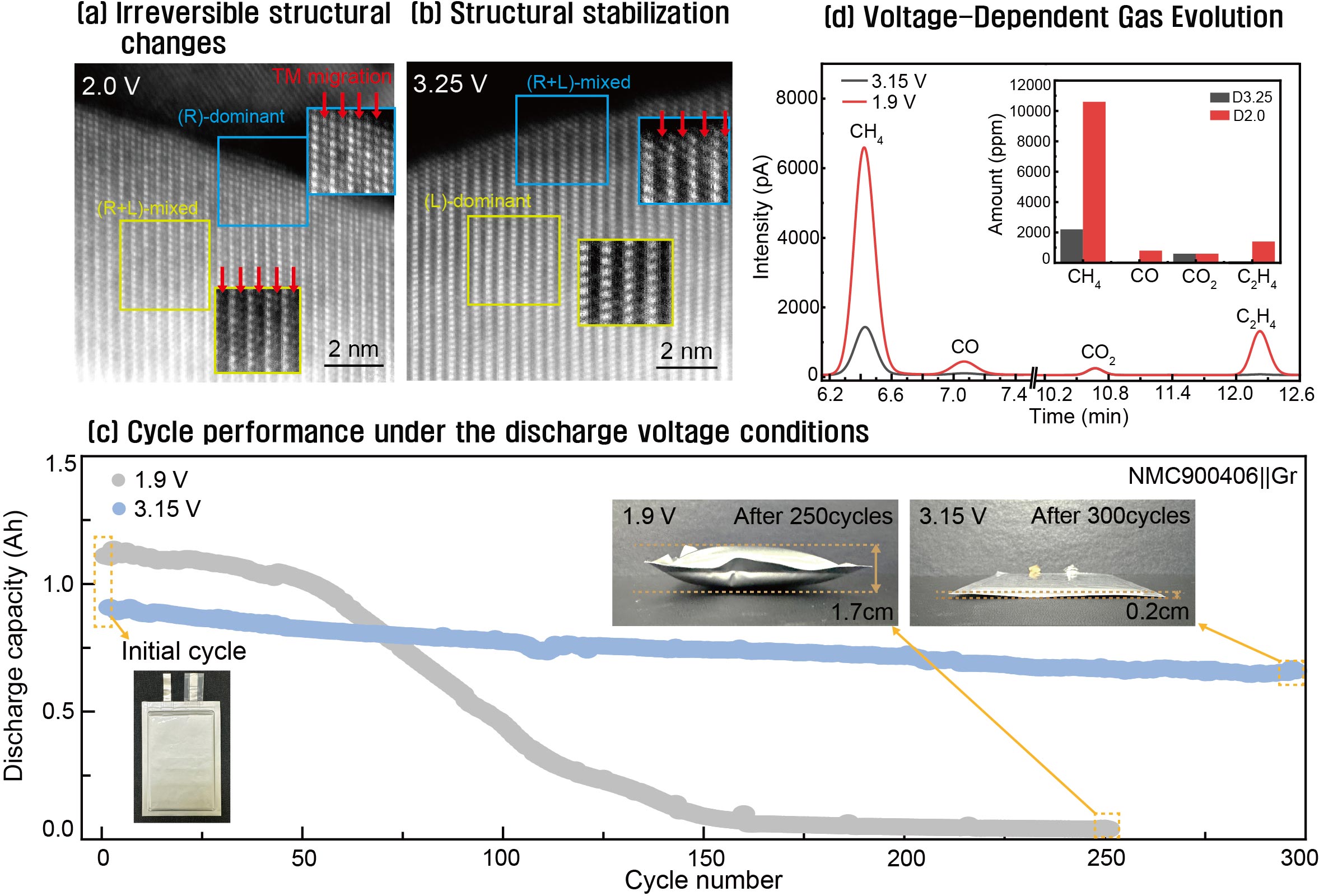
    Discharge Voltage Dependent Structural Degradation and Gas Evolution
    (a) Irreversible structural changes were observed on the surface after 150 charge/discharge cycles within the voltage range in which the quasi-conversion reaction occurs. (b) The original layered structure was preserved even after 150 cycles within a more stable voltage range. (c) When high nickel pouch-type cells were cycled more than 250 times at 1.9 V (where the quasi-conversion reaction occurs) and 3.15 V (where it does not), capacity retention improved significantly solely by adjusting the discharge cutoff voltage. (d) Increasing the discharge voltage effectively suppressed oxygen loss and subsequent side reactions at the surface, resulting in a significant reduction in the evolution of gases (CO, CO₂, CH₄, and C₂H₄). Credit: POSTECH

    They discovered that when a battery is used for extended periods without recharging, a phenomenon known as the “quasi-conversion reaction” occurs on the cathode surface. During this reaction, oxygen escapes from the surface and combines with lithium to form lithium oxide (Li₂O) during discharge, particularly around 3.0V. This compound further reacts with the electrolyte, generating gas and accelerating battery degradation.

    The quasi-conversion reaction was found to be more severe in high nickel cathodes. The research team confirmed that when batteries are used until most of their capacity is depleted, the effects of the degradation process including battery swelling, become increasingly pronounced.

    A Simple Strategy to Prolong Battery Life

    Importantly, the study also revealed a simple yet effective solution. The research team significantly extended cycle life by optimizing battery usage and avoiding full discharge. In experiments with high-nickel batteries (containing over 90% nickel), those discharged deep enough to trigger the quasi-conversion reaction retained only 3.8% of their capacity after 250 cycles, whereas batteries with controlled usage maintained 73.4% of their capacity even after 300 cycles.

    Prof. Jihyun Hong, who led the research, stated, “The impact of discharge—the actual process of using a battery—has been largely overlooked until now,” and added, “This research presents an important direction for the developing longer-lasting batteries.”

    Reference: “Reduction-Induced Oxygen Loss: the Hidden Surface Reconstruction Mechanism of Layered Oxide Cathodes in Lithium-Ion Batteries” by Seungyun Jeon, Gukhyun Lim, Hoseok Lee, Hyunyoung Park, Min Kyung Cho, Chan Kim, YeEun Lee, Jaehoon Kim, Minhyung Kwon, Jung-Keun Yoo, Hyangsoo Jeong, Jinwoo Kim, Seung-Ho Yu, Minah Lee, Jongsoon Kim and Jihyun Hong, 16 January 2025, Advanced Energy Materials.
    DOI: 10.1002/aenm.202404193

    This research was supported by the Korea Institute for Advancement of Technology (KIAT) through the Ministry of Trade, Industry & Energy (MOTIE) (HRD Program for Industrial Innovation). It was also funded by the Korea Planning & Evaluation Institute of Industrial Technology (KEIT).

    Never miss a breakthrough: Join the SciTechDaily newsletter.
    Follow us on Google and Google News.

    Battery Technology Energy Engineering Pohang University of Science & Technology Popular
    Share. Facebook Twitter Pinterest LinkedIn Email Reddit

    Related Articles

    Korean Scientists Develop Cheaper, Safer Alternative to Lithium-Ion Batteries

    Fully Charged in Just 6 Minutes – Groundbreaking Technique Could Revolutionize EV Charging

    300% More Capacity: New Battery Technology Could Significantly Lower Energy Storage Costs

    Next-Generation Energy Storage Breakthrough: Fast-Charging, Long-Running, Flexible

    New Aluminum Batteries Increase the Range of UUVs Tenfold

    MIT Engineers Look Toward All-Solid Lithium Batteries

    Engineers Design Calcium-Based Multi-Element for Liquid Batteries

    Solid Electrolyte Paves the Way for Rechargeable Batteries with Almost Indefinite Lifetimes

    Power Conserving Chip May Increase Smartphone Battery Life

    Leave A Reply Cancel Reply

    • Facebook
    • Twitter
    • Pinterest
    • YouTube

    Don't Miss a Discovery

    Subscribe for the Latest in Science & Tech!

    Trending News

    Largest-Ever Study Finds Medicinal Cannabis Ineffective for Anxiety, Depression, PTSD

    250-Million-Year-Old Egg Solves One of Evolution’s Biggest Mysteries

    Living With Roommates Might Be Changing Your Gut Microbiome Without You Knowing

    Century-Old Cleaning Chemical Linked to 500% Increased Risk of Parkinson’s Disease

    What if Your Memories Never Happened? Physicists Take a New Look at the Boltzmann Brain Paradox

    One of the Universe’s Largest Stars May Be Getting Ready To Explode

    Scientists Discover Enzyme That Could Supercharge Ozempic-Like Weight Loss Drugs

    Popular Sweetener Linked to DNA Damage – “It’s Something You Should Not Be Eating”

    Follow SciTechDaily
    • Facebook
    • Twitter
    • YouTube
    • Pinterest
    • Newsletter
    • RSS
    SciTech News
    • Biology News
    • Chemistry News
    • Earth News
    • Health News
    • Physics News
    • Science News
    • Space News
    • Technology News
    Recent Posts
    • Scientists Say This Overlooked Organ Could Hold the Key to Longer Life
    • Want Less Stress? Landmark Study Points to a Simple Habit
    • Scientists Reveal Eating Fruits and Vegetables May Increase Your Risk of Lung Cancer
    • AI Reveals Explosive Growth of Floating Algae Across the World’s Oceans
    • 5.5 Million Bees Discovered Living Beneath a New York Cemetery
    Copyright © 1998 - 2026 SciTechDaily. All Rights Reserved.
    • Science News
    • About
    • Contact
    • Editorial Board
    • Privacy Policy
    • Terms of Use

    Type above and press Enter to search. Press Esc to cancel.