
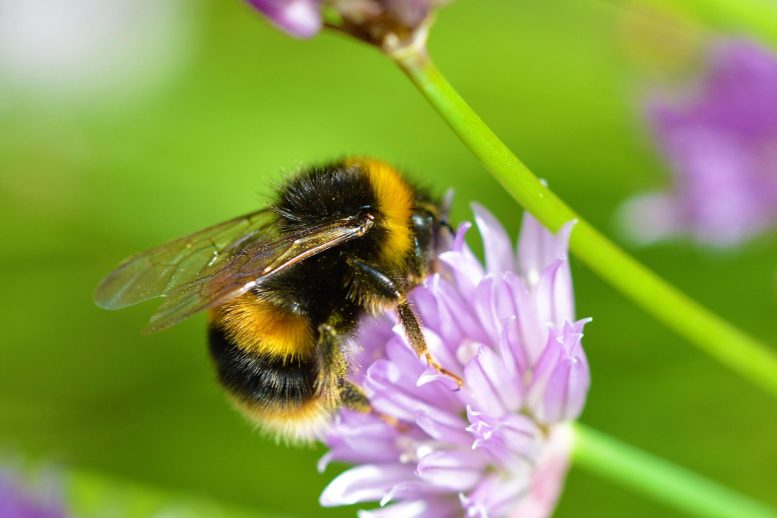
Utilizing the computational capabilities of the Roar supercomputer, a new study details how a Hox gene and its gene targets craft the unique color patterns of bumble bees, enhancing our understanding of genetic contributions to their mimicry and defensive signaling.
While most people in the U.S. may think of bumble bees as the standard yellow and black variety, there are an estimated 260 bee species that sport about 400 different color patterns. One reason many people associate bumble bees with distinct colors is because evolution can influence multiple bee species to share similar color patterns in specific geographic regions, which scientists call mimicry.
When multiple species mimic each other’s patterns they alert would-be predators in a certain area that when they see these colors, a painful sting may follow. In other places of the world, bees use a palette of blacks, oranges, reds, yellows, and whites to create that shared warning signal.
Genetic Drivers of Bee Coloration
Now, researchers are finding out more about the role that evolutionary genetics plays in shaping the distinctive color patterns that give different bee species their regional flare.
In a study, the researchers report how a Hox gene, a major developmental gene that regulates the identity of structures on the segments of the bee, turns on a complex set of downstream genes that ultimately drive segmental changes in the bee’s pigmentation.
“In a previous paper, what we couldn’t explain is how a change in the Hox gene called Abdominal-B leads to a change in the pigments that color these bees,” said Heather Hines, associate professor of biology and entomology. “In this particular paper, we were trying to fill in that gap and understand what genes are being targeted by this first gene, and what is the cascade of events that ultimately leads to these mimetic color differences.”
Uncovering the Role of Pheomelanin in Insects
The researchers, who report their findings in a recent issue of Genome Biology and Evolution, found that genomic targeting of a major developmental gene allows several melanin genes, rather than just one specific enzyme, to be altered to reinforce these color traits. They also said that the study adds to the knowledge about the genes involved in the production of a pigment called pheomelanin. The pigment was known to be involved in red coloration in vertebrates, but only recently was found to occur in insects.
According to Hines, a lot of work remains on understanding the evolutionary genetics of these bees. “Understanding these genes, we now have the potential to look at so many different bee species and how they’ve diversified,” said Hines. “So, it’s not a case that once we are finished here that we’re done. Given the diversity in these bees, there’s just so much more that can be done with the discovery. This is just really the first step.”
Researchers tend to use certain organisms — or model organisms — when they investigate evolutionary genetics because they are convenient and easy to study. This is one of the few studies that looked at coloration genes outside of these well-studied organisms, or non-models. Studying non-model systems allows researchers to understand the evolution of some of nature’s most exceptional diversifications of form, such as this color radiation.
“This really adds to non-model, evolutionary genetic research, which is a growing field and the field is also expanding to be more comparative,” Hines said. “As we move forward, researchers will be looking at how genes and gene pathways have evolved across a broader diversity of species.”
Computationally Expensive Research: ROAR to the Rescue
“The use of high-performance computation power has made this type of research more manageable and reproducible,” said Sarthok Rahman, former doctoral student and ICDS student affiliate, Penn State and postdoctoral researcher in biological sciences, University of Alabama, and first author of the study.
The researchers relied on the Institute for Computational and Data Sciences’ Roar supercomputer to provide that computational power for the gene expression studies on the bees.
“We did the sequencing in the Genomics Core Facility, and then we mostly used the operational server for the differential gene expression analysis. Because it’s a non-model organism, we also have to use other genomic sources from Drosophila and mice, for example, to search the genes and assign the identity,” said Rahman. “These analyses can be pretty computationally expensive and would take a lot of time if it were done on an everyday laptop or desktop, which is why we used the ICDS supercomputing facility for this paper and the paper before it.”
Reference: “Developmental Transcriptomics Reveals a Gene Network Driving Mimetic Color Variation in a Bumble Bee” by Sarthok Rasique Rahman, Tatiana Terranova, Li Tian and Heather M Hines, 21 April 2021, Genome Biology and Evolution.
DOI: 10.1093/gbe/evab080
The team also included Tatiana Terranova, an honors undergraduate research student at Penn State; and Li Tian, former postdoctoral researcher in the Hines Lab at Penn State.
The National Science Foundation supported the work.
Never miss a breakthrough: Join the SciTechDaily newsletter.
Follow us on Google and Google News.