
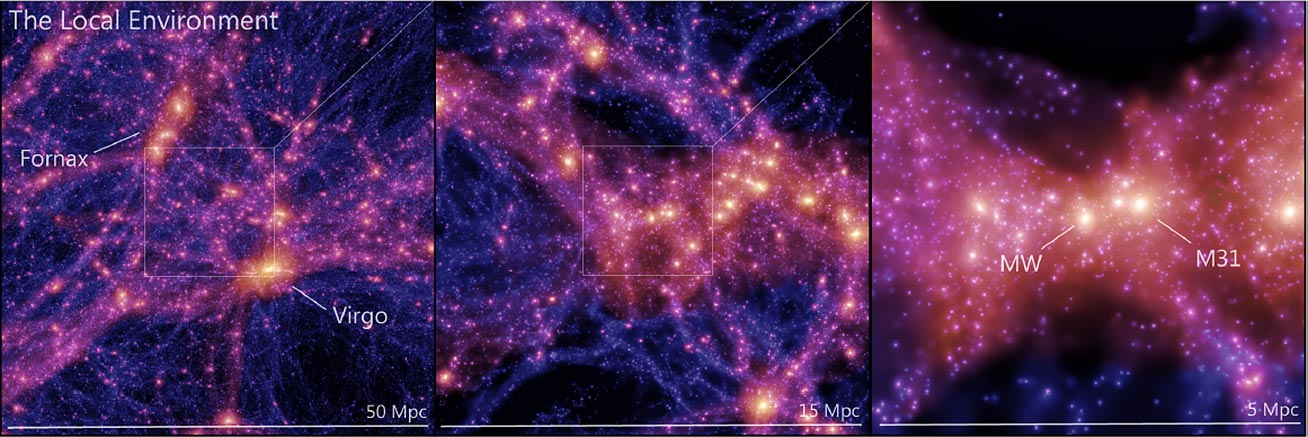
Scientists have created the largest and most accurate virtual representation of the Universe using supercomputer simulations that mimic cosmic evolution from the Big Bang to the present.
Named SIBELIUS-DARK, the simulation covers a volume of 600 million light-years and reproduces known structures such as the Virgo and Coma clusters. This project supports the Cold Dark Matter model, offering new insights into how dark matter and gas evolve to form galaxies.
Scientists have produced the largest and most accurate virtual representation of the Universe to date. An international team of researchers, led by the University of Helsinki, and including members from Durham University in the UK, used supercomputer simulations to recreate the entire evolution of the cosmos, from the Big Bang to the present. The findings are published in the Monthly Notices of the Royal Astronomical Society.
The SIBELIUS-DARK Project
The simulation, named SIBELIUS-DARK, is part of the “Simulations Beyond the Local Universe” (SIBELIUS) project, and is the largest and most comprehensive ‘constrained realization’ simulation to date. The team meticulously compared the virtual Universe to a series of observational surveys to find the correct locations and properties for the virtual analogies of the familiar structures.
Our particular region of the Universe was determined to be rather unique, since the simulation anticipated a smaller number of galaxies on average owing to a local large-scale ‘underdensity’ of matter. While the magnitude of this underdensity is not thought to pose a challenge to the conventional model of cosmology, it may have implications for how we interpret data from observed galaxy surveys.
The simulation covers a volume up to a distance of 600 million light-years from Earth and is represented by over 130 billion simulated ‘particles’, requiring many thousands of computers working in tandem over several weeks and producing large amounts of data. The simulation was performed on the DiRAC COSmology MAchine (COSMA) operated by the Institute for Computational Cosmology at Durham University.
Simulating Dark Matter and Galaxy Formation
These ‘cosmological simulations’ developed by the team used relevant physics equations to describe how dark matter and cosmic gas evolve throughout the Universe’s lifetime. Dark matter is a hypothetical form of matter thought to account for a large amount of all matter in the Universe.
First, the dark matter coalesces into small clumps, called haloes, and the surrounding gas is gravitationally attracted towards these clumps, eventually fragmenting into stars to form galaxies. Overtime, haloes grow large enough to host galaxies like our own Milky Way.
Over the past 20 years, cosmologists have developed a ‘standard model’ of cosmology – the ‘Cold Dark Matter’ model – which can explain a plethora of observed astronomical data, from the properties of the heat left over from the Big Bang, to the number and spatial distribution of galaxies we observe around us today.
When simulating a virtual cold dark matter universe, most cosmologists follow a ‘typical’, or random, patch, one that is similar to our own observed Universe, yet only in a statistical sense.
The simulations carried out in this study are different. By using advanced generative algorithms (models how the data was generated in order to categorize a signal), the simulations are conditioned to reproduce our specific patch of Universe, thus containing the present day structures in the vicinity of our own galaxy that astronomers have observed over decades.
This means that the familiar structures within our Local Universe, such as the Virgo, Coma, and Perseus clusters of galaxies, the ‘Great Wall’ and the ‘Local Void’ – our cosmic habitat – are reproduced in the simulation. At the center of the simulation is perhaps the most important structure, a pair of galaxies, the virtual counterparts of our own Milky Way and our nearby massive neighbor, the Andromeda galaxy.
Supporting the Cold Dark Matter Model with New Insights
Professor Carlos Frenk, Ogden Professor of Fundamental Physics at the Institute for Computational Cosmology, at Durham University, said: “It is immensely exciting to see the familiar structures that we know exist around us emerge from a computer calculation.
“The simulations simply reveal the consequences of the laws of physics acting on the dark matter and cosmic gas throughout the 13.7 billion years that our universe has been around.
“The fact that we have been able to reproduce these familiar structures provides impressive support for the standard Cold Dark Matter model and tells us that we are on the right track to understand the evolution of the entire Universe.”
Dr. Matthieu Schaller from Leiden University added: “This project is truly ground-breaking. These simulations demonstrate that the standard Cold Dark Matter Model can produce all the galaxies we see in our neighborhood. This is a very important test for the model to pass.”
Former Durham PHD student Dr. Stuart McAlpine, Postdoctoral researcher at the University of Helsinki, said: “By simulating our Universe, as we see it, we are one step closer to understanding the nature of our cosmos. This project provides an important bridge between decades of theory and astronomical observations.”
The international research team will further analyze the simulation created with the hope of providing further stringent tests of the standard model of cosmology.
Reference: ” SIBELIUS-DARK: a galaxy catalogue of the Local Volume from a constrained realisation simulation Get access Arrow” by Stuart McAlpine, John C Helly, Matthieu Schaller, Till Sawala, Guilhem Lavaux, Jens Jasche, Carlos S Frenk, Adrian Jenkins, John R Lucey and Peter H Johansson, 8 February 2022, Monthly Notices of the Royal Astronomical Society.
DOI: 10.1093/mnras/stac295
Never miss a breakthrough: Join the SciTechDaily newsletter.
Follow us on Google and Google News.
3 Comments
Efficient and good modeling of the universe by following dark matter history.Thanks to the authors.
Deceiving and being deceived. Bong bang theory is false a d unscientific
Seth if you’re going to try can claim an article false and unscientific, the least you could do is spell right.