

Close Menu
    Facebook X (Twitter) Instagram
    SciTechDaily
    • Biology
    • Chemistry
    • Earth
    • Health
    • Physics
    • Science
    • Space
    • Technology
    Facebook X (Twitter) Pinterest YouTube RSS
    SciTechDaily
    Home»Space»Scientists Use Light From an Exploding Star to Study Distant Galaxy
    Space

    Scientists Use Light From an Exploding Star to Study Distant Galaxy

    By Gemini ObservatoryAugust 30, 2012No Comments5 Mins Read
    Facebook Twitter Pinterest Telegram LinkedIn WhatsApp Email Reddit
    Share
    Facebook Twitter LinkedIn Pinterest Telegram Email Reddit
    Bright Star Flash Supernova Astronomy Concept
    Scientists used light from a supernova to investigate the gas conditions in the interstellar space of a distant galaxy.

    A recently published study details how scientists used light from an exploding star as a probe to study the gas conditions in the space between the host galaxy’s stars, revealing that the distant galaxy‘s interstellar conditions appear “reassuringly normal.”

    Nature hath no fury like a dying star – and astronomers couldn’t be happier…

    An international research team, led by Edo Berger of Harvard University, made the most of a dying star’s fury to probe a distant galaxy some 9.5 billion light-years distant. The dying star, which lit the galactic scene, is the most distant stellar explosion of its kind ever studied. According to Berger, “It’s like someone turned on a flashlight in a dark room and suddenly allowed us to see, for a short time, what this far-off galaxy looks like, what it is composed of.”

    The study, published recently in The Astrophysical Journal, describes how the researchers used the exploding star’s light (called an ultra-luminous core-collapse supernova) as a probe to study the gas conditions in the space between the host galaxy’s stars. Berger says the findings reveal that the distant galaxy‘s interstellar conditions appear “reassuringly normal” when compared to those seen in the galaxies of our local universe. “This shows the enormous potential of using the most luminous supernovae to study the early universe,” he says. “Ultimately it will help us understand how galaxies like our Milky Way came to be.”
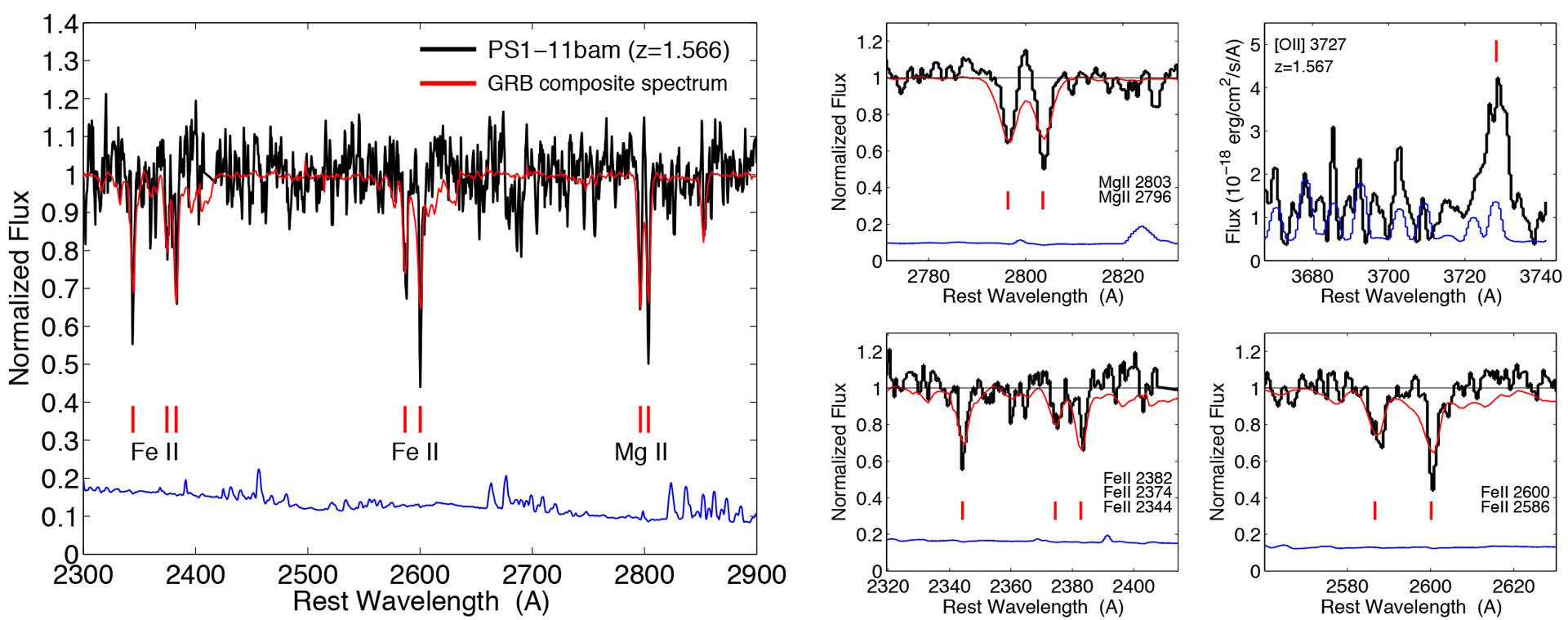
    stellar explosion helps understand far-off galaxy
    Left: Portion of the Gemini spectrum of PS1-11bam from December 5 containing several interstellar absorption features of Fe II and Mg II at z = 1.566 (black). The error spectrum is shown in blue. For comparison we plot the GRB composite spectrum of Christensen et al. (2011). Right: A zoom-in on the relevant Fe II and Mg II lines demonstrates the similarity to GRB absorption spectra. Also shown is the [O II]3727 emission line at z = 1.567 from the January 1 Gemini spectrum. Credit: Gemini Observatory
    The discovery of the dying star in this distant galaxy was made using images from the Pan-STARRS1 survey telescope on Haleakala in Maui, Hawai‘i. “These are the types of exciting and unexpected applications that appear when a new capability comes on line,” said John Tonry, one of the study’s co-authors and supernovae researcher at the University of Hawai‘i at Manoa’s Institute for Astronomy. Tonry adds, “Pan-STARRS is pioneering a new era in deep, wide-field, time-critical astronomy – and this is just the beginning.” After the Pan-STARRS discovery, spectroscopic follow-up studies using the Multiple Mirror Telescope in Arizona and the 8-meter Gemini North telescope on Mauna Kea, Hawai‘i provided the data used by the team to probe the gas of the distant galaxy’s interstellar environment.

    The spectra revealed the signatures of a distant ultra-luminous supernova, and equally important, the unique fingerprints of iron and magnesium within the distant galaxy that hosted the explosion. The galaxy itself contains a very young population of stars (~15 to 45 million years old) with a mass totaling some 2 billion Suns. The ultra-luminous supernova explosion belongs to a relatively recently-identified and special breed of exploding stars. They are some 10-100 times more luminous than their ordinary less-energetic cousins and unusually blue in color. While the process leading to their demise is still being explored, evidence points to the central core-collapse of a star having as much as 100 times the mass of our Sun. The collapse triggers an enormous explosion that blasts prodigious amounts of heavier elements through the star’s enormous outer layers before expanding into space.

    Traditionally, astronomers have used two techniques to study distant galaxies: They would either; 1) look directly for chemical elements leaving bright imprints on the galaxy’s spectrum of light; or 2) search indirectly for dark signatures in the spectrum of an even more distant quasar, which reveals chemical elements in an intervening system that have absorbed light along our line of sight.

    Recently, astronomers have supplanted these methods with another: seeking dark absorption imprints in the afterglows of “gamma-ray bursts” (GRBs); these brief flashes are the brightest and most energetic explosions in the universe, but they fade away within hours. The method is also limited by the need for expensive Earth-orbiting satellites to first detect and pinpoint a burst’s location with precision before astronomers can make ground-based studies.

    “The beauty of studying distant galaxies using ultra-luminous supernovae as a tool is that it eliminates the need for satellites and offers more time for study,” says Alicia Soderberg of Harvard University. “A typical ultra-luminous supernova can take several weeks to fade away.”

    The study by Berger and his team provides the first direct demonstration that ultra-luminous supernovae can serve as probes of distant galaxies. Their results suggest that with the future combination of large survey and spectroscopic telescopes ultra-luminous supernovae could be used to probe galaxies 90 percent of the way back to the Big Bang.

    Reference: “Ultraluminous Supernovae as a New Probe of the Interstellar Medium in Distant Galaxies” by E. Berger, R. Chornock, R. Lunnan, R. Foley, I. Czekala, A. Rest, C. Leibler, A. M. Soderberg, K. Roth, G. Narayan, M. E. Huber, D. Milisavljevic, N. E. Sanders, M. Drout, R. Margutti, R. P. Kirshner, G. H. Marion, P. J. Challis, A. G. Riess,, S. J. Smartt, W. S. Burgett, K. W. Hodapp, J. N. Heasley, N. Kaiser, R.-P. Kudritzki, E. A. Magnier, M. McCrum, P. A. Price, K. Smith, J. L. Tonry and R. J. Wainscoat, 3 August 2012, The Astrophysical Journal.
    DOI: 10.1088/2041-8205/755/2/L29

    Never miss a breakthrough: Join the SciTechDaily newsletter.
    Follow us on Google and Google News.

    Astronomy Astrophysics Gemini Observatory Harvard-Smithsonian Center for Astrophysics Supernova
    Share. Facebook Twitter Pinterest LinkedIn Email Reddit

    Related Articles

    Extreme Weight Loss: Shocking Supernova Discovery Challenges the Standard Theory of Stellar Evolution

    Astronomers Discover Surprising Cause of a “Fizzled” Gamma-Ray Burst

    Fragments of Titanium Found Blasting Out of a Famous Supernova

    How Do the Most Massive Stars Explode? Bubbles With Titanium Trigger Titanic Explosions

    Intriguing Remains of a Rare Stellar Explosion Discovered in Milky Way Center

    Cloud of Hydrogen and Helium Plunging Toward the Galactic Center

    Video and Sound Help Turn Astronomical Data Into Art

    Supernova Shock Wave Breaks Through a Cocoon of Gas

    Origins of Type Ia Supernovae

    Leave A Reply Cancel Reply

    • Facebook
    • Twitter
    • Pinterest
    • YouTube

    Don't Miss a Discovery

    Subscribe for the Latest in Science & Tech!

    Trending News

    Artificial Sweeteners May Harm Future Generations, Study Suggests

    Splashdown! NASA Artemis II Returns From Record-Breaking Moon Mission

    What If Consciousness Exists Beyond Your Brain

    Scientists Finally Crack the 100-Million-Year Evolutionary Mystery of Squid and Cuttlefish

    Beyond “Safe Levels”: Study Challenges What We Know About Pesticides and Cancer

    Researchers Have Found a Dietary Compound That Increases Longevity

    Scientists Baffled by Bizarre “Living Fossil” From 275 Million Years Ago

    Your IQ at 23 Could Predict Your Wealth at 27, Study Finds

    Follow SciTechDaily
    • Facebook
    • Twitter
    • YouTube
    • Pinterest
    • Newsletter
    • RSS
    SciTech News
    • Biology News
    • Chemistry News
    • Earth News
    • Health News
    • Physics News
    • Science News
    • Space News
    • Technology News
    Recent Posts
    • What if Dark Matter Has Two Forms? Bold New Hypothesis Could Explain a Cosmic Mystery
    • Researchers Expose Hidden Chemistry of “Ore-Forming” Elements in Biology
    • Geologists Reveal the Americas Collided Earlier Than We Thought
    • 20x Difference: Study Reveals True Source of Airborne Microplastics
    • Scientists Uncover Hidden Force Powering Yellowstone’s Supervolcano
    Copyright © 1998 - 2026 SciTechDaily. All Rights Reserved.
    • Science News
    • About
    • Contact
    • Editorial Board
    • Privacy Policy
    • Terms of Use

    Type above and press Enter to search. Press Esc to cancel.