

Close Menu
    Facebook X (Twitter) Instagram
    SciTechDaily
    • Biology
    • Chemistry
    • Earth
    • Health
    • Physics
    • Science
    • Space
    • Technology
    Facebook X (Twitter) Pinterest YouTube RSS
    SciTechDaily
    Home»Biology»Extra Gaits in Horses Traced to Single Mutation
    Biology

    Extra Gaits in Horses Traced to Single Mutation

    By SciTechDailyAugust 30, 2012No Comments2 Mins Read
    Facebook Twitter Pinterest Telegram LinkedIn WhatsApp Email Reddit
    Share
    Facebook Twitter LinkedIn Pinterest Telegram Email Reddit
    icelandic-horse-gait
    Icelandic horse.

    In horses, unusual gaits have been traced to a single mutation. This endows them with a wider repertoire of gaits, showing that some seemingly complex physical traits can have a simple genetic basis. This could also elucidate the genes behind movement disorders in humans.

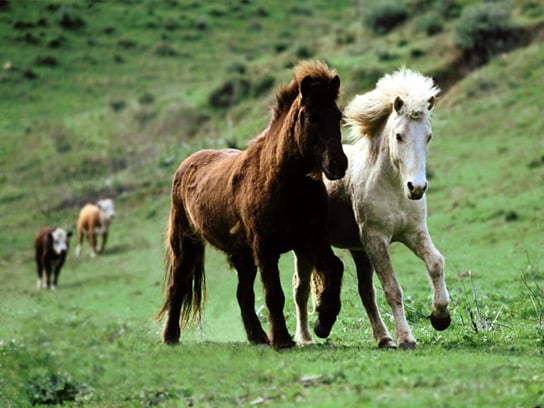
    The researchers published their findings in the journal Nature. Horses typically have three styles of gait, walking, trotting, and galloping. However, certain breeds can perform extra gaits, such as pacing, in which the legs on one side of the body move together. This can be useful in certain types of racing, and breeds like the American Standardbred and some Icelandic horses can pace.
    icelandic-horse-pacing

    Leif Andersson, a geneticist at Uppsala University in Sweden, who led the study, studied the genomes of 70 horses that could perform extra gaits. 40 could do pacing and 30 could perform alternate gaits. The analysis of the genes revealed that a single mutation in a gene called DMRT3 was common to all horses that could pace.

    The control of gait seems a complicated trait, but the results were simple. In order to confirm it, the researchers studied its function in mice, and found that mice with no functional copy of the gene had trouble coordinating their limbs. The gene was also expressed in cells in the mouse spinal cord that connects to motor neurons.

    Horses without this single mutation cannot move their hindleg and right foreleg forward simultaneously, but with it, the regulation of movement isn’t so strict. It shortens the encoded protein by about one-third.

    This work could provide a basis for further studies of movement disorders in humans. Studies indicate that movement disorders in humans feature similar phenotypes to the ones found in horses. The relationship might not be as simple as the one in horses and pacing, but walking difficulty is a common symptom of many neuromuscular disorders.

    Reference: “Mutations in DMRT3 affect locomotion in horses and spinal circuit function in mice” by Lisa S. Andersson, Martin Larhammar, Fatima Memic, Hanna Wootz, Doreen Schwochow, Carl-Johan Rubin, Kalicharan Patra, Thorvaldur Arnason, Lisbeth Wellbring, Göran Hjälm, Freyja Imsland, Jessica L. Petersen, Molly E. McCue, James R. Mickelson, Gus Cothran, Nadav Ahituv, Lars Roepstorff, Sofia Mikko, Anna Vallstedt, Gabriella Lindgren, Leif Andersson and Klas Kullander, 29 August 2012, Nature.
    DOI: 10.1038/nature11399

    Never miss a breakthrough: Join the SciTechDaily newsletter.
    Follow us on Google and Google News.

    Disease Genetics Genomics Neuroscience
    Share. Facebook Twitter Pinterest LinkedIn Email Reddit

    Related Articles

    Neuroscientists Link APOE4 Gene to Alzheimer’s

    Yale Scientists Recode Organisms to Resist Viral Contamination

    Hereditary Form of Autism May Be Treatable With Nutritional Supplements

    De Novo Somatic Mutations Likely Cause Hemimegalencephaly

    Imbalance Between Neuronal Excitation and Inhibition May Account for Seizure Susceptibility in Angelman Syndrome

    Locomotion Restored in Mice With Huntington’s-Like Condition

    “Area X” of Zebra Finch May Provide Insights to Human Speech Disorders

    Genetically Modified Mosquitoes to Fight Diseases

    Researchers Identify Genetic Mutation While Studying Cold Urticarial

    Leave A Reply Cancel Reply

    • Facebook
    • Twitter
    • Pinterest
    • YouTube

    Don't Miss a Discovery

    Subscribe for the Latest in Science & Tech!

    Trending News

    Artificial Sweeteners May Harm Future Generations, Study Suggests

    Splashdown! NASA Artemis II Returns From Record-Breaking Moon Mission

    What If Consciousness Exists Beyond Your Brain

    Scientists Finally Crack the 100-Million-Year Evolutionary Mystery of Squid and Cuttlefish

    Beyond “Safe Levels”: Study Challenges What We Know About Pesticides and Cancer

    Researchers Have Found a Dietary Compound That Increases Longevity

    Scientists Baffled by Bizarre “Living Fossil” From 275 Million Years Ago

    Your IQ at 23 Could Predict Your Wealth at 27, Study Finds

    Follow SciTechDaily
    • Facebook
    • Twitter
    • YouTube
    • Pinterest
    • Newsletter
    • RSS
    SciTech News
    • Biology News
    • Chemistry News
    • Earth News
    • Health News
    • Physics News
    • Science News
    • Space News
    • Technology News
    Recent Posts
    • Researchers Expose Hidden Chemistry of “Ore-Forming” Elements in Biology
    • Geologists Reveal the Americas Collided Earlier Than We Thought
    • 20x Difference: Study Reveals True Source of Airborne Microplastics
    • Scientists Uncover Hidden Force Powering Yellowstone’s Supervolcano
    • This Metal Melts in Your Hand – and Scientists Just Discovered Something Strange
    Copyright © 1998 - 2026 SciTechDaily. All Rights Reserved.
    • Science News
    • About
    • Contact
    • Editorial Board
    • Privacy Policy
    • Terms of Use

    Type above and press Enter to search. Press Esc to cancel.