
Close Menu
    Facebook X (Twitter) Instagram
    SciTechDaily
    • Biology
    • Chemistry
    • Earth
    • Health
    • Physics
    • Science
    • Space
    • Technology
    Facebook X (Twitter) Pinterest YouTube RSS
    SciTechDaily
    Home»Space»A Superbubble in Star Cluster NGC 1929
    Space

    A Superbubble in Star Cluster NGC 1929

    By Chandra X-ray ObservatoryAugust 31, 2012No Comments3 Mins Read
    Facebook Twitter Pinterest Telegram LinkedIn WhatsApp Email Reddit
    Share
    Facebook Twitter LinkedIn Pinterest Telegram Email Reddit
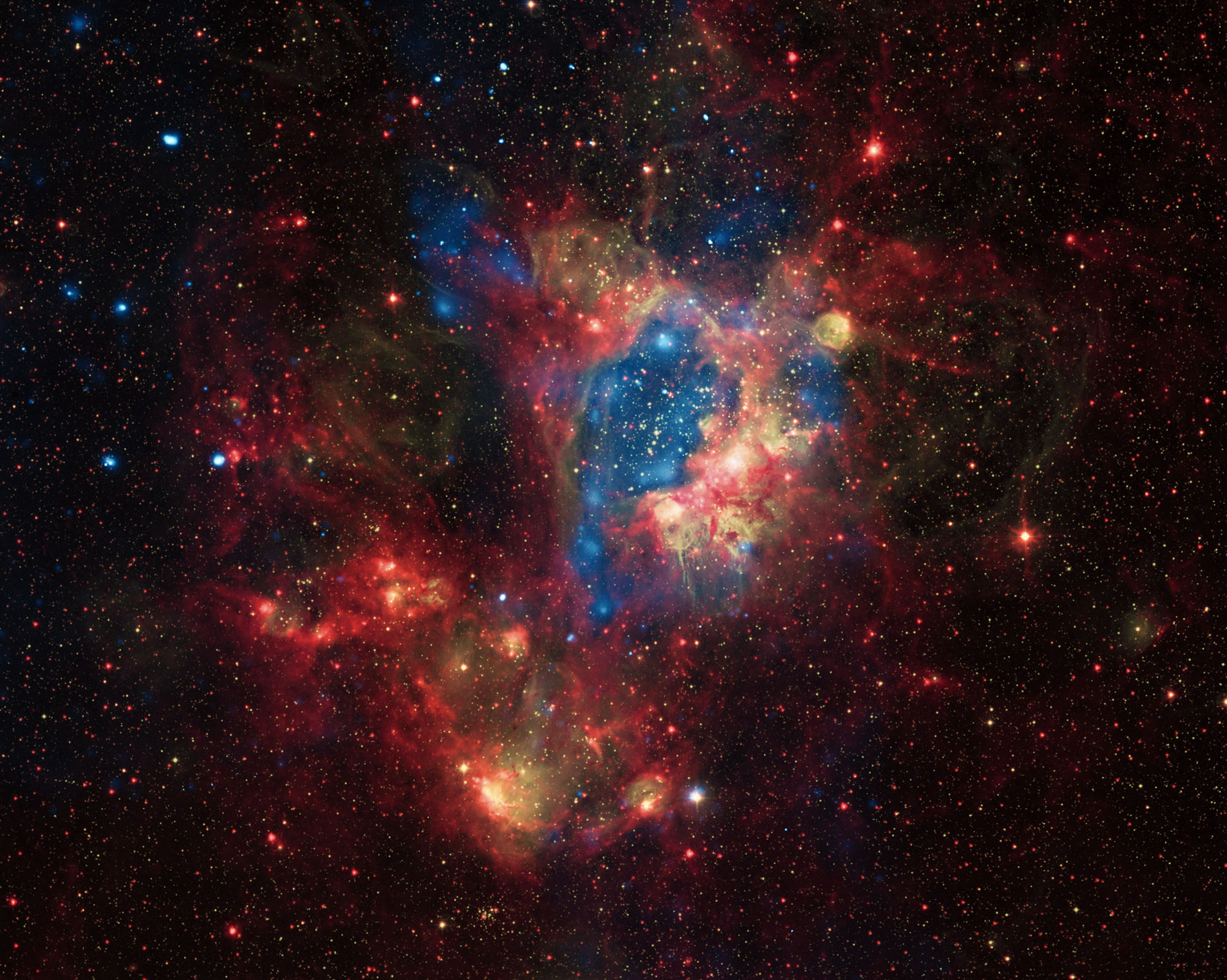
    NGC 1929, a star cluster embedded in the N44 nebula
    This composite image displays a superbubble within NGC 1929, a star cluster nestled within the N44 nebula located in the Large Magellanic Cloud. Credit: X-ray: NASA/CXC/U.Mich./S.Oey, IR: NASA/JPL, Optical: ESO/WFI/2.2-m

    Using data from NASA’s Chandra X-ray Observatory, NASA’s Spitzer Space Telescope and the Max-Planck-ESO telescope, this composite image shows a superbubble in NGC 1929, which is a star cluster embedded in the N44 nebula found in the Large Magellanic Cloud.

    This composite image shows a superbubble in the Large Magellanic Cloud (LMC), a small satellite galaxy of the Milky Way, located about 160,000 light years from Earth. Many new stars, some of them very massive, are forming in the star cluster NGC 1929, which is embedded in the nebula N44. The massive stars produce intense radiation, expel matter at high speeds, and race through their evolution to explode as supernovas.

    The winds and supernova shock waves carve out huge cavities called superbubbles in the surrounding gas. X-rays from NASA’s Chandra X-ray Observatory (blue) show hot regions created by these winds and shocks, while infrared data from NASA’s Spitzer Space Telescope (red) outline where the dust and cooler gas are found. The optical light from the 2.2m Max-Planck-ESO telescope (yellow) in Chile shows where ultraviolet radiation from hot, young stars is causing gas in the nebula to glow.

    A long-running problem in high-energy astrophysics has been that some superbubbles in the LMC, including N44, give off a lot more X-rays than expected from models of their structure. A Chandra study published in 2011 showed that there are two extra sources of the bright X-ray emission: supernova shock waves striking the walls of the cavities, and hot material evaporating from the cavity walls. The observations show no evidence for an enhancement of elements heavier than hydrogen and helium in the cavities, thus ruling out this possibility as an explanation for the bright X-ray emission. This is the first time that the data have been good enough to distinguish between different sources of the X-rays produced by superbubbles.

    The Chandra study of N44 and another superbubble in the LMC was led by Anne Jaskot from the University of Michigan in Ann Arbor. The co-authors were Dave Strickland from Johns Hopkins University in Baltimore, Maryland, Sally Oey from University of Michigan, You-Hua Chu from University of Illinois and Guillermo Garcia-Segura from Instituto de Astronomia-UNAM in Ensenada, Mexico.

    NASA’s Marshall Space Flight Center in Huntsville, Alabama, manages the Chandra program for NASA’s Science Mission Directorate in Washington. The Smithsonian Astrophysical Observatory controls Chandra’s science and flight operations from Cambridge, Massachusetts.

    Never miss a breakthrough: Join the SciTechDaily newsletter.
    Follow us on Google and Google News.

    Astronomy Astrophysics Chandra X-ray Observatory Popular
    Share. Facebook Twitter Pinterest LinkedIn Email Reddit

    Related Articles

    The Give and Take of Stellar Mega-Flares: By Studying Thousands of Young Stars, New Information Has Emerged

    World’s Most Powerful Telescopes Unite in Unprecedented Observations of Famous Black Hole

    Unprecedented New Panorama of the Center of Our Milky Way – Reveals Magnetized Threads Weaving Spectacular Galactic Tapestry

    How Habitable Are Planets That Orbit Red Dwarfs – The Most Common Type of Stars in the Galaxy?

    How Do the Most Massive Stars Explode? Bubbles With Titanium Trigger Titanic Explosions

    Massive X-ray Jet – Extending for 160,000 Light-Years – Spied From Supermassive Black Hole in Early Universe

    Reclusive Neutron Star May Have Been Found in Famous Supernova SN 1987A

    Chandra Studies Extraordinary Magnetar: Fastest Spinning and Possibly the Youngest Magnetar Known

    Deepening Astronomical Mystery: On the Hunt for a Missing Giant Black Hole

    Leave A Reply Cancel Reply

    • Facebook
    • Twitter
    • Pinterest
    • YouTube

    Don't Miss a Discovery

    Subscribe for the Latest in Science & Tech!

    Trending News

    New Pill Lowers Stubborn Blood Pressure and Protects the Kidneys

    Humans May Have Hidden Regenerative Powers, New Study Suggests

    Scientists Just Solved the Mystery of Why Crabs Walk Sideways

    Doctors Are Surprised by What This Vaccine Is Doing to the Heart

    This Popular Supplement May Boost Your Brain, Not Just Your Muscles

    Scientists Say This Simple Supplement May Actually Reverse Heart Disease

    Warming Oceans Could Trigger a Dangerous Methane Surge

    This Simple Movement Could Be Secretly Cleaning Your Brain

    Follow SciTechDaily
    • Facebook
    • Twitter
    • YouTube
    • Pinterest
    • Newsletter
    • RSS
    SciTech News
    • Biology News
    • Chemistry News
    • Earth News
    • Health News
    • Physics News
    • Science News
    • Space News
    • Technology News
    Recent Posts
    • Study Reveals Dangerous Flaw in AI Symptom Checkers
    • New MRI Breakthrough Captures Stunningly Clear Images of the Eye and Brain
    • Scientists Warn Sitting Too Much Can Harm Your Body in Surprising Ways
    • Your Blood Pressure Reading Could Be Wrong Because of One Simple Mistake
    • Scientists Discover Cheap Material That Kills Deadly Superbugs
    Copyright © 1998 - 2026 SciTechDaily. All Rights Reserved.
    • Science News
    • About
    • Contact
    • Editorial Board
    • Privacy Policy
    • Terms of Use

    Type above and press Enter to search. Press Esc to cancel.