
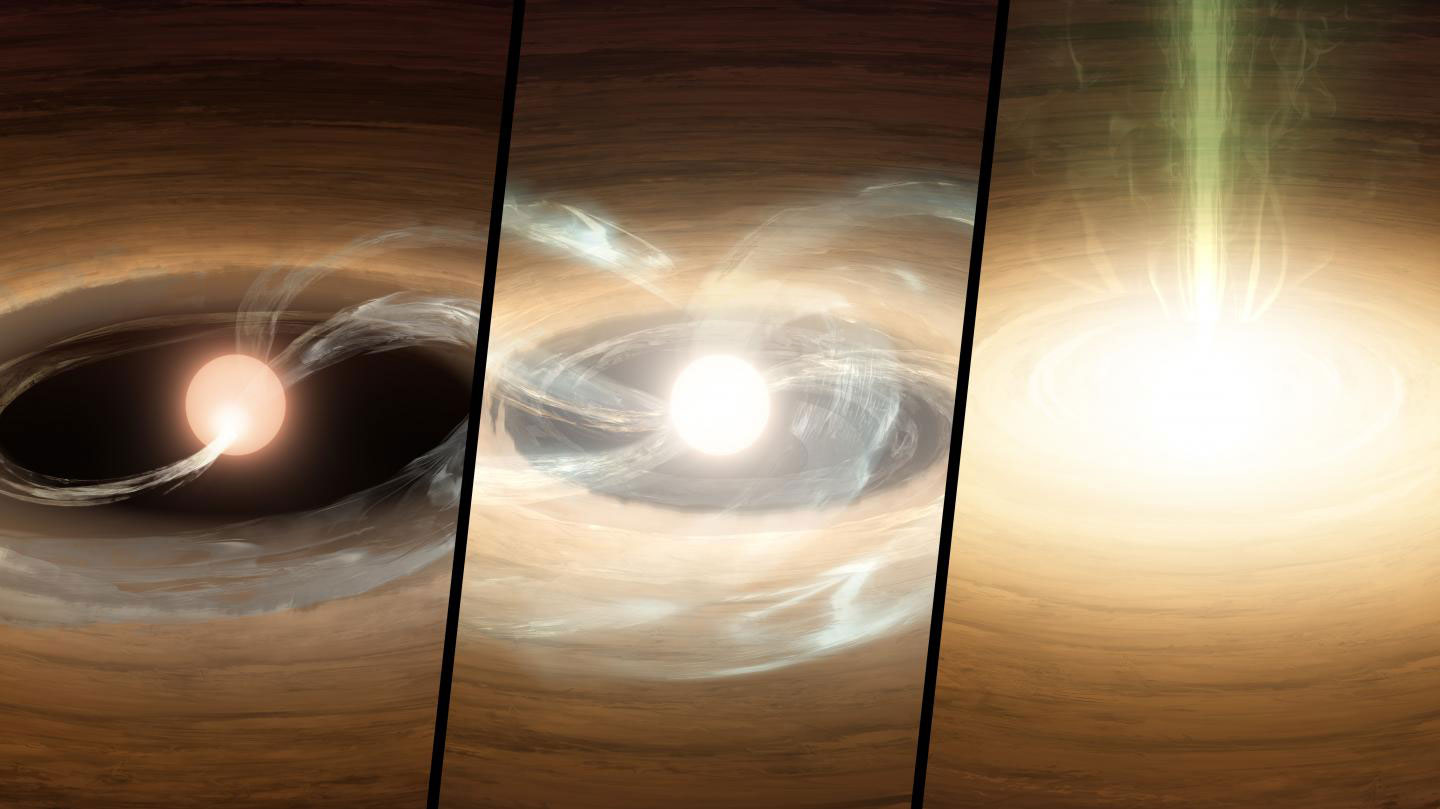
Astronomers have discovered a young star undergoing a rare growth spurt – giving a fascinating glimpse into the development of these distant stellar objects.
A team of international researchers, including experts from the University of Exeter’s Physics and Astronomy department, have observed a rare stellar outburst on a newfound star, called Gaia 17bpi.
Gaia 17bpi belongs to a group of stars known as FU Ori’s, named after the original member of the group, FU Orionis found in the Orion constellation.
Typically these FU Ori stars, which are less than a few million years old, are hidden behind thick clouds of dust and are therefore hard to observe.
However, the research team spotted the star undertaking a dramatic phase of evolution, whereby matter swirling around falls onto the star, and so bulking up its mass. The team was able to see this stellar outburst through both infrared and visible light.
Gaia 17bpi is only the 25th member of the FU Ori class found to date, and one of only about a dozen caught in the act of an outburst. The research is published in The Astrophysical Journal.
Professor Tim Naylor, from Exeter’s Astrophysics group and co-author of the study said: “It’s taken a lot of patient waiting and careful sifting of data to uncover this star, but once we realized what was going it has exceeded expectations.
“It also gives us insight into events which may have happened as the planets in our own Solar System were beginning to form from a disc of material around the sun.”
Gaia 17bpi was first spotted by the European Space Agency’s Gaia satellite, which scans the sky continuously and makes precise measurements of stars in visible light. When Gaia spots a change in a star’s brightness, an alert goes out to the astronomy community.
Exeter graduate student, and co-author of the study Sam Morrell was the first to notice that the star had brightened. Fellow members of the research team took the discovery forward, and discovered that the star’s brightening had been independently captured in infrared light by NASA’s asteroid-hunting NEOWISE satellite at the same time that Gaia saw it, as well as one-and-a-half-years earlier.
NASA’s infrared-sensing Spitzer Space Telescope also happened to have witnessed the beginning of the star’s brightening phase twice back in 2014, giving the researchers a bonanza of infrared data.
“These FU Ori events are extremely important in our current understanding of the process of star formation but have remained almost mythical because they have been so difficult to observe,” says Lynne Hillenbrand, professor of astronomy at Caltech and lead author of a new report. “This is actually the first time we’ve ever seen one of these events as it happens in both optical and infrared light, and these data have let us map the movement of material through the disk and onto the star.”
The new findings shine a light on some of the longstanding mysteries surrounding the evolution of young stars, including how a star acquires all of its mass. Theorists believe that FU Ori events—in which mass is dumped from the disk onto the star over a total period of about 100 years—may help solve the riddle.
The new study shows, with the most detail yet, how material moves from the midrange of a disk, in a region located around one astronomical unit — the distance between the Earth and the sun — from the star, to the star itself.
NEOWISE and Spitzer were the first to pick up signs of the buildup of material in the middle of the disk. As the material started to accumulate in the disk, it warmed up, giving off infrared light. Then, as this material fell onto the star, it heated up even more, giving off visible light, which is what Gaia detected.
“While NEOWISE’s primary mission is detecting nearby solar system objects, it also images all of the background stars and galaxies as it sweeps around the sky every six months,” says co-author Roc Cutri, lead scientist for the NEOWISE Data Center at IPAC, an astronomy and data center at Caltech. “NEOWISE has been surveying in this way for five years now, so it is very effective for detecting changes in the brightness of objects.”
Carlos Contreras, a Postdoctoral Research Fellow from the University of Exeter and co-author of the study added: “The FU Ori-type outbursts could also have an impact on the early formation and evolution of the planets that form in the discs around young stars.
The discovery of Gaia 17bpi was the by-product of an Exeter program that has been monitoring a large sample of young stars using the data from the Gaia satellite, to measure the frequency of the FU Ori events during the planet-forming stage.”
The researchers used the W. M. Keck Observatory and Caltech’s Palomar Observatory to help confirm the FU Ori nature of the newfound star. Says Hillenbrand, “You can think of Gaia as discovering the initial crime scene, while Keck and Palomar pointed us to the smoking gun.”
Reference: “Gaia 17bpi: An FU Ori–type Outburst” by Lynne A. Hillenbrand, Carlos Contreras Peña, Sam Morrel, Tim Naylor, Michael A. Kuhn, Roc M. Cutri, Luisa M. Rebull, Simon Hodgkin, Dirk Froebrich and Amy K. Mainzer, 20 December 2018, The Astrophysical Journal.
DOI: 10.3847/1538-4357/aaf414
Never miss a breakthrough: Join the SciTechDaily newsletter.
Follow us on Google and Google News.