
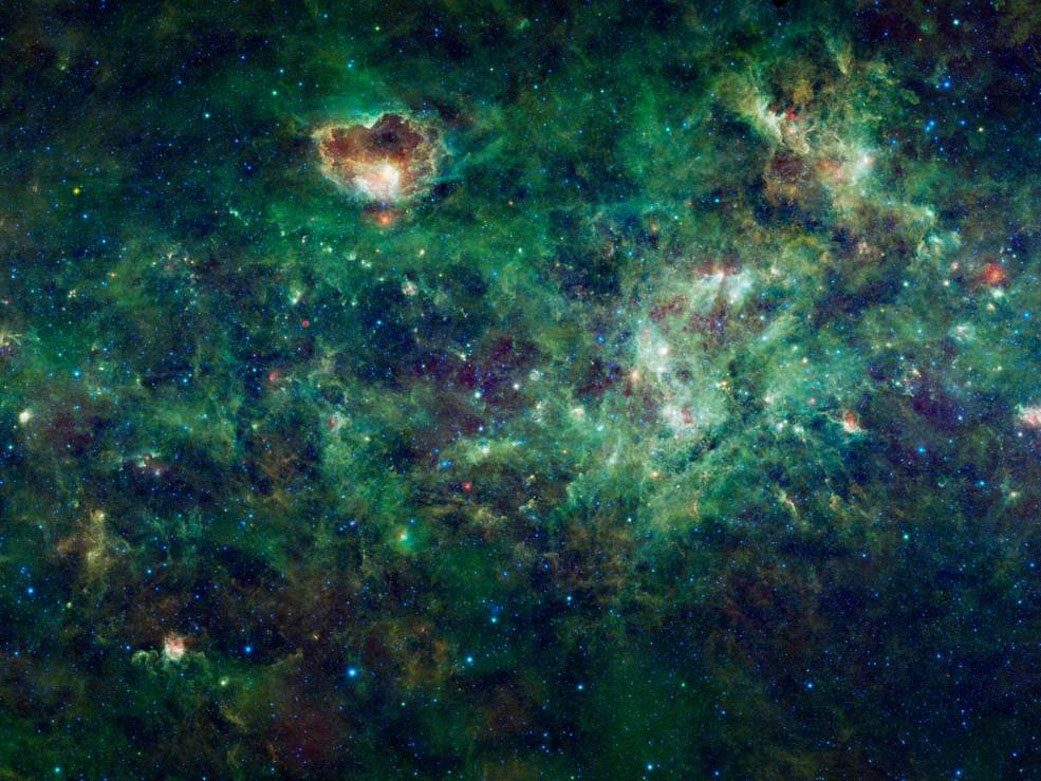
When we think of sugar, it’s in the form of a holiday sweet or a reason to head back to the gym after New Year’s Eve — we don’t usually think of the complex varieties that form the structural backbones of our very genetic code. And we certainly don’t think of sugar floating around in the vast darkness of space.
New research suggests that the sugar molecule that puts the “D” in DNA — 2-deoxyribose — could exist in the far reaches of space. A team of NASA astrophysicists were able to create DNA’s sugar in laboratory conditions that mimic interstellar space.
The researchers believe their results, published on Tuesday in Nature Communications, show that yet another of life’s critical chemical building blocks could be widespread in the universe and potentially seed other planets as well.
“We don’t yet know whether life is common in the universe, but we’re pretty sure the presence of life’s building blocks is not a limiting factor,” said Michel Nuevo, a researcher at NASA’s Ames Research Center in California’s Silicon Valley and the lead author of the paper.
The results represent the first solid evidence of the formation of DNA’s sugar in an astrophysical setting.
Interstellar space in a lab
The vast, frigid, low-density regions between stars are not as empty as they may seem. The interstellar medium contains dust and gases, and these are bombarded by high-energy photons and particles. Chemical reactions do occur, although extremely slowly at temperatures hovering in the range of -440 degrees Fahrenheit (230 degrees Celsius).
These were the conditions that Nuevo and his team simulated in the “cosmic chamber” at Ames’ Astrophysics and Astrochemistry Lab. The team used a vacuum chamber that contained an aluminum substance cooled to almost absolute zero and added a gaseous mixture of water vapor and the common carbon compound methanol. At such a low temperature, an icy layer formed on the surface of the substance. After irradiating the chamber with ultraviolet light and warming the substance, the researchers examined the resulting material and found that a variety of sugar derivatives, as well as the complex sugar 2-deoxyribose had been created.
In 2016, another team of researchers in France made a similar laboratory discovery of ribose, the sugar of RNA used by the body to make proteins and considered a possible precursor to DNA in the first life forms on early Earth.
“For more than two decades we’ve asked ourselves if the chemistry we find in space can make the kinds of compounds essential to life. So far, we haven’t picked a single broad set of molecules that can’t be produced,” said Scott Sandford, a senior scientist in the Ames astrochemistry lab and an author on the new paper.
The universe as a chemist
These complex sugars add to the growing list of organic compounds found on meteorites and in cosmic-like laboratory conditions. These include amino acids, the building blocks of proteins; nucleobases, the basic units of the genetic code; and amphiphiles, the class of molecules used by life to produce the membranes around cells.
“The universe is an organic chemist,” said Sandford. “It has big beakers and lots of time — and the result is a lot of organic material, some of which is useful to life.”
As the swirling debris of the interstellar medium condenses into new stars and planetary systems, how do the organic molecules made in space make it onto the surface of newly-forming planets?
The early Earth was probably showered with such materials as meteoroids and comets pummeled its surface. Sugar derivatives like sugar acids and sugar alcohols have been found in these samples. These sugar derivatives can evolve into the sugars used in DNA and RNA in the presence of water, giving researchers new avenues to explore about the chemistry of life’s beginnings.
Reference: “Deoxyribose and deoxysugar derivatives from photoprocessed astrophysical ice analogues and comparison to meteorites” by Michel Nuevo, George Cooper and Scott A. Sandford, 18 December 2018, Nature Communications.
DOI: 10.1038/s41467-018-07693-x
Never miss a breakthrough: Join the SciTechDaily newsletter.
Follow us on Google and Google News.