
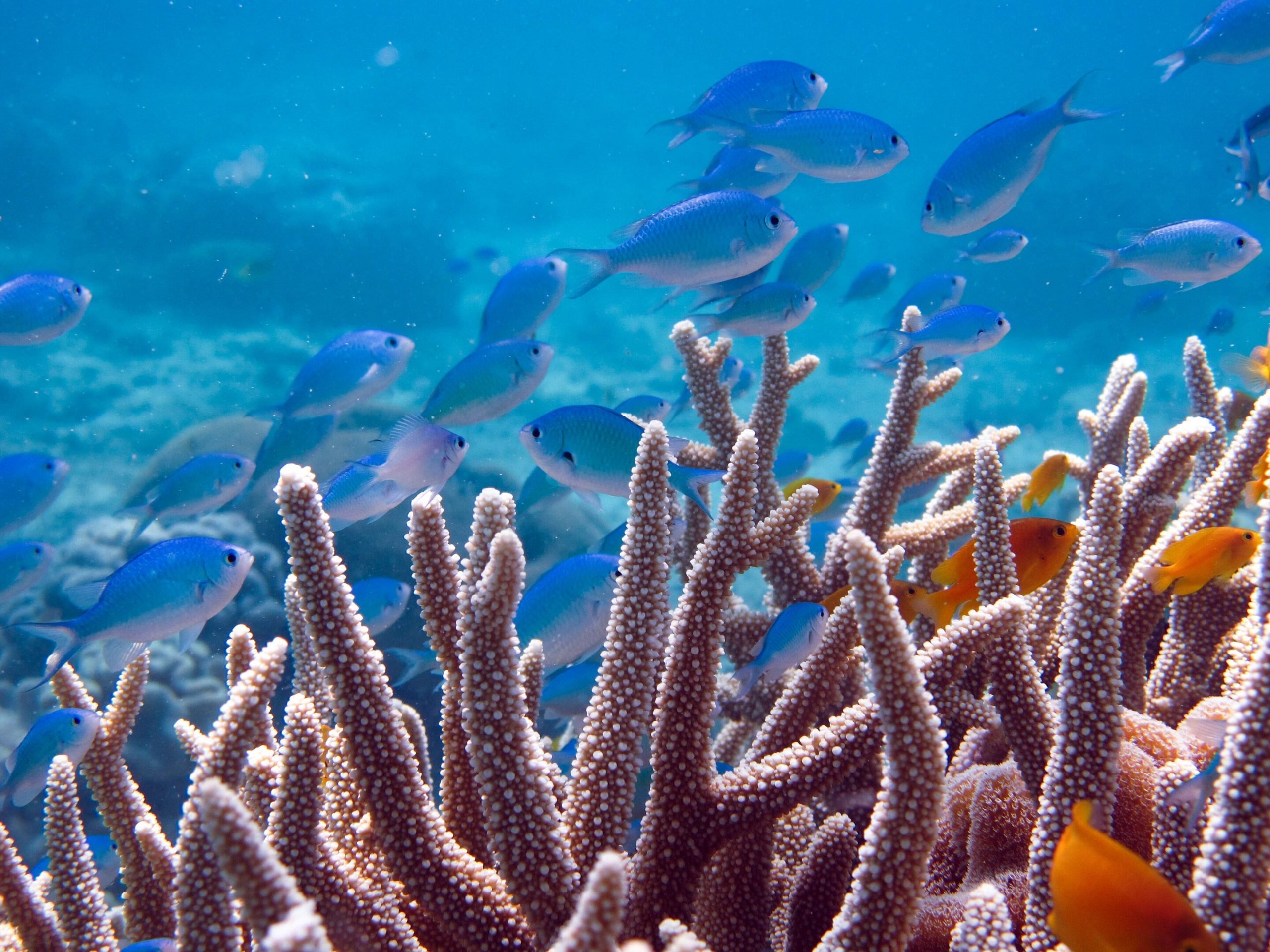
Double-Checking the Science on the Effects of Ocean Acidification
Sometimes it helps to check the facts. You may be surprised by what you find.
Over the last decade, several high-profile scientific studies have reported that tropical fish living in coral reefs are adversely affected by ocean acidification caused by climate change — that is, they behave oddly and are attracted to predators as levels of carbon dioxide dissolved from air pollution increase.
But now new research suggests that isn’t the case.
“We have comprehensively and transparently shown that … ocean acidification has negligible direct impacts on the behavior of fish on coral reefs.” — Timothy Clark
In fact, in the most exhaustive study yet of the impacts of ocean acidification on the behavior of coral reef fish, headed up in Australia and co-authored by two Université de Montréal researchers, it turns out fish behavior is not affected at all.
“The past decade has seen many high-profile studies that have found alarming effects of ocean acidification on coral reef fish behavior,” with some reporting that “fish become attracted to the smell of predators in acidified waters,” said lead author Timothy Clark, an associate professor at Deakin University’s School of Life and Environmental Sciences in Geelong, a seaside city near Melbourne, Australia.
But when they tried to re-do those earlier studies with many of the same species, and by crunching the data in a new analysis, Clark and his team of Canadian and Scandinavian scientists — including UdeM biologists Sandra Binning and Dominique Roche — arrived at very different results.
It turns out the original results couldn’t be replicated.

“We expected previous results would be easy to repeat because of how clear and strong they appeared in the initial papers. Instead, we found consistently normal behaviors in fish that we acclimated to (predicted) end-of-(21st)-century levels of CO2,” said Clark.
But “by using rigorous methods, measuring multiple behaviors in multiple species, and making our data and analysis code openly available, we have comprehensively and transparently shown that … ocean acidification has negligible direct impacts on the behavior of fish on coral reefs,” said Clark.
“Some people may be surprised by these findings, but that’s how science operates: it’s a normal and healthy process to question published results. Sometimes they hold up, and sometimes they don’t.” — Sandra Binning
“Specifically, elevated CO2 does not meaningfully alter activity levels or behavioral lateralization (left-right turning preference), nor does it alter the response of fish to the chemical cues released by predators.”
The new study is bound to make a big impact in the marine biology world, the scientists believe. Not only does it contradict earlier studies, it shows that science doesn’t always produce results to buttress things everyone agrees on, like climate change.
Quite the opposite, in fact.
“Some people may be surprised by these findings, but that’s how science operates: it’s a normal and healthy process to question published results. Sometimes they hold up, and sometimes they don’t. Ultimately, it’s the accumulation of evidence that matters and brings us closer to the truth,” said Binning, an assistant professor at UdeM.
“It’s not because some researchers have found one thing that we should take it at face value. As scientists, we should always be critical of what we read and what we see. That’s how science advances.”

“We’re not saying that climate change is not a problem — far from it,” added Roche, her husband, a research associate at UdeM. “Our point is that replication studies are very important, just as are ocean acidification and global warming generally.”
Clark agreed.
“The negative effects of CO2 emissions are well established, with global warming already having devastating effects on coral reef ecosystems around the world. Among other things, more frequent storms and coral bleaching during heatwaves is causing severe habitat loss for fish,” he said.
“So, despite our new results, coral reefs and their fish communities remain in grave danger because of increasing atmospheric CO2.”
Now, instead of concentrating on how fish behavior is affected by ocean acidification, scientists would do better to focus their attention “on other aspects of climate change that are more in need of research,” such as infectious disease risk, habitat destruction, and decreased oxygen levels in water, said Binning, holder of a Canada Research Chair on Eco-Evolution and Host-Parasite Interactions.
“With so little time left to combat climate change, it’s vitally important that research dollars are used in the best way possible to better help us understand and target systems and organisms at the greatest risk,” added Roche.
Reference: “Ocean acidification does not impair the behaviour of coral reef fishes” by Timothy D. Clark, Graham D. Raby, Dominique G. Roche, Sandra A. Binning, Ben Speers-Roesch, Fredrik Jutfelt and Josefin Sundin, 8 January 2020, Nature.
DOI: 10.1038/s41586-019-1903-y
Never miss a breakthrough: Join the SciTechDaily newsletter.
Follow us on Google and Google News.
10 Comments
Well, there goes sam harris and that as well leaving the left like I did the right over relig0on also being a lie for money and power. Honesty don’t expect it from cheap people even with money and fame.
But one thing that definitely will change a fish’s behaviour is when the coral doesn’t exist anymore. As temperatures rise, mass coral bleaching events and infectious disease outbreaks are becoming more frequent. Additionally, carbon dioxide absorbed into the ocean from the atmosphere has already begun to reduce calcification rates in reef-building and reef-associated organisms by altering seawater chemistry through decreases in pH. This process is called ocean acidification. Let’s see how the fish behave when they don’t have a habitat.
Take your meds
What Baird said is correct — acidification lowers pH. Lower pH destroys corals. Destroyed corals don’t attract fish.
The results of this study are very useful, for sure, but John-Paul up there obviously took this to mean that acidification of the oceans is either a hoax or not a problem.
I’m not sure how ocean acidification and dying coral reefs is a play for money or power.
Turns out the stove isn’t burning, it’s the house – a little less fire to fight.
@John-Paul: Sorry, I don’t understand your comment. If it alludes to doing some big difference, the article notes it didn’t: “… despite our new results, coral reefs and their fish communities remain in grave danger because of increasing atmospheric CO2.””
This must be Bright-Fart science or lack of science division.
The term “acidification” is a misnomer. The oceans are alkaline and are 7.5 on the Ph scale above Pure Water which is Neutral at 6. The oceans historically have had CO2 levels multiple times higher than currently and remained Alkaline, and also supported life. The only “wildcard” is the rapidity of the “acidification” or decreases in ocean alkalinity, that can be an issue, and this is the issue with all of the so called climate change issues. What bothers me about this article and new research is the absolute certainty and acceptance of the previous data, and this can be attributed to much of the “climate change” data, how reliable, vetted and reliable is it?
https://www.spectator.co.uk/2016/04/ocean-acidification-yet-another-wobbly-pillar-of-climate-alarmism/
https://wattsupwiththat.com/2018/06/05/the-total-myth-of-ocean-acidification/
https://www.compoundchem.com/2015/07/09/ph-scale/
Is it not a fact that coral is dying at an alarming rate, and that the studies re acidification, etc are efforts to pin down the mechanisms by which this is happening, in the hope that that might lead to a method to alleviate the problem? The worry is that deniers will take these results as supporting their case while ignoring the principal problem which is the widespread death of coral.
Such a poorly chosen title, and equally poorly written article you might think it was written by Retta Skitta. “Behavior” should definitely be included in the title, as in “Coral Reef Fish Behavior not affected by Ocean Acidification from Climate Change, Contradicting previous study results”.
pH of 6 is neutral and oceans have a pH of 7.5? Wow, I must have really misunderstood my chemistry class. 7 is considered a neutral pH and the pH of ocean water is a little over 8, but what you fail to understand about the argument is that acidification is the process of *becoming* more acidic. While average ocean pH was somewhere around 8.2 and is now somewhere closer to 8.0ish, in the logarithmic world of pH, that change is incredibly massive (each 1.0 point is a 10x change up or down). To put this in perspective, your body’s internal pH is kept very tightly between 7.35 and 7.45 and if it were to drift down to 7.15 you’d probably be visiting an ICU soon. If it dropped below 7.0 you’d probably be on your way to the morgue shortly.