
Close Menu
    Facebook X (Twitter) Instagram
    SciTechDaily
    • Biology
    • Chemistry
    • Earth
    • Health
    • Physics
    • Science
    • Space
    • Technology
    Facebook X (Twitter) Pinterest YouTube RSS
    SciTechDaily
    Home»Space»NASA Solar Dynamics Observatory’s HD Video of 2012 Venus Transit
    Space

    NASA Solar Dynamics Observatory’s HD Video of 2012 Venus Transit

    By NASA Goddard Space Flight CenterJune 6, 20121 Comment2 Mins Read
    Facebook Twitter Pinterest Telegram LinkedIn WhatsApp Email Reddit
    Share
    Facebook Twitter LinkedIn Pinterest Telegram Email Reddit
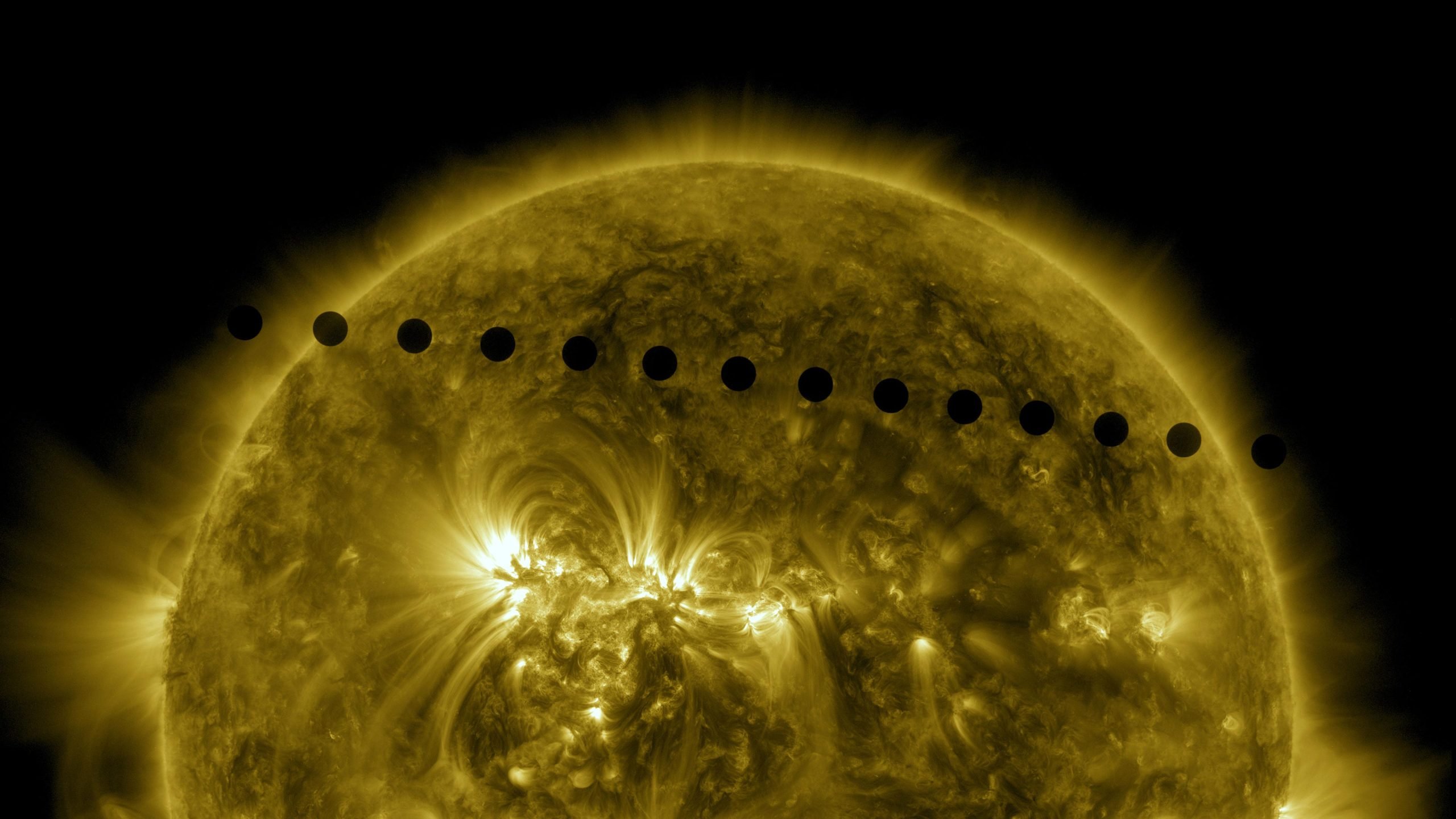
    NASA SDO 2012 Venus Transit
    Sequence of images from Solar Dynamic Observatory in 171 wavelength of the Venus transit, merged together to show the path of Venus across the sun. Credit: NASA/SDO

    In case you missed it, here is video footage of the 2012 Venus transit from the Solar Dynamics Observatory.

    Launched on February 11, 2010, the Solar Dynamics Observatory, or SDO, is the most advanced spacecraft ever designed to study the sun. During its five-year mission, it will examine the sun’s atmosphere, magnetic field and also provide a better understanding of the role the sun plays in Earth’s atmospheric chemistry and climate. SDO provides images with resolution 8 times better than high-definition television and returns more than a terabyte of data each day.


    Credit: NASA Goddard Space Flight Center/SDO

    On June 5, 2012, SDO collected images of the rarest predictable solar event—the transit of Venus across the face of the sun. This event happens in pairs eight years apart that are separated from each other by 105 or 121 years. The last transit was in 2004 and the next will not happen until 2117.

    The videos and images displayed here are constructed from several wavelengths of extreme ultraviolet light and a portion of the visible spectrum. The red colored sun is the 304-angstrom ultraviolet, the golden-colored sun is 171 angstrom, the magenta sun is 1700 angstrom, and the orange sun is filtered visible light. 304 and 171 show the atmosphere of the sun, which does not appear in the visible part of the spectrum.

    Never miss a breakthrough: Join the SciTechDaily newsletter.
    Follow us on Google and Google News.

    NASA Goddard Space Flight Center Venus
    Share. Facebook Twitter Pinterest LinkedIn Email Reddit

    Related Articles

    Student-Built, Dime-Sized Instrument Is Venus-Bound on NASA’s DAVINCI Space Probe

    NASA’s DAVINCI Space Probe To Plunge Through Hellish Atmosphere of Venus

    Parker Solar Probe Captures Stunning New Images of Venus – Faint Glow Detected From the Planet’s Surface

    DAVINCI: NASA’s Deep Atmosphere Venus Investigation of Noble Gases, Chemistry and Imaging

    Ten Astonishing Mysteries of Venus

    First NASA Probe Mission to Venus in 40 Years: DAVINCI+ to Explore Divergent Fate of Earth’s Mysterious Twin

    NASA’s Parker Solar Probe Delivers 1st Complete View of Venus’ Orbital Dust Ring

    NASA’s Parker Solar Probe Captures Stunning View of Venus

    HFAs and Their Effect on Venus

    1 Comment

    1. eric on June 9, 2012 7:41 pm

      Amazing video. I notice that when the planet passes over the sun it looks like there is an after image, is that from the spacecraft data?

      Reply
    Leave A Reply Cancel Reply

    • Facebook
    • Twitter
    • Pinterest
    • YouTube

    Don't Miss a Discovery

    Subscribe for the Latest in Science & Tech!

    Trending News

    A Star Near the Milky Way’s Black Hole Is Losing Mass at an Astonishing Rate

    Scientists Solve a Vitamin B12 Mystery With an Unexpected Culprit

    Has the Autism Spectrum Become Too Broad? Leading Scientist Warns of Hidden Consequences

    Rewriting History: Researchers Uncover a Forgotten Amazon Civilization That May Have Housed 3 Million People

    New Research May Change How We Think About Weight Loss Drugs Like Ozempic

    Coffee Drinkers Show Surprising Differences in Fat, Muscle, and Hormones

    New Treatment Targets Gum Disease Without Killing Good Bacteria

    Scientists Discover a 245-Million-Year-Old Reptile With Its Organs Still Preserved

    Follow SciTechDaily
    • Facebook
    • Twitter
    • YouTube
    • Pinterest
    • Newsletter
    • RSS
    SciTech News
    • Biology News
    • Chemistry News
    • Earth News
    • Health News
    • Physics News
    • Science News
    • Space News
    • Technology News
    Recent Posts
    • Mysterious “Golden Tree” Coral Discovered in Costa Rica’s Deep Pacific
    • Scientists Film Dolphins Using Seashells As Hunting Tools
    • Scientists Discover a Hidden Hormone Pathway That Protects the Liver From Damage
    • Quitting Alcohol Can Change the Brain in Surprising Ways, Mouse Study Finds
    • FDA-Approved Drug Shows Promise for Reversing Osteoarthritis Damage
    Copyright © 1998 - 2026 SciTechDaily. All Rights Reserved.
    • Science News
    • About
    • Contact
    • Editorial Board
    • Privacy Policy
    • Terms of Use

    Type above and press Enter to search. Press Esc to cancel.