
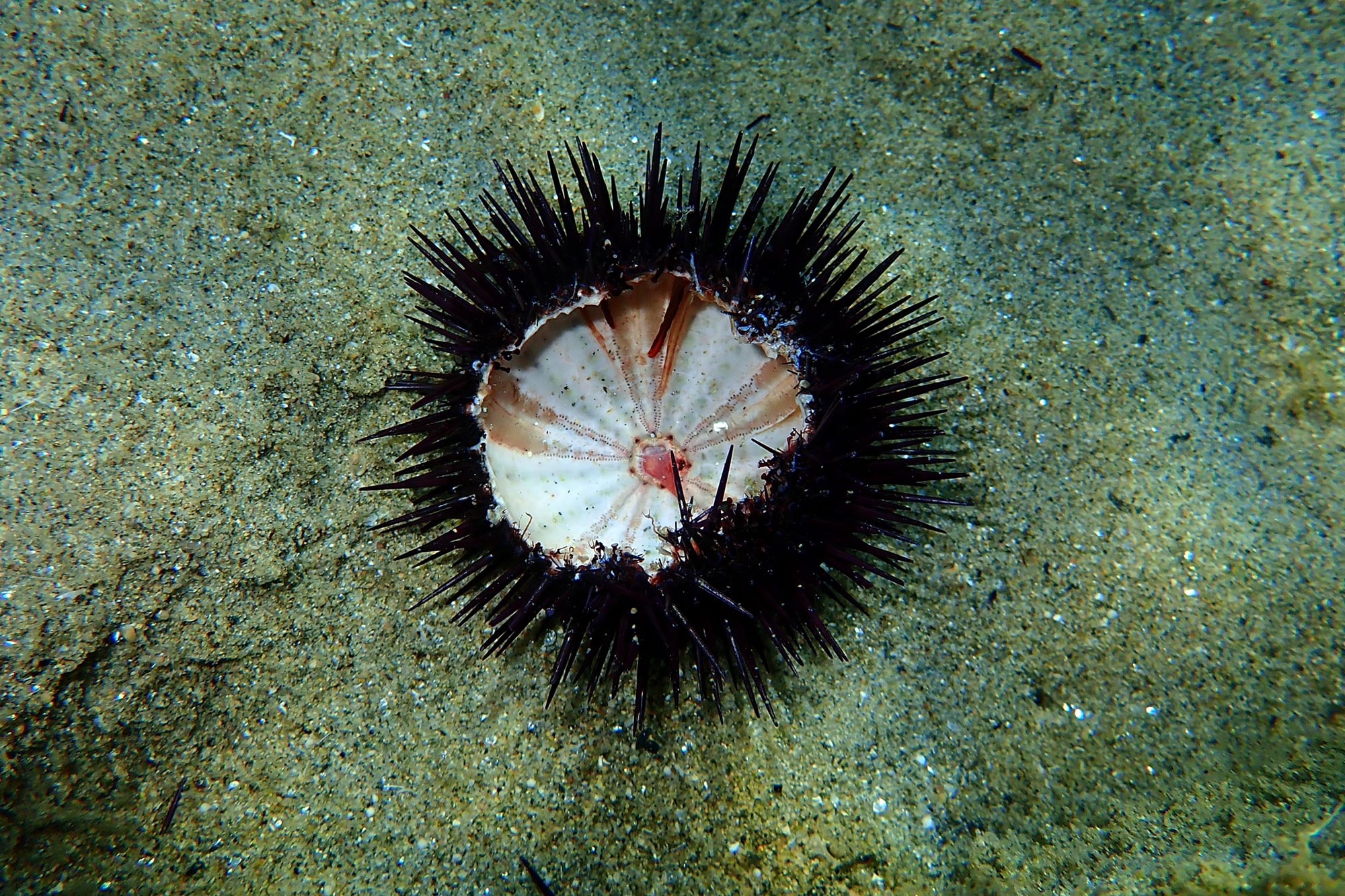
The Canary Islands may represent the “missing link” in a global pandemic killing sea urchins.
Sea urchins help build and maintain marine habitats in much the same way that large plant-eating animals shape landscapes on land. As they graze and tear apart seaweed and seagrass, they limit algae and can give slower growing organisms, including corals and some calcifying algae, a better chance to persist. Many animals also rely on urchins for food, from marine mammals and fish to crustaceans and sea stars. But if urchins become too numerous, such as when their predators are overhunted or overfished, they can strip reefs and seafloor habitats and create what are known as ‘urchin barrens’.
A new study in Frontiers in Marine Science reports that an overlooked, worldwide wave of sea urchin deaths over the past four years has reached the Canary Islands. Scientists do not yet know the full ecological fallout there, but the effects are likely significant.
“Here we show the spread and impacts of a ‘mass mortality event’ which severely hit populations of the sea urchin Diadema africanum in the Canary Islands and Madeira through 2022 and 2023,” said Iván Cano, a doctoral student at the University of La Laguna on Tenerife in the Canaries Islands, Spain.
“At approximately the same time, the Diadema species have been observed to be dying off in the Caribbean, the Mediterranean, the Red Sea, the Sea of Oman, and the western Indian Ocean.”
Diadema is a genus of eight species found in warm subtropical and tropical seas worldwide. One of them, D. africanum, historically flourished on rocky reefs off western Africa and the Azores at depths between five meters and 20 meters. In the Canary Islands, the population has been rising since the mid-1960s, a trend researchers link to predator declines from overfishing and to global warming. In some parts of the archipelago, high densities previously contributed to ‘urchin barrens’, leading to attempted biological control that ultimately failed between 2005 and 2019.
Sea change
In February 2022, Cano and colleagues first noticed widespread deaths of D. africanum near La Palma and Gomera in the western Canaries. Over the following months, the outbreak moved east across the archipelago. Affected urchins became less active, moved in unusual ways, stopped responding to stimuli, and then lost flesh and spines before dying.
The scientists recognized these symptoms, because this was not the first outbreak of such mass mortality events in the islands. In early 2008, and again in early 2018, a disease killed an estimated 93% of D. africanum individuals on Tenerife and La Palma, and 90% of the islands in the neighboring Madeira archipelago.
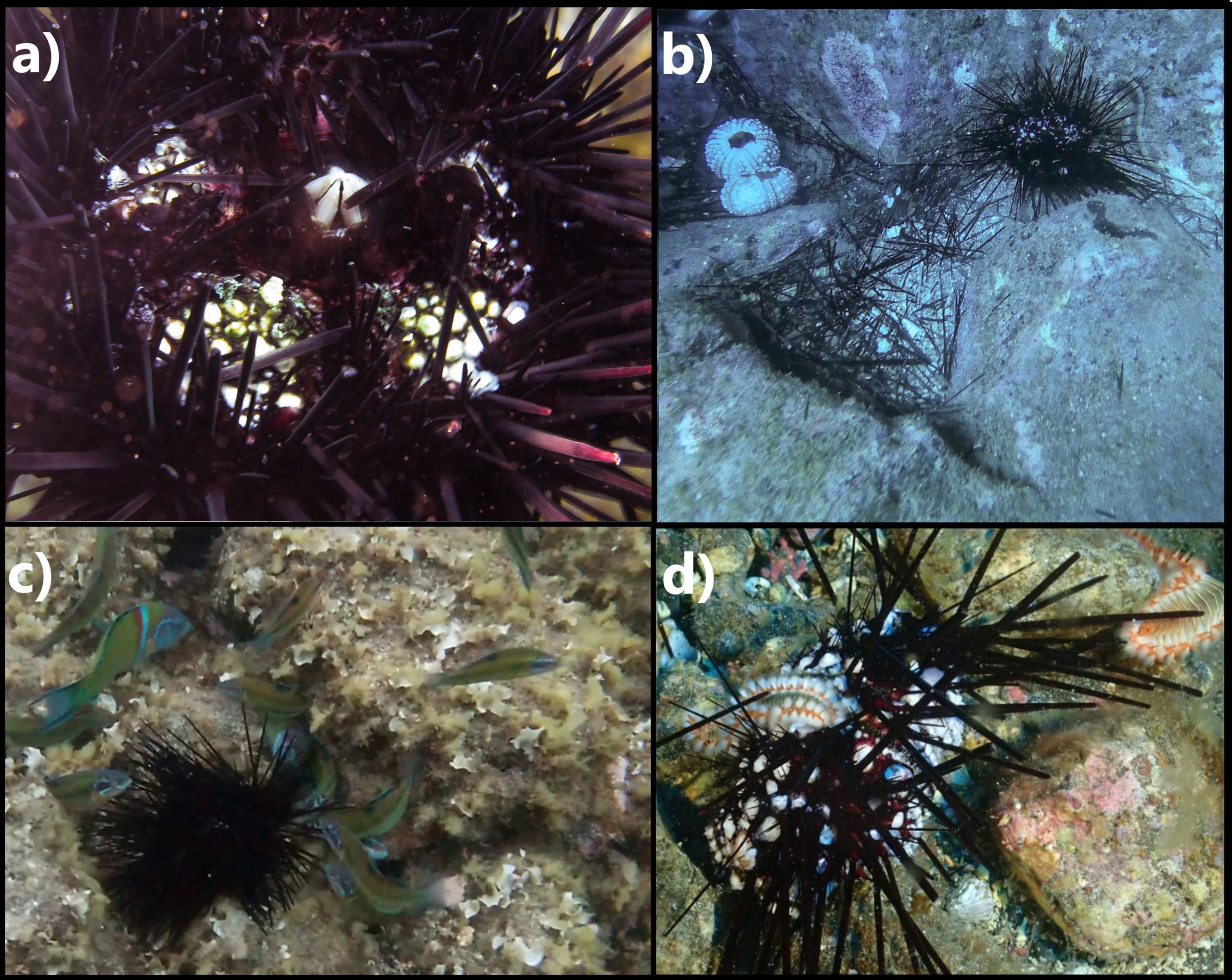
But the 2022 outbreak was different: while many affected populations had recovered – sometimes surprisingly fast – after the 2008 event, this didn’t seem to happen in 2022. Rather, a second wave of mass mortality struck the Canary Islands over the course of 2023.
To assess the impact of the die-off, Cano et al. surveyed D. africanum numbers at 76 sites across the archipelago’s seven main islands between the summer of 2022 and the summer of 2025, comparing these to historical data. The authors also invited professional divers to give information on their relative abundance at their usual dive sites in 2023 and between 2018 and 2021. They then used traps to collect dispersing larvae at four sites off eastern Tenerife in September 2023, the annual peak of the spawning season. Finally, they quantified the number of newly settled juveniles at the same sites in January 2024.
“Our analyses showed that the current abundance of D. africanum across the Canary Islands is at an all-time low, with several populations nearing local extinction,” said Cano.
“Moreover, the 2022-2023 mass mortality event affected the entire population of the species across the archipelago. For example, since 2021, there has been a 74% decrease in La Palma and a 99.7 % decrease in Tenerife.”
Prickly issue
The authors also concluded that since the 2022-2023 event, effective reproduction of D. africanum has mostly ceased on the eastern coast of Tenerife: only negligible numbers of larvae were caught in the traps, and no early juveniles were observed in any of the shallow rocky habitats surveyed.
“Reports from elsewhere suggest that the 2022-2023 die-off in the Canary Islands was another step in a broader marine pandemic, with serious consequences for these key reef grazers,” concluded Cano.
“We don’t yet know for certain which pathogen is causing these die-offs. Mass mortality events of Diadema elsewhere in the world have been linked to scuticociliate ciliates in the genus Philaster, a kind of single-celled parasitic organisms,” said Cano.
“Previous die-offs in the Canary Islands were associated with amoebae such as Neoparamoeba branchiphila and followed episodes of strong southern swells and unusual wave activity, similar to what we saw again in 2022. Without a confirmed identification, we cannot say whether the agent arrived from the Caribbean by currents or shipping, or whether climate change is to blame.”
“We aren’t yet sure how this pandemic will evolve. So far, it seems to have not spared to other Diadema populations in Southeast Asia and Australia, which is good news – but we cannot rule out the possibility that the disease will reappear and potentially spread further.”
Reference: “Insights on the last sea urchin Diadema africanum mass mortality suggest a worldwide Diadematid pandemic in 2022-2023” by Iván Cano, Jacob Lorenzo-Morales, Omri Bronstein, Carlos Sangil and José Carlos Hernández, 17 October 2025, Frontiers in Marine Science.
DOI: 10.3389/fmars.2025.1665504
Never miss a breakthrough: Join the SciTechDaily newsletter.
Follow us on Google and Google News.
1 Comment
“Without a confirmed identification, we cannot say whether the agent arrived from the Caribbean by currents or shipping, or whether climate change is to blame.”
Have you ruled out the possibility that over-abundance of the urchins have made them vulnerable to epidemics because of increased transmissibility? Or a lack of food has lowered their resistance to infection? Why mention “climate change” as a possible agent without mentioning any of the other possible agents? In the spirit of T. C. Chamberlain’s “Method of Multiple Working Hypotheses,” one should initially consider all possible hypotheses before settling on one or two to be tested in more detail.