
Close Menu
    Facebook X (Twitter) Instagram
    SciTechDaily
    • Biology
    • Chemistry
    • Earth
    • Health
    • Physics
    • Science
    • Space
    • Technology
    Facebook X (Twitter) Pinterest YouTube RSS
    SciTechDaily
    Home»Space»The Search for Variable Stars in Globular Cluster M4
    Space

    The Search for Variable Stars in Globular Cluster M4

    By Harvard-Smithsonian Center for AstrophysicsJuly 25, 2014No Comments3 Mins Read
    Facebook Twitter Pinterest Telegram LinkedIn WhatsApp Email Reddit
    Share
    Facebook Twitter LinkedIn Pinterest Telegram Email Reddit
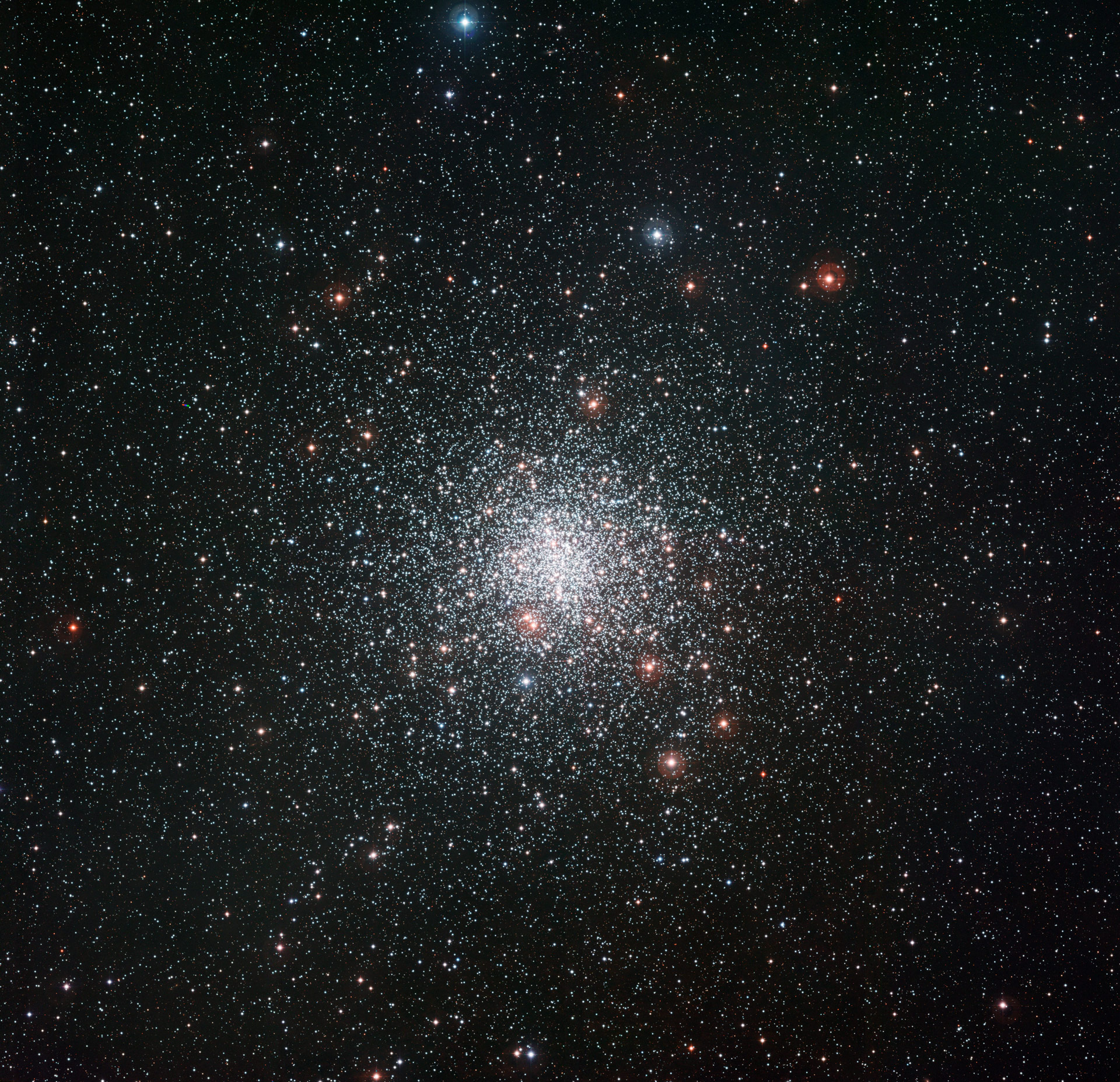
    Binary Stars in the Globular Cluster Messier 4
    An image of the globular cluster Messier 4. New observations of M4 have studied the binary stars in this cluster. Credit: ESO

    In a newly published study, astronomers detail the results of a photometric search for variable stars in the core of the globular cluster M4.

    A globular cluster is a roughly spherical ensemble of stars, as many as several million of them, gravitationally bound together in groups whose diameters can be as small as only tens of light-years. To sense the dramatic implications of this dense packing, consider that the nearest star to the Sun, Proxima Centauri, is about four light-years away. Messier 4 (M4) is the closest globular cluster to Earth at a distance of about six thousand light-years, and a puzzle to astronomers. Normal gravitational effects should, over time, redistribute the stars in a globular cluster until they are more numerous towards the center, but while M4 shows a central concentration of stars it does not show evidence for a steep central cusp even though astronomers think enough time has passed.

    To understand what is going on in this globular cluster, and to help understand how these clusters evolve in general, CfA astronomer Maureen van den Berg and her collaborators have undertaken a large and unprecedented set of deep images of M4 with the Hubble Space Telescope to look for binary stars, that is stars with companions. The dynamical interactions between the densely crowded stars in a globular cluster should disrupt many such binaries, but for reasons that are not understood about fifteen percent of the stars in M4 are binaries, at least based on monitoring brightness variations (a more typical number is two percent). Whether or not this unusual abundance is connected to the lack of a central cusp in stellar density is also not understood.

    The astronomers set out to use Hubble to study the binary star population in M4 looking at both brightness variations and stellar wobble (astrometric) variations, in particular due to binaries with a massive, faint, and evolved companion like a white dwarf or neutron star. The team was able to find and characterize a much more complete set of binaries, including thirty-six new variables. They note in passing that, as part of the search process, any stars with massive “hot Jupiter” exoplanet companions would probably also have been detected, but none were. The extensive results are still being analyzed, but the improved statistics will make the conclusions much more reliable.

    Reference: “The M 4 Core Project with HST – III. Search for variable stars in the primary field” by V.Nascimbeni, L. R. Bedin, D. C. Heggie, M. van den Berg, M. Giersz, G. Piotto, K. Brogaard, A. Bellini, A. P. Milone, R. M. Rich, D. Pooley, J. Anderson, L. Ubeda, S. Ortolani, L. Malavolta, A. Cunial and A. Pietrinferni, 20 June 2014, MNRAS
    DOI: 10.1093/mnras/stu930
    arXiv: 1405.1626

    Never miss a breakthrough: Join the SciTechDaily newsletter.
    Follow us on Google and Google News.

    Astronomy Astrophysics Harvard-Smithsonian Center for Astrophysics
    Share. Facebook Twitter Pinterest LinkedIn Email Reddit

    Related Articles

    X-Ray Emission From Mysterious Dark Matter

    Analyzing Dust Storm Sequences on Mars

    Intriguing Remains of a Rare Stellar Explosion Discovered in Milky Way Center

    Puzzling Astrophysics of Quasars in the Early Universe

    Four Exoplanets – Including a Super-Earth Planet – Discovered by High School Students

    Massive Rotating Stars in the Pleiades Cluster

    Astronomers Discover First Cloudless, Jupiter-Like Planet – “Smoking Gun Evidence”

    Chandra X-ray Observatory Studies Extraordinary Magnetar [Video]

    Chandra Studies Extraordinary Magnetar: Fastest Spinning and Possibly the Youngest Magnetar Known

    Leave A Reply Cancel Reply

    • Facebook
    • Twitter
    • Pinterest
    • YouTube

    Don't Miss a Discovery

    Subscribe for the Latest in Science & Tech!

    Trending News

    Scientists Discover Mysterious Creature Living in the Great Salt Lake – and It Exists Nowhere Else on Earth

    It’s Alive? Surprising Discovery Changes What We Know About Fog

    A Tiny Bright-Blue Octopus Found in the Galápagos Is Completely New to Science

    Scientists Discover Surprising Anti-Aging Power Hidden in Aged Garlic

    Why More People in Their 30s Are Suddenly Getting Colon Cancer

    Scientists Discover Sperm Seem To Bypass a Fundamental Law of Physics

    Archaeologists Discover Mysterious Artificial Island Older Than Stonehenge in Scotland

    Massive Study Warns Marijuana Use in Teens Is Linked to Serious Mental Illness

    Follow SciTechDaily
    • Facebook
    • Twitter
    • YouTube
    • Pinterest
    • Newsletter
    • RSS
    SciTech News
    • Biology News
    • Chemistry News
    • Earth News
    • Health News
    • Physics News
    • Science News
    • Space News
    • Technology News
    Recent Posts
    • Stress Can Literally Make You Lose Your Direction, According to New MRI Evidence
    • Scientists Uncover a Hidden Alzheimer’s Target and Create the First Tool To Control It
    • Scientists May Have Found a Completely New Way To Treat Depression
    • Scientists Discover Surprising Similarities Between Freud’s Ideas and Modern Neuroscience
    • New 7-Dimensional Theory May Finally Solve the Black Hole Information Paradox
    Copyright © 1998 - 2026 SciTechDaily. All Rights Reserved.
    • Science News
    • About
    • Contact
    • Editorial Board
    • Privacy Policy
    • Terms of Use

    Type above and press Enter to search. Press Esc to cancel.