
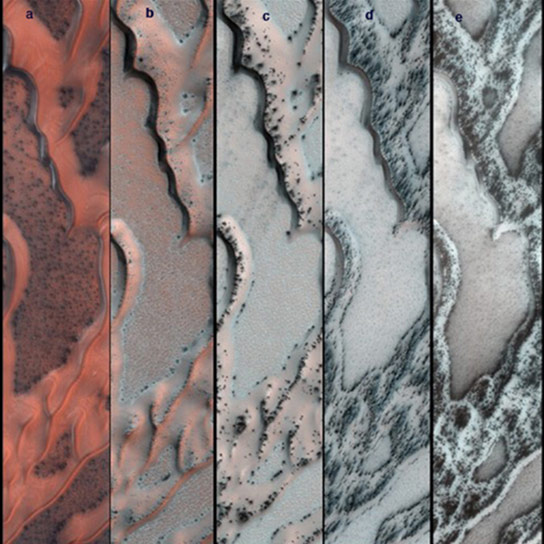
A new video from NASA’s Mars Reconnaissance Orbiter shows the springtime thaw of seasonal carbon dioxide ice on Mars that allows dust and gas to escape and reshapes the surface of the dunes.
Researchers using NASA’s Mars Reconnaissance Orbiter see seasonal changes on far-northern Martian sand dunes caused by warming of a winter blanket of frozen carbon dioxide.
Earth has no naturally frozen carbon dioxide, though pieces of manufactured carbon-dioxide ice, called “dry ice,” sublime directly from solid to gas on Earth, just as the vast blankets of dry ice do on Mars. A driving factor in the springtime changes where seasonal coverings of dry ice form on Mars is that thawing occurs at the underside of the ice sheet, where it is in contact with dark ground being warmed by early-spring sunshine through translucent ice. The trapped gas builds up pressure and breaks out in various ways.
Transient grooves form on dunes when gas trapped under the ice blanket finds an escape point and whooshes out, carrying out sand with it. The expelled sand forms dark fans or streaks on top of the ice layer at first, but this evidence disappears with the seasonal ice, and summer winds erase most of the grooves in the dunes before the next winter. The grooves are smaller features than the gullies that earlier research linked to carbon dioxide sublimation on steeper dune slopes.
Similar activity has been documented and explained previously where seasonal sheets of frozen carbon dioxide form and thaw near Mars’ south pole. Details of the different northern seasonal changes are newly reported in a set of three papers for the journal Icarus.
Mars Reconnaissance Orbiter captures the springtime thaw of seasonal carbon dioxide ice on Mars. Credit: NASA/JPL-Caltech
The findings reinforce growing appreciation that Mars today, however different from its former self, is still a dynamic world, and however similar to Earth in some respects, displays some quite unearthly processes.
“It’s an amazingly dynamic process,” said Candice Hansen of the Planetary Science Institute, Tucson. She is lead author of the first of the three new reports. “We had this old paradigm that all the action on Mars was billions of years ago. Thanks to the ability to monitor changes with the Mars Reconnaissance Orbiter, one of the new paradigms is that Mars has many active processes today.”
With three Martian years (six Earth years) of data in hand from the Mars Reconnaissance Orbiter’s High Resolution Imaging Science Experiment (HiRISE) camera, the researchers report on the sequence and variety of seasonal changes. The spring changes include outbursts of gas-carrying sand, polygonal cracking of the winter ice blanketing the dunes, sandfalls down the faces of the dunes, and dark fans of sand propelled out onto the ice.
“It is a challenge to catch when and how those changes happen, they are so fast,” said Ganna Portyankina of the University of Bern in Switzerland, lead author of the second report. “That’s why only now we start to see the bigger picture that both hemispheres actually tell us similar stories.”
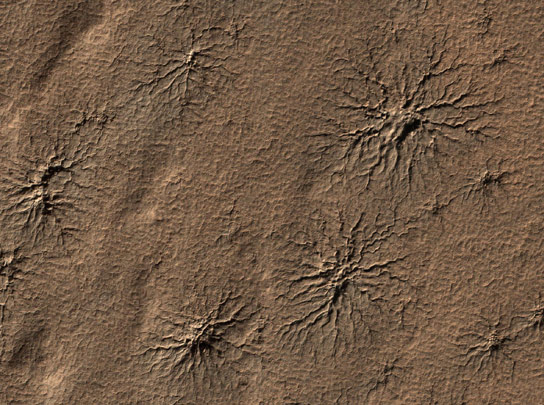
The process of outrushing gas that carves grooves into the northern dunes resembles the process creating spider-shaped features in far southern Mars, as seen in an image below, but the spiders have not been seen in the north. The seasonal dry-ice sheets overlie different types of terrain in the two hemispheres. In the south, diverse terrains include the flat, erodible ground where the spiders form, but in the north, a broad band of sand dunes encircles the permanent north polar ice cap.
Another difference is in brightening on parts of the ice-covered dunes. This brightening in the north results from the presence of water-ice frost, while in the south, similar brightening is caused by fresh carbon dioxide. The third paper of the Icarus set, by Antoine Pommerol of the University of Bern and co-authors, reports distribution of the water frost using the Compact Reconnaissance Imaging Spectrometer for Mars (CRISM). The light water frost is blown around by spring winds.
The University of Arizona, Tucson, operates the HiRISE camera, which was built by Ball Aerospace & Technologies Corp., Boulder, Colorado. The Johns Hopkins University Applied Physics Laboratory, Laurel, Maryland, provided and operates CRISM. NASA’s Jet Propulsion Laboratory, a division of the California Institute of Technology in Pasadena, manages the Mars Reconnaissance Orbiter for NASA’s Science Mission Directorate in Washington. Lockheed Martin Space Systems, Denver, built the orbiter.
Never miss a breakthrough: Join the SciTechDaily newsletter.
Follow us on Google and Google News.
1 Comment
Pretty sure the surface of Mars is like freeze dried coffee. Crusty and crumbly. It would sponge up water like, well a sponge. Any ice would be like the ice crystals in your old freezer. Nasty and dry. Don’t know why you would want to go there. Just saying…..