
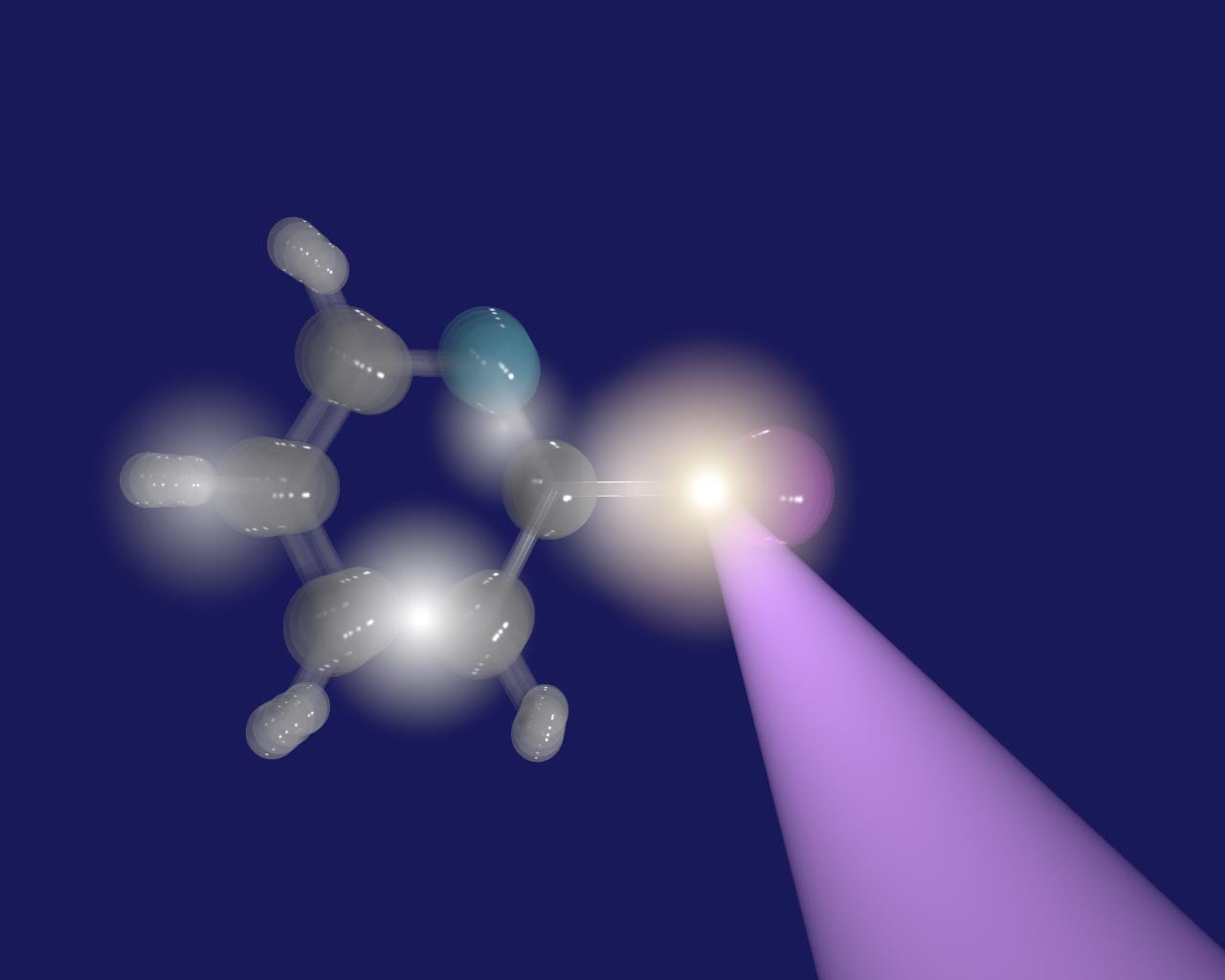
Using the world’s most powerful X-ray laser, scientists have filmed atoms performing an eternal quantum dance that never stops — even at absolute zero. This first-ever direct view of zero-point motion reveals that molecules vibrate in beautifully ordered, synchronized patterns instead of random motion.
Most people struggle to make sense of the quantum realm: According to Heisenberg’s uncertainty principle, observing it is like watching a dancer while being allowed to see either their position or their speed, but never both at the same time. Even so, this quantum “dance” is not random. The movements follow strict, well defined patterns.
Within molecules, this unusual behavior has a surprising effect. Even at absolute zero, a temperature at which all motion should vanish, a molecule never becomes completely still. Its atoms continue a faint, continuous motion driven by what scientists call zero-point energy.
Breakthrough in Measuring Zero-Point Motion
For decades, researchers believed these subtle zero-point movements could never be tracked directly. That assumption has now changed. A team at Goethe University Frankfurt and collaborating institutions succeeded in observing them at the European XFEL in Hamburg, Germany, the world’s most powerful X-ray laser. By illuminating individual molecules and recording rapid-fire snapshots of their atoms, the team revealed each atom’s detailed pattern of movement.
Professor Till Jahnke of the Institute for Nuclear Physics at Goethe University Frankfurt and the Max Planck Institute for Nuclear Physics in Heidelberg explains: “The exciting thing about our work is that we were able to see that the atoms don’t just vibrate individually, but that they vibrate in a coupled manner, following fixed patterns. We directly measured this behavior for the first time in individual medium-sized molecules that were also in their lowest energy state. This zero-point motion is a purely quantum mechanical phenomenon that cannot be explained classically.”
Physicists describe these patterns as vibrational modes. Simple molecules containing only a few atoms are relatively easy to characterize, but the situation becomes much more complicated as molecules grow larger. The team examined iodopyridine, which contains eleven atoms and displays 27 different vibrational modes that range across an entire spectrum of motion.
Years of Data Lead to a Breakthrough
“This experiment has a long history,” says Jahnke. “We originally collected the data in 2019 during a measurement campaign led by Rebecca Boll at the European XFEL, which had an entirely different goal. It wasn’t until two years later that we realized we were actually seeing signs of zero-point motion. The breakthrough came through collaboration with our colleagues from theoretical physics from the Center for Free-Electron Laser Science in Hamburg. Benoît Richard and Ludger Inhester, in particular, came up with new analysis methods that elevated our data interpretation to an entirely new level. Looking back, many puzzle pieces had to come together perfectly.”
Imaging Molecules Through Controlled Explosion
Capturing motion on this scale requires an unconventional technique. In Coulomb Explosion Imaging, ultrashort, intense X-ray laser pulses cause molecules to undergo a controlled breakup. The pulse removes many electrons from the molecule, leaving the atoms positively charged. Those atoms rapidly repel each other and fly apart in less than a trillionth of a second. Specialized detectors record the time and location at which the fragments arrive, allowing scientists to reconstruct the molecule’s original structure.
This approach is made possible by the COLTRIMS reaction microscope, a tool refined over several decades by the Atomic Physics group at Goethe University. A custom version designed for the European XFEL was built by Dr. Gregor Kastirke during his PhD research. Kastirke reflects on the achievement: “Witnessing such groundbreaking results makes me feel a little proud. After all, they only come about through years of preparation and close teamwork.”
A New Window Into Quantum Behavior
The team’s findings open a new path toward understanding quantum processes. For the first time, complex zero-point motion patterns in larger molecules can be viewed directly rather than inferred. The success also highlights the capabilities of the COLTRIMS reaction microscope.
“We’re constantly improving our method and are already planning the next experiments,” says Jahnke. “Our goal is to go beyond the dance of atoms and observe in addition the dance of electrons – a choreography that is significantly faster and also influenced by atomic motion. With our apparatus, we can gradually create real short films of molecular processes – something that was once unimaginable.”
Reference: “Imaging collective quantum fluctuations of the structure of a complex molecule” by Benoît Richard, Rebecca Boll, Sourav Banerjee, Julia M. Schäfer, Zoltan Jurek, Gregor Kastirke, Kilian Fehre, Markus S. Schöffler, Nils Anders, Thomas M. Baumann, Sebastian Eckart, Benjamin Erk, Alberto De Fanis, Reinhard Dörner, Sven Grundmann, Patrik Grychtol, Max Hofmann, Markus Ilchen, Max Kircher, Katharina Kubicek, Maksim Kunitski, Xiang Li, Tommaso Mazza, Severin Meister, Niklas Melzer, Jacobo Montano, Valerija Music, Yevheniy Ovcharenko, Christopher Passow, Andreas Pier, Nils Rennhack, Jonas Rist, Daniel E. Rivas, Daniel Rolles, Ilme Schlichting, Lothar Ph. H. Schmidt, Philipp Schmidt, Daniel Trabert, Florian Trinter, Rene Wagner, Peter Walter, Pawel Ziolkowski, Artem Rudenko, Michael Meyer, Robin Santra, Ludger Inhester and Till Jahnke, 7 August 2025, Science.
DOI: 10.1126/science.adu2637
Never miss a breakthrough: Join the SciTechDaily newsletter.
Follow us on Google and Google News.
5 Comments
The article appears to confirm and describe the radiant coherent pulsing angular lines of gravity force I first observed in 2009 and have been demonstrating and commenting on in online videos since 2012, with my latest low-budget video uploaded just last June: https://odysee.com/@charlesgshaver:d/5Gravity:c If so, then it also seems to confirm my original finding that it was the pulsing angular lines of gravity force, not a duality of particles and waves, that caused the scattered dot patterns in the early double-slit experiments and ever since. Perhaps now it will be possible for scientists to better understand the unstable nature of so-called “quantum devices?”
The team’s findings open a new path toward understanding quantum processes. For the first time, complex zero-point motion patterns in larger molecules can be viewed directly rather than inferred.
VERY GOOD!
Please ask researchers to think deeply:
1. How can you be sure that your zero-point motion can ignore Heisenberg’s uncertainty principle?
2. How do you understand quantum?
The mathematical formalism of quantum mechanics is highly successful, yet its physical interpretation has long been shrouded in mystification, leading to a series of philosophical dilemmas detached from physical reality. Quantum mechanics is an effective mathematical tool for describing the behavior of low-dimensional spacetime matter, but its mystified interpretation has severely hindered the progress of physics.
Topological Vortex Theory (TVT), through a set of concise yet profound mathematical formulas, provides a promising theoretical framework for unifying spacetime, gravity [1], and quantum phenomena. Its mathematical skeleton not only demonstrates the powerful role of topological methods [4, 6, 8] in fundamental physics but also opens new paths for understanding the fundamental laws of the universe. Although TVT is still under development, its core idea—that the nature of the physical world is topological—has shown unique insight and explanatory potential. With the refinement of mathematical tools and deeper physical applications, TVT is expected to make substantive contributions to solving quantum gravity [5] puzzles and exploring the origin of matter.
When we pursue the ultimate truth of all things, the space in which our bodies and all things exist may itself be the final and deepest puzzle we need to explore. This is not only the pursuit of physics, but also the most magnificent exploration of the origin of the universe by human reason.
Based on the Topological Vortex Theory (TVT), space is an uniformly incompressible physical entity. Space-time vortices are the products of topological phase transitions of the tipping points in space, are the point defects in spacetime. Point defects do not only impact the thermodynamic properties, but are also central to kinetic processes. They create all things and shape the world through spin and self-organization.
In today’s physics, some so-called peer-reviewed journals—including Physical Review Letters, Nature, Science, and others—stubbornly insist on and promote the following:
1. Even though θ and τ particles exhibit differences in experiments, physics can claim they are the same particle. This is science.
2. Even though topological vortices and antivortices have identical structures and opposite rotational directions, physics can define their structures and directions as entirely different. This is science.
3. Even though two sets of cobalt-60 rotate in opposite directions and experiments reveal asymmetry, physics can still define them as mirror images of each other. This is science.
4. Even though vortex structures are ubiquitous—from cosmic accretion disks to particle spins—physics must insist that vortex structures do not exist and require verification. Only the particles that like God, Demonic, or Angelic are the most fundamental structures of the universe. This is science.
5. Even though everything occupies space and maintains its existence in time, physics must still debate and insist on whether space exists and whether time is a figment of the human mind. This is science.
6. Even though space, with its non-stick, incompressible, and isotropic characteristics, provides a solid foundation for the development of physics, physics must still insist that the ideal fluid properties of space do not exist. This is science.
and go on.
Is this the counterintuitive science they widely promote? Compromising with pseudo academic publications and peer review by pseudo scholars is an insult to science and public intelligence. Some so-called scholars no longer understand what shame is. The study of Topological Vortex Theory (TVT) reminds us that the most profound problems in physics often lie at the intersection of different theories. By exploring these border regions, we can not only resolve contradictions in existing theories but also discover new physical phenomena and application possibilities.
Under the topological vortex architecture, it is highly challenging for even two hydrogen atoms or two quarks to be perfectly symmetrical, let alone counter-rotating two sets of cobalt-60. Contemporary physics and so-called peer-reviewed publications (including Physical Review Letters, Science, Nature, etc.) stubbornly believe that two sets of counter rotating cobalt-60 are two mirror images of each other, constructing a more shocking pseudoscientific theoretical framework in the history of science than the “geocentric model”. This pseudo scientific framework and system have seriously hindered scientific progress and social development.
For nearly a century, physics has been manipulated by this pseudo scientific theoretical system and the interest groups behind it, wasting a lot of manpower, funds, and time. A large amount of pseudo scientific research has been conducted, and countless pseudo scientific papers have been published, causing serious negative impacts on scientific and social progress, as well as humanistic development.
Complexity does not necessarily mean that there is no logical and architectural framework to follow. Mathematics is the language and tool that reveals the motion of spacetime, rather than the motion itself. Although the physical form of spacetime vortices is extremely simple, their interaction patterns are highly complex, and we must develop more and richer mathematical languages to describe and understand them.
The development of the Topological Vortex Theory (TVT) reflects a progression from concrete physical phenomena to abstract mathematical modeling and, ultimately, to interdisciplinary unification. Its core innovation lies in forging the continuous spacetime geometry of general relativity with the discrete interactions of quantum field theory within the same topological dynamical system.
——Excerpted from https://scitechdaily.com/microscope-spacecrafts-most-precise-test-of-key-component-of-the-theory-of-general-relativity/#comment-909171.