

University of Arizona researchers have developed an ‘attomicroscopy’ technique using a novel ultrafast electron microscope that captures moving electrons in unprecedented detail, paving the way for significant scientific breakthroughs in physics and other fields.
Imagine having a camera so advanced that it can capture freeze-frame images of a moving electron—an object so fast it could orbit the Earth multiple times in just a second. Researchers at the University of Arizona have developed the world’s fastest electron microscope capable of this remarkable feat.
They believe their work will lead to groundbreaking advancements in physics, chemistry, bioengineering, materials sciences, and more.
“When you get the latest version of a smartphone, it comes with a better camera,” said Mohammed Hassan, associate professor of physics and optical sciences. “This transmission electron microscope is like a very powerful camera in the latest version of smartphones; it allows us to take pictures of things we were not able to see before – like electrons. With this microscope, we hope the scientific community can understand the quantum physics behind how an electron behaves and how an electron moves.”
Hassan led a team of researchers in the departments of physics and optical sciences that published the research in the Science Advances journal.
The Functionality of Transmission Electron Microscopes
A transmission electron microscope is a tool used by scientists and researchers to magnify objects up to millions of times their actual size in order to see details too small for a traditional light microscope to detect. Instead of using visible light, a transmission electron microscope directs beams of electrons through whatever sample is being studied. The interaction between the electrons and the sample is captured by lenses and detected by a camera sensor in order to generate detailed images of the sample.
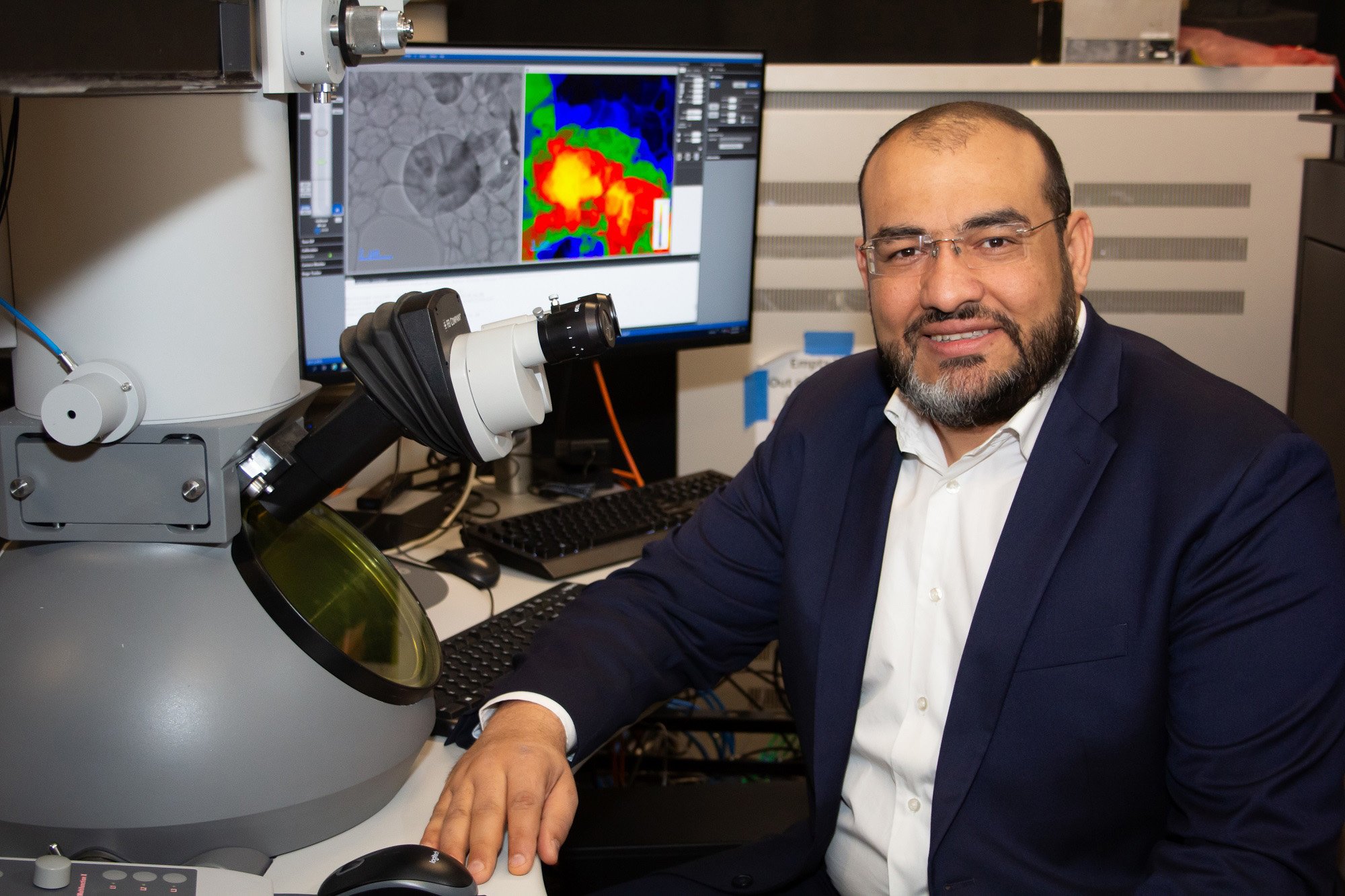
Ultrafast electron microscopes using these principles were first developed in the 2000s and use a laser to generate pulsed beams of electrons. This technique greatly increases a microscope’s temporal resolution – its ability to measure and observe changes in a sample over time. In these ultrafast microscopes, instead of relying on the speed of a camera’s shutter to dictate image quality, the resolution of a transmission electron microscope is determined by the duration of electron pulses.
The faster the pulse, the better the image.
Ultrafast electron microscopes previously operated by emitting a train of electron pulses at speeds of a few attoseconds. An attosecond is one quintillionth of a second. Pulses at these speeds create a series of images, like frames in a movie – but scientists were still missing the reactions and changes in an electron that takes place in between those frames as it evolves in real-time. In order to see an electron frozen in place, U of A researchers, for the first time, generated a single attosecond electron pulse, which is as fast as electrons moves, thereby enhancing the microscope’s temporal resolution, like a high-speed camera capturing movements that would otherwise be invisible.
Future Implications and Research
Hassan and his colleagues based their work on the Nobel Prize-winning accomplishments of Pierre Agostini, Ferenc Krausz, and Anne L’Huilliere, who won the Novel Prize in Physics in 2023 after generating the first extreme ultraviolet radiation pulse so short it could be measured in attoseconds.
Using that work as a stepping stone, U of A researchers developed a microscope in which a powerful laser is split and converted into two parts – a very fast electron pulse and two ultra-short light pulses. The first light pulse, known as the pump pulse, feeds energy into a sample and causes electrons to move or undergo other rapid changes. The second light pulse, also called the “optical gating pulse” acts like a gate by creating a brief window of time in which the gated, single attosecond electron pulse is generated. The speed of the gating pulse therefore dictates the resolution of the image. By carefully synchronizing the two pulses, researchers control when the electron pulses probe the sample to observe ultrafast processes at the atomic level.
“The improvement of the temporal resolution inside of electron microscopes has been long anticipated and the focus of many research groups – because we all want to see the electron motion,” Hassan said. “These movements happen in attoseconds. But now, for the first time, we are able to attain attosecond temporal resolution with our electron transmission microscope – and we coined it ‘attomicroscopy.’ For the first time, we can see pieces of the electron in motion.”
Reference: “Attosecond electron microscopy and diffraction” by Dandan Hui, Husain Alqattan, Mohamed Sennary, Nikolay V. Golubev and Mohammed Th. Hassan, 21 August 2024, Science Advances.
DOI: 10.1126/sciadv.adp5805
The study was funded by the Gordon and Betty Moore Foundation and the Air Force Office of Scientific Research.
Hassan worked alongside Nikolay Golubev, assistant professor of physics; Dandan Hui, co-lead author and former research associate in optics and physics who now works at the Xi’an Institute of Optics and Precision Mechanics, Chinese Academy of Sciences; Husain Alqattan, co-lead author, U of A alumnus and assistant professor of physics at Kuwait University; and Mohamed Sennary, a graduate student studying optics and physics.
Never miss a breakthrough: Join the SciTechDaily newsletter.
Follow us on Google and Google News.
5 Comments
You write:
“Imagine having a camera so advanced that it can capture freeze-frame images of a moving electron—an object so fast it could orbit the Earth multiple times in just a second.”
Your speed calculation is incorrect. It would take an electron about 5.78 seconds to orbit the Earth once around the equator. The Earth is 12,756 km in diameter and the speed of an electron is 2,200 km/sec.
The electron can be accelerated by an electric potential gradient to close to the speed of light.
World’s Fastest Microscope Freezes Time To Capture Moving Electrons.
VERY GOOD!
Please ask researchers to think deeply:
1. What exactly are you freezing?
2. Do you really understand time?
3. Do you understand the physical meaning of synchronization?
and so on.
Scientific research guided by correct theories can help humanity avoid detours, failures, and pomposity. Please witness the exemplary collaboration between theoretical physicists and experimentalists (https://scitechdaily.com/microscope-spacecrafts-most-precise-test-of-key-component-of-the-theory-of-general-relativity/#comment-854286). Some people in contemporary physics has always lived in a self righteous children’s story world. Whose values have been overturned by such a comical and ridiculous reality?
From Physical Review Letters (PRL), to Nature, and Science, even the Proceedings of the National Academy of Sciences (PNAS), the so-called academic journals firmly believe that two high-dimensional spacetime objects (such as two sets of cobalt-60) rotating in opposite directions can be transformed into two objects that mirror each other, and that the asymmetry between the amount of created matter and antimatter led to the matter-dominated Universe as we know it today.
Does the facts tell the so-called academic journals that two sets of cobalt-60 rotating in opposite directions can be transformed into two objects that mirror each other? Does mathematics tell the so-called academic journals that matter and antimatter are asymmetric?
When physics no longer believes in facts and mathematics, it is no different from theology.
The so-called academic publications (such as Physical Review Letters, Nature, Science, the Proceedings of the National Academy of Sciences, etc.) blatantly humiliate public wisdom, and have degenerated into malignant tumors that hinder scientific development and progress. Isn’t this a shame in today’s academic community?
If the researcher is interested, you can browse https://scitechdaily.com/microscope-spacecrafts-most-precise-test-of-key-component-of-the-theory-of-general-relativity/#comment-775504.
Science must understand natural laws via mathematical rules. Author hope researchers are not fooled by the pseudoscientific theories of the Physical Review Letters (PRL), and hope more people dare to stand up and fight against rampant pseudoscience.
“An attosecond is one quintillionth of a second.”
Really? No thanks for that. A meaningless word “explained” by another meaningless word. God gave us powers of ten for a reason, you know!
Pointless insulting, why are you wasting your & everyone else’s time with that