
Close Menu
    Facebook X (Twitter) Instagram
    SciTechDaily
    • Biology
    • Chemistry
    • Earth
    • Health
    • Physics
    • Science
    • Space
    • Technology
    Facebook X (Twitter) Pinterest YouTube RSS
    SciTechDaily
    Home»Space»Secrets of an Earlier Universe Revealed by Red-Supergiant Supernova
    Space

    Secrets of an Earlier Universe Revealed by Red-Supergiant Supernova

    By University of MinnesotaDecember 12, 2022No Comments5 Mins Read
    Facebook Twitter Pinterest Telegram LinkedIn WhatsApp Email Reddit
    Share
    Facebook Twitter LinkedIn Pinterest Telegram Email Reddit
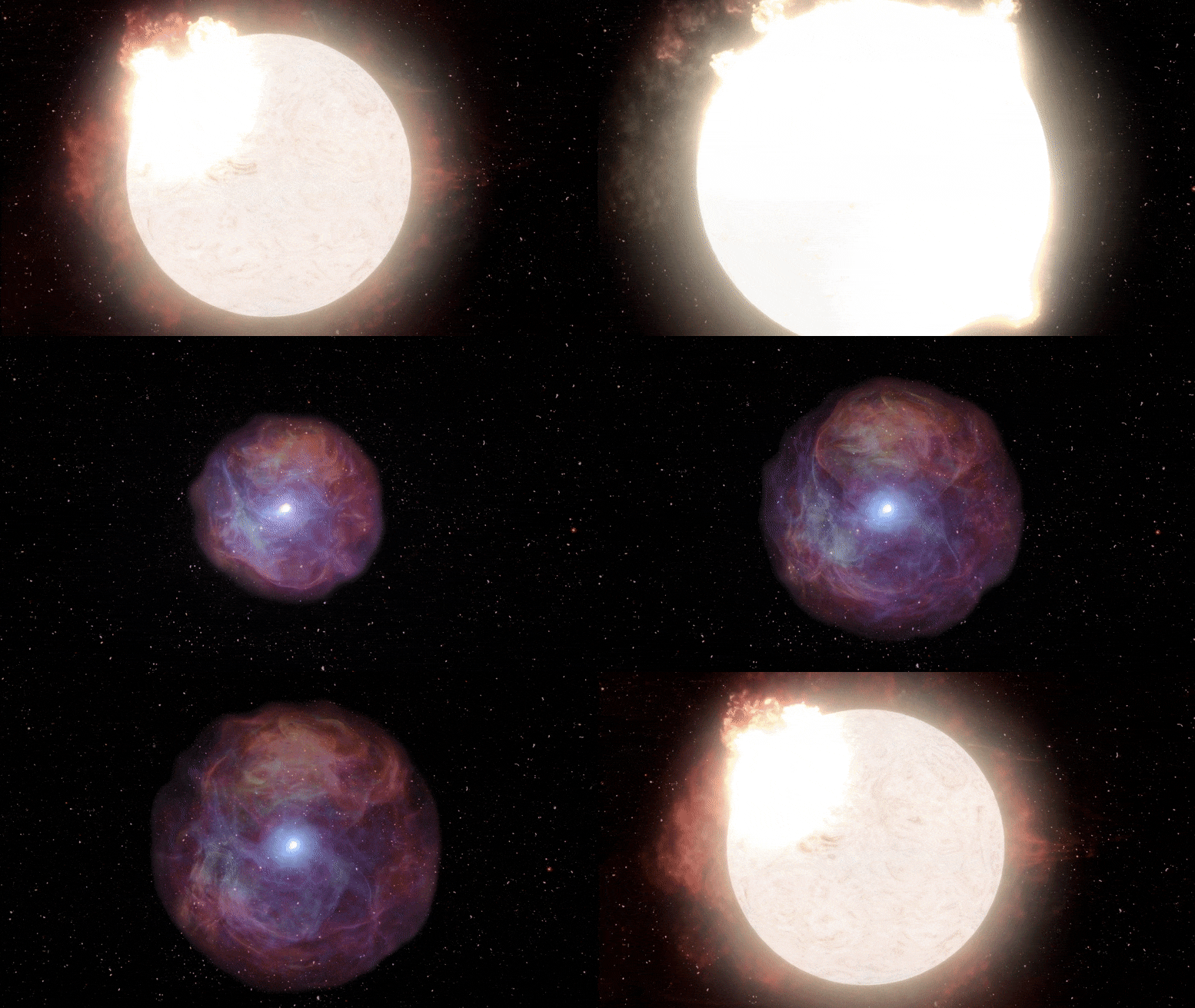
    Red Supergiant Star Goes Supernova
    An artist’s rendition of a red supergiant star transitioning into a Type II supernova, emitting a violent eruption of radiation and gas on its dying breath before collapsing and exploding. Credit: W. M. Keck Observatory/Adam Makarenko

    Detailed telescope images help scientists learn more about the Universe two billion years after the Big Bang.

    An international research team has measured the size of a star dating back 2 billion years after the Big Bang, or more than 11 billion years ago. Detailed images show the exploding star cooling and could help scientists learn more about the stars and galaxies that existed in the early Universe.

    Led by researchers at the University of Minnesota Twin Cities, the study was published recently in Nature, the world’s leading peer-reviewed, multidisciplinary science journal.

    “This is the first detailed look at a supernova at a much earlier epoch of the Universe’s evolution,” said Patrick Kelly, a lead author of the paper and an associate professor in the University of Minnesota School of Physics and Astronomy. “It’s very exciting because we can learn in detail about an individual star when the Universe was less than a fifth of its current age, and begin to understand if the stars that existed many billions of years ago are different from the ones nearby.”

    The red supergiant in question was about 500 times larger than the sun, and it’s located at redshift three, which is about 60 times farther away than any other supernova observed in this detail.
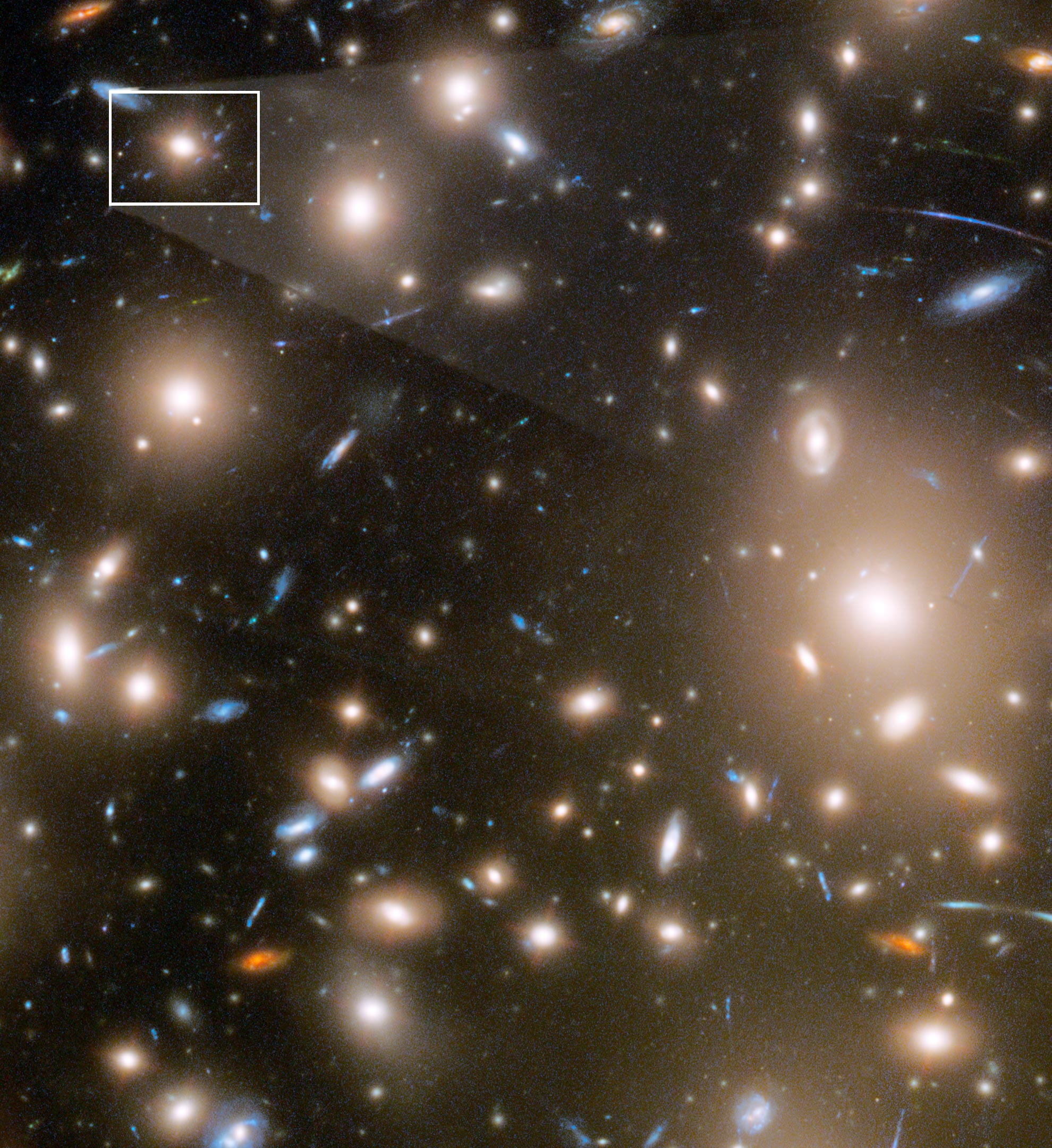
    Supernova Behind Galaxy Cluster Abell 370
    An international research team led by the University of Minnesota Twin Cities has measured the size of a star dating back more than 11 billion years ago using images that show the evolution of the star exploding and cooling. The above image shows the light from the supernova behind the galaxy cluster Abell 370. Credit: Wenlei Chen, NASA

    Using data from the Hubble Space Telescope with follow-up spectroscopy using the University of Minnesota’s access to the Large Binocular Telescope, the researchers were able to identify multiple detailed images of the red supergiant because of a phenomenon called gravitational lensing, where mass, such as that in a galaxy, bends light. This magnifies the light emitted from the star.

    “The gravitational lens acts as a natural magnifying glass and multiplies Hubble’s power by a factor of eight,” Kelly said. “Here, we see three images. Even though they can be seen at the same time, they show the supernova as it was at different ages separated by several days. We see the supernova rapidly cooling, which allows us to basically reconstruct what happened and study how the supernova cooled in its first few days with just one set of images. It enables us to see a rerun of a supernova.”

    The researchers combined this discovery with another one of Kelly’s supernova discoveries from 2014 to estimate how many stars were exploding when the Universe was a small fraction of its current age. They found that there were likely many more supernovae than previously thought.

    Several Different Stages of Supernova
    Panels A-D (clockwise from upper left) show several different stages of the supernova: the location of the host galaxy after the supernova faded, the three images of the host galaxy and the supernova at different phases in its evolution, the three different faces of the evolving supernova, and the different colors of the cooling supernova. Credit: Wenlei Chen, NASA

    “Core-collapse supernovae mark the deaths of massive, short-lived stars. The number of core-collapse supernovae we detect can be used to understand how many massive stars were formed in galaxies when the Universe was much younger,” said Wenlei Chen, first author of the paper and a postdoctoral researcher in the University of Minnesota School of Physics and Astronomy.

    Reference: “Shock cooling of a red-supergiant supernova at redshift 3 in lensed images” by Wenlei Chen, Patrick L. Kelly, Masamune Oguri, Thomas J. Broadhurst, Jose M. Diego, Najmeh Emami, Alexei V. Filippenko, Tommaso L. Treu and Adi Zitrin, 9 November 2022, Nature.
    DOI: 10.1038/s41586-022-05252-5

    The research was funded by the National Science Foundation; the Hubble Space Telescope Cycle 27 Archival Research and Frontier Fields program; the World Premier International Research Center Initiative, MEXT, Japan; the United States-Israel Binational Science Foundation; the Ministry of Science & Technology, Israel; the Christopher R. Redlich Fund; and the University of California, Berkeley Miller Institute for Basic Research in Science.

    In addition to Kelly and Chen, the research team included University of Minnesota School of Physics and Astronomy researcher Najmeh Emami; University of Tokyo researcher Masamune Oguri; University of the Basque Country research professor Thomas Broadhurst; Instituto de Física de Cantabria researcher Jose Diego; University of California, Berkeley professor Alexei Filippenko; University of California, Los Angeles professor Tommaso Treu; and Ben-Gurion University of the Negev associate professor Adi Zitrin.

    Never miss a breakthrough: Join the SciTechDaily newsletter.
    Follow us on Google and Google News.

    Astronomy Astrophysics Hubble Space Telescope Supernova University of Minnesota
    Share. Facebook Twitter Pinterest LinkedIn Email Reddit

    Related Articles

    How Hubble Sees Through Cosmic Dust to Map Galaxies

    Astronomy & Astrophysics 101: Supernova

    Hubble Reveals Surviving Companion Star in Aftermath of Titanic Supernova Explosion

    Supernova Déjà-Vu: Astronomers Spot the Same Stellar Explosion Three Times – And Predict a Fourth Sighting in 16 Years

    Supernova Requiem: Rerun of Massive Blast From Exploding Star Expected To Appear in 2037

    Bizarre, Metallic Star Spotted Hurtling Out of the Milky Way at 2 Million Miles an Hour

    Hubble Views Supernova Remnant SNR 0519

    Hubble Views Supernova That Exploded Over 10 Billion Years Ago

    SN Primo Is Farthest Type Ia Supernova Discovered

    Leave A Reply Cancel Reply

    • Facebook
    • Twitter
    • Pinterest
    • YouTube

    Don't Miss a Discovery

    Subscribe for the Latest in Science & Tech!

    Trending News

    Monster Storms on Jupiter Unleash Lightning Beyond Anything on Earth

    Scientists Create “Liquid Gears” That Spin Without Touching

    The Simple Habit That Could Help Prevent Cancer

    Millions Take These IBS Drugs, But a New Study Finds Serious Risks

    Scientists Unlock Hidden Secrets of 2,300-Year-Old Mummies Using Cutting-Edge CT Scanner

    Bread Might Be Making You Gain Weight Even Without Eating More Calories

    Scientists Discover Massive Magma Reservoir Beneath Tuscany

    Europe’s Most Active Volcano Just Got Stranger – Here’s Why Scientists Are Rethinking It

    Follow SciTechDaily
    • Facebook
    • Twitter
    • YouTube
    • Pinterest
    • Newsletter
    • RSS
    SciTech News
    • Biology News
    • Chemistry News
    • Earth News
    • Health News
    • Physics News
    • Science News
    • Space News
    • Technology News
    Recent Posts
    • Scientists Were Wrong About This Strange “Rule-Breaking” Particle
    • Webb Space Telescope Uncovers Unexpected Ice Clouds on a Jupiter-Like World
    • 289-Million-Year-Old Reptile Mummy Reveals Origin of Human Breathing System
    • New Brain Discovery Challenges Long-Held Theory of Teenage Brain Development
    • Sharks Are Overheating as Warming Oceans Push Them to the Edge
    Copyright © 1998 - 2026 SciTechDaily. All Rights Reserved.
    • Science News
    • About
    • Contact
    • Editorial Board
    • Privacy Policy
    • Terms of Use

    Type above and press Enter to search. Press Esc to cancel.