
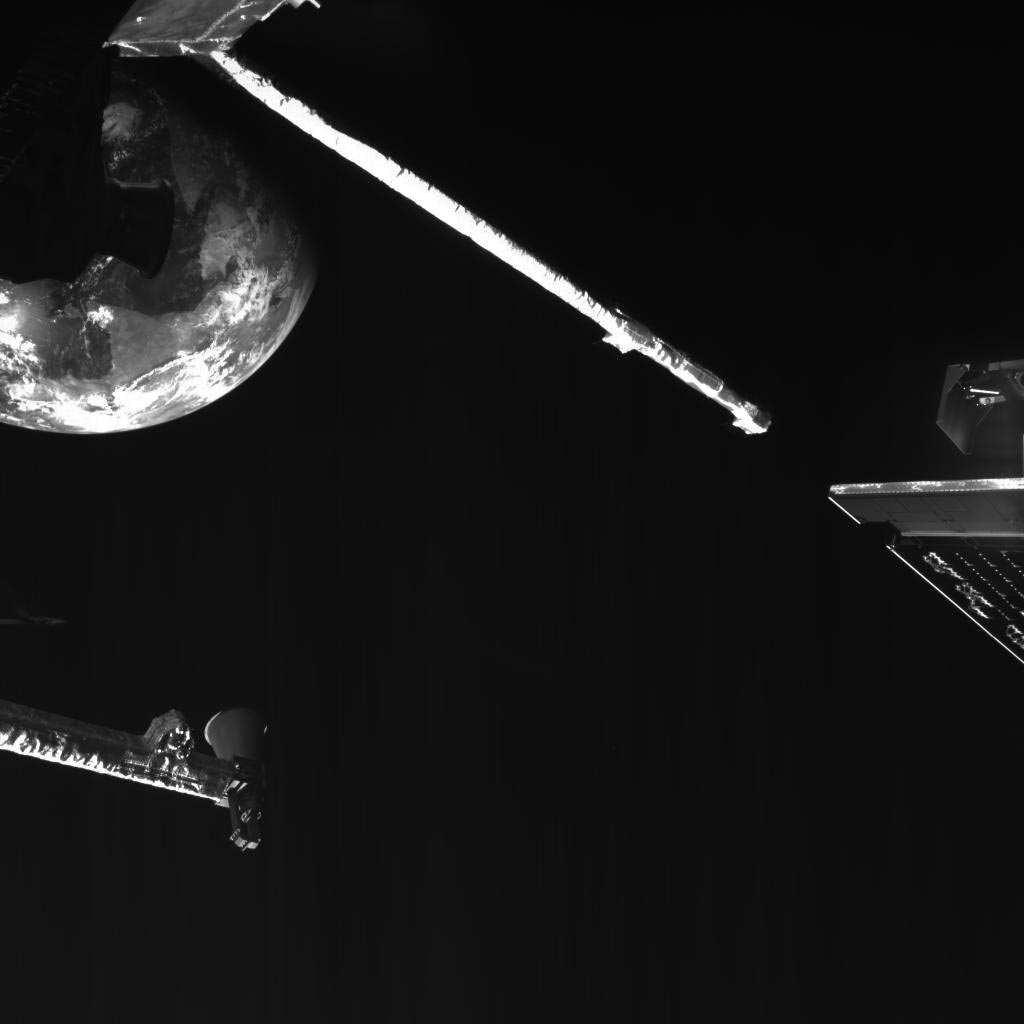
The ESA/JAXA BepiColombo mission completed its first flyby on April 10, as the spacecraft came less than 12,700 km from Earth’s surface at 06:25 CEST, steering its trajectory towards the final destination, Mercury. Images gathered just before closest approach portray our planet shining through darkness, during one of humankind’s most challenging times in recent history.
Launched in 2018, BepiColombo is on a seven-year journey to the smallest and innermost planet orbiting the Sun, which holds important clues about the formation and evolution of the entire Solar System.
Today’s operation is the first of nine flybys which, together with the onboard solar propulsion system, will help the spacecraft reach its target orbit around Mercury. The next two flybys will take place at Venus and further six at Mercury itself
While the maneuver took advantage of Earth’s gravity to adjust the path of the spacecraft and did not require any active operations, such as firing thrusters, it included 34 critical minutes shortly after BepiColombo’s closest approach to our planet, when the spacecraft flew across the shadow of Earth.
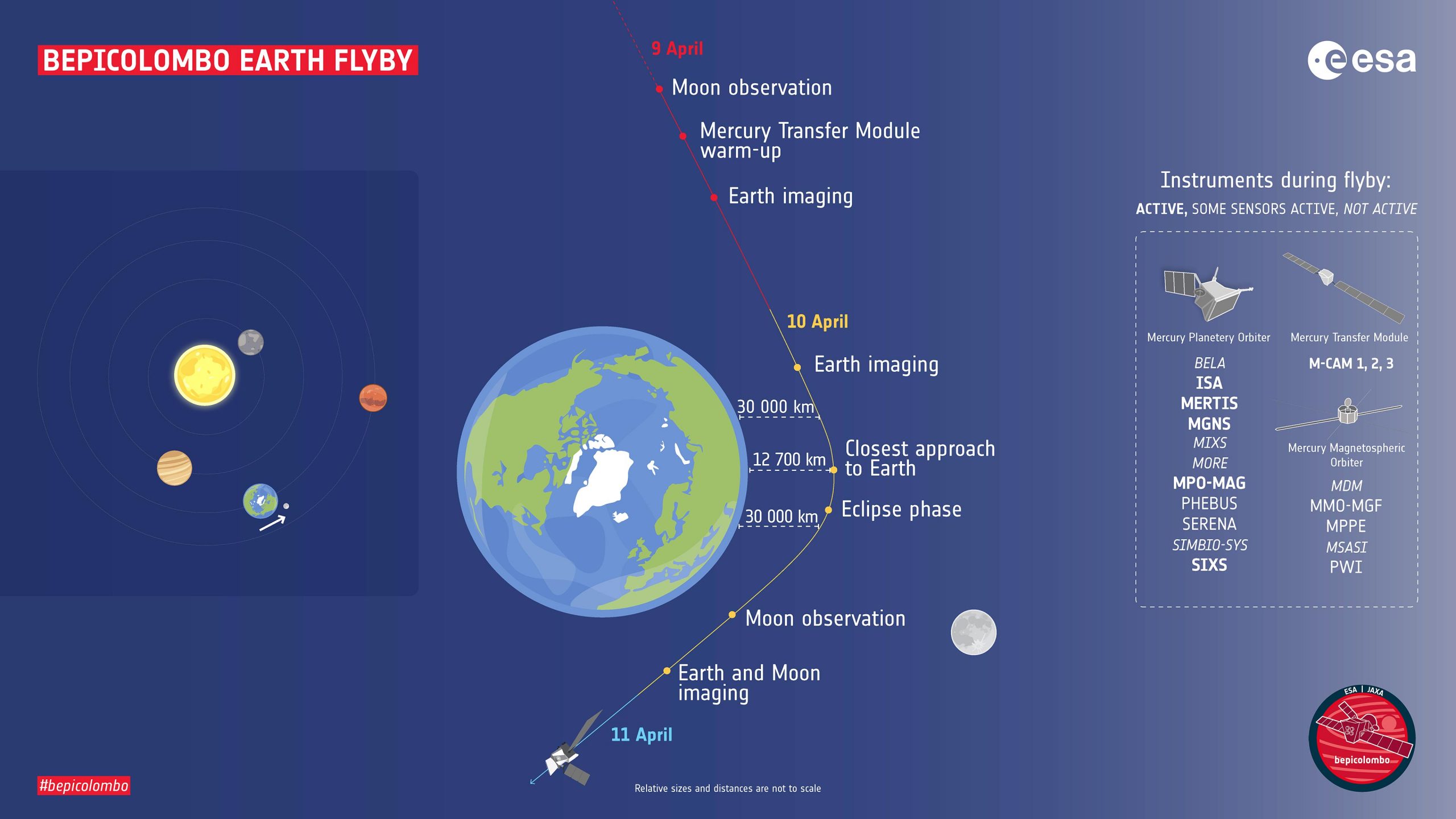
Several instruments and sensors on the two science orbiters that make up the mission – the Mercury Planetary Orbiter (MPO), the Mercury Magnetospheric Orbiter (Mio) – will be switched on during the flyby, as indicated on the right side of the graphic. The data gathered during the flyby include images of the Moon and measurements of Earth’s magnetic field, which will be used to calibrate the instruments.
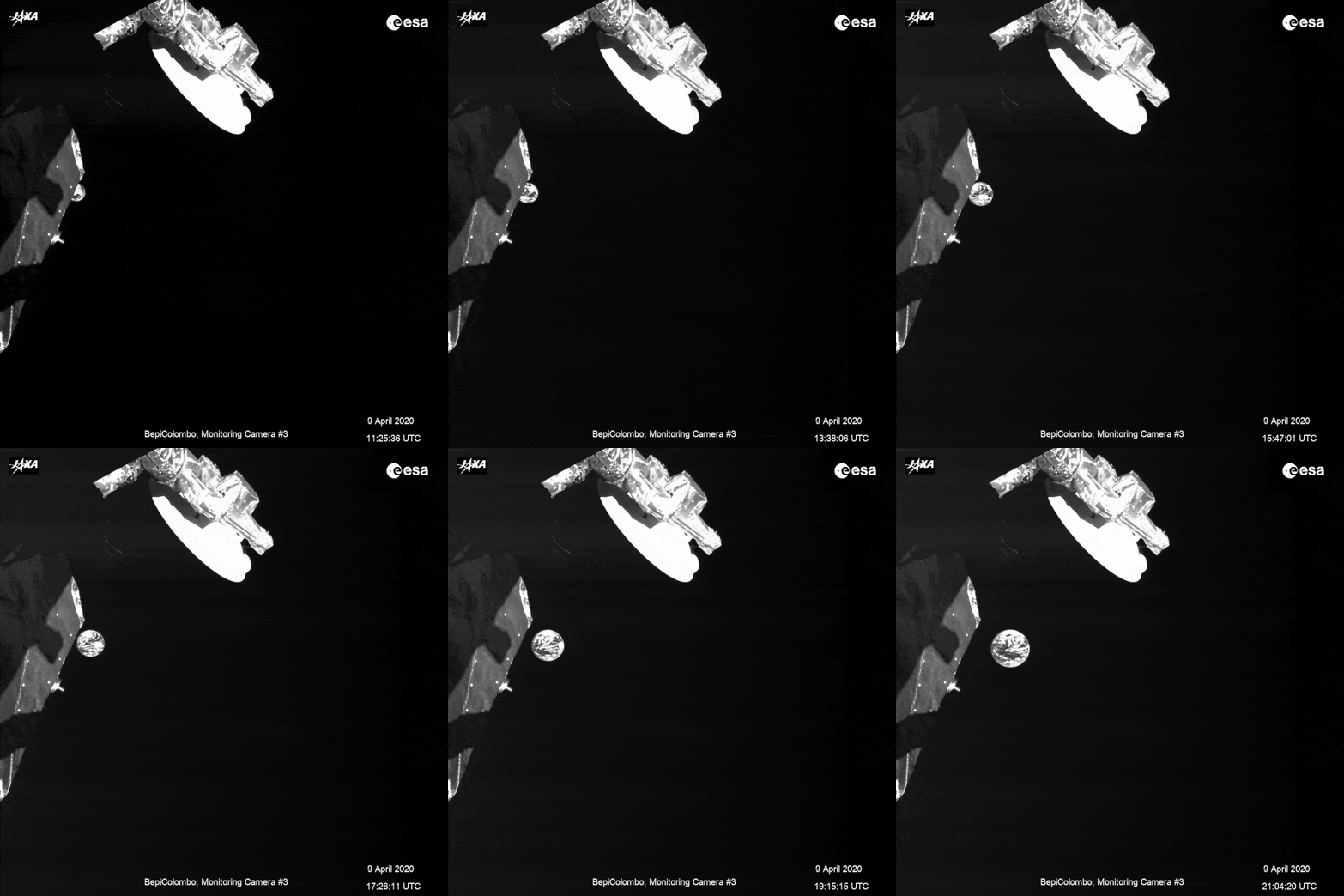
The three monitoring cameras mounted on the MTM are also programmed to take several ‘selfies’ of the spacecraft with Earth upon approach and departure.
Credit: ESA
“This eclipse phase was the most delicate part of the flyby, with the spacecraft passing through the shadow of our planet and not receiving any direct sunlight for the first time after launch,” said Elsa Montagnon, BepiColombo Spacecraft Operations Manager for ESA.
To prepare for the scheduled eclipse, mission operators fully charged the spacecraft batteries and warmed up all components in advance, then closely monitored the temperature of all onboard systems during the period in darkness, between 07:01 and 07:35 CEST.
“It is always nerve-wracking to know a spacecraft’s solar panels are not bathed in sunlight. When we saw the solar cells had restarted to generate electrical current, we knew BepiColombo was finally out of Earth’s shadow and ready to proceed on its interplanetary journey,” added Elsa.
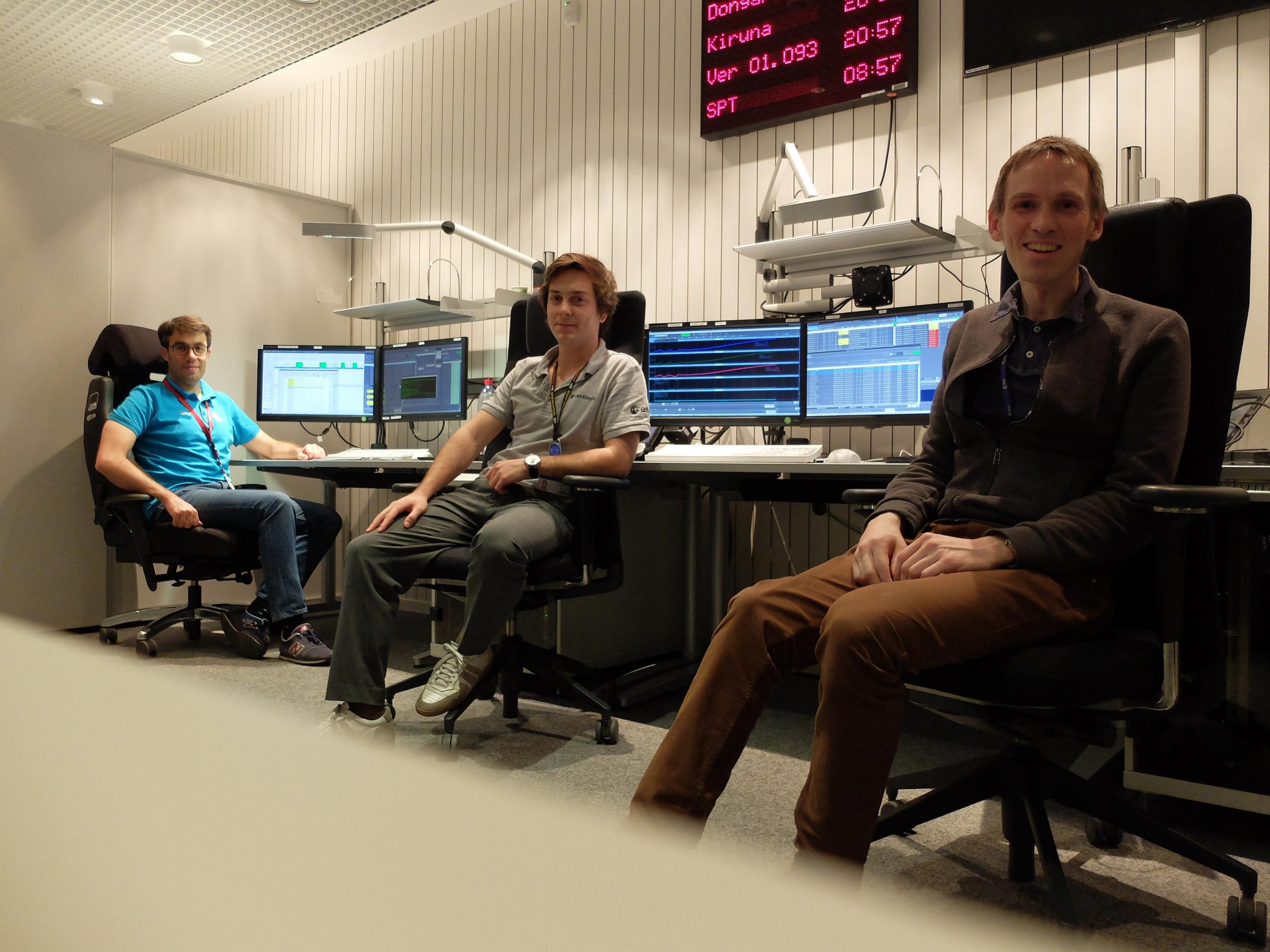
Space operations are never routine at ESA’s mission control center in Darmstadt, Germany, but today’s flyby had one extra challenge. The maneuver, programmed long in advance and impossible to postpone, had to be prepared with limited on-site personnel, amid the social distancing measures adopted by the Agency in response to the ongoing coronavirus pandemic; but the restrictions had no impact on the operation’s success.
As BepiColombo swung by our planet, most scientific instruments on ESA’s Mercury Planetary Orbiter – one of the two science spacecraft that make up the mission – were switched on. Several sensors were also active on the second component of the mission, JAXA’s Mercury Magnetospheric Orbiter, also known as Mio.
Scientists will use the data gathered during the flyby, which include images of the Moon and measurements of Earth’s magnetic field as the spacecraft zipped past, to calibrate the instruments that will, as of 2026, investigate Mercury to solve the mystery of how the scorched planet formed.
“Today was of course very different to what we could have imagined only a couple of months ago,” said Johannes Benkhoff, ESA’s BepiColombo Project Scientist, who followed the operation from his home in the Netherlands, along with the many scientists from the 16 instrument teams that comprise the mission, scattered between Europe and Japan.
“We are all pleased that the flyby went well and that we could operate several scientific instruments, and we are looking forward to receiving and analyzing the data. These will also be useful to prepare for the next flyby, when BepiColombo will swing past Venus in October.”
“There is a great interest in Japan in the BepiColombo mission. Thus, after the successful flyby we are looking forward to the science at Venus and Mercury,” said Go Murakami, BepiColombo Project Scientist at JAXA.
Our Home From Space
On April 9, ahead of the flyby, and then again today, just before closing in, the BepiColombo monitoring cameras snapped a series of images of Earth from space, picturing our planet in these difficult times for humans across Europe and the world.
“These selfies from space are humbling, showing our planet, the common home that we share, in one of the most troubling and uncertain periods many of us have gone through,” said Günther Hasinger, ESA’s Director of Science, who also followed the event remotely from home, in Spain.
“We are scientists who fly spacecraft to explore the Solar System and observe the Universe in search of our cosmic origins, but before that we are humans, caring for one another and coping with a planetary emergency together. When I look at these images, I am reminded of the strength and resilience of humankind, of the challenges we can overcome when we team up, and I wish they bring you the same sense of hope for our future.”
Never miss a breakthrough: Join the SciTechDaily newsletter.
Follow us on Google and Google News.
11 Comments
why not use a high resolution video camera and record the journey through space and everything that is encountered along the way. Instead they have a rediculous black and white presentation and it is bad CGI.
One, bandwidth. Video uses more data than still photos and data transmission requires electrical power. Two, what exactly do you expect to see? Except for these Earth encounters it’s all been empty space. Three, mission objective. This isn’t a guided tour bus through Hollywood. The antenna’s size, the power source limits, and flyby encounters have all been predetermined by the mission objective. That objective does not include supplying you with HD color video of the preliminary flybys. If you want better video of Earth from space, go look for it. It’s out there. As for me, I’m reallying enjoying the sense of distance and speed provided by this video here. Just watch the distance covered in the time it takes the Earth to do a half rotation. Breathtaking.
I have to agree about using HD video. And WHY does the composite of stills end so early?
Some bad planning on that selfiecam.
Saludos to the ESA from Florida USA. Congrats, and this does give
Me renewed hope and faith in mankind working together to overcome global challenges.
We sure need it more than ever.
what is this bs?
That video looks super fake
Why? Because it doesn’t look like the movies? The movies are CGI.
D-
See me after class.
Finally a sequence that show “hauling speed” in space. Thank you. This is what I want to see.
I just checked the comments to see if there were flat-earthers, and of course lol
Haha same!