
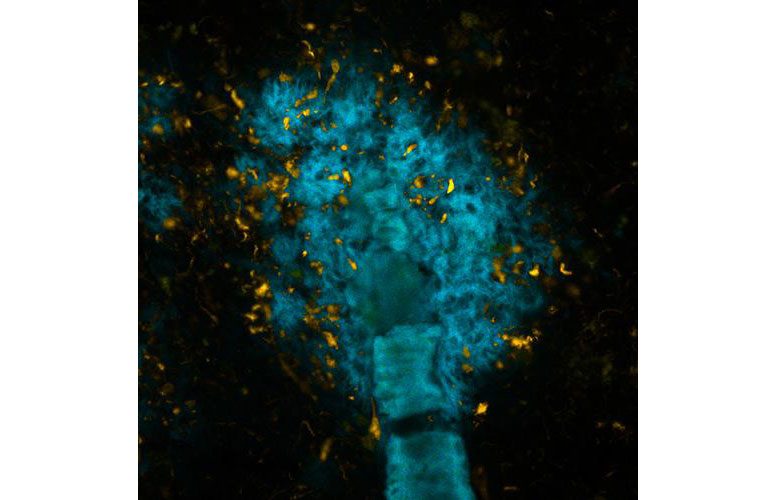
Small shining molecules developed by scientists at Linköping University in Sweden can be designed to distinguish between plaque of different proteins in the brain. They may pave the way for better diagnosis of neurodegenerative diseases, such as Alzheimer’s disease, in which plaque forms from the amyloid beta or tau proteins.
Researchers at Linköping University, LiU, have discovered that small changes in the structure of known tracer molecules can enable them to recognize either amyloid beta or tau. These small molecules, which have previously been developed by the researchers, bind to a specific target protein. When the molecules are illuminated, they emit a signal in the form of light at a different wavelength.
“This opens the possibility of developing more advanced diagnostic tools for diseases in which amyloid beta and tau are involved,” says Peter Nilsson, professor at the Department of Physics, Chemistry and Biology. He has led the study, which has now been presented in the scientific journal Chemistry – A European Journal.
In several diseases of the brain, long fibers of protein form, and eventually become tangled to form dense bodies known as “plaque” or “aggregates.” Alzheimer’s disease, which causes dementia, is one well-known example, in which the plaque usually consists of faulty variants of two proteins: amyloid beta and tau. But deposits of the tau protein in the brain are also seen in a group of less common conditions known as “tauopathies.” In recent years, several cases of brain damage in relatively young people with a professional sporting career have been widely written about. Chronic traumatic encephalopathy (CTE) can occur in individuals who have received blows to the head on repeated occasions, such as may occur in contact sports such as boxing, ice hockey, and American football. Another group at risk is professional soldiers. The only way currently available to reach a firm diagnosis is during an autopsy. Thus, there is an urgent need for diagnostic tools that can be used to investigate living people, and that can distinguish between deposits of amyloid beta and tau in the brain.
What makes these molecules unique is that they have flexible backbones and adapt to the structure of the protein to which they are bound. When the molecule changes its configuration, the color of the light that it emits changes. The researchers started with a tracer molecule that only binds to and recognizes aggregates of amyloid beta. They adapted this molecule to become more similar to molecules that had been developed by other researcher groups and that bind to tau. They made two variants, and it turned out that one of the molecules binds very tightly and exclusively to tau, while the other variant was completely unsuitable.
“We see that extremely small changes, just moving a couple of atoms, can cause the tracer molecule to bind preferentially to another type of aggregate. This means that we can tailor molecules to recognize different aggregates, based on which protein is present,” says Peter Nilsson.
The researchers now plan to further develop the tracer molecules by labeling them with radioisotopes, used during positron emission tomography (PET). One huge advantage of PET investigations is that they can be carried out on living people.
“If we can develop more advanced diagnostic tools that can distinguish between amyloid beta and tau, it would be possible to determine which protein aggregate forms first and how the aggregates interact. It would also be possible to investigate whether different forms of treatment are effective against one type of aggregate without affecting the other,” says Peter Nilsson.
The research has been financed with support from the Swedish Foundation for Strategic Research, the Swedish Research Council, the Erling Persson Foundation, and the National Institutes of Health. The researchers have patented the tau tracer molecules in collaboration with a company.
Reference: “Synthesis of Thiophene-Based Optical Ligands That Selectively Detect Tau Pathology in Alzheimer’s Disease” by Dr. Hamid Shirani, Dr. Hanna Appelqvist, Dr. Marcus Bäck, Dr. Therése Klingstedt, Prof. Nigel J. Cairns and Prof. K. Peter R. Nilsson, 19 September 2017, Chemistry.
DOI: 10.1002/chem.201703846
Never miss a breakthrough: Join the SciTechDaily newsletter.
Follow us on Google and Google News.