
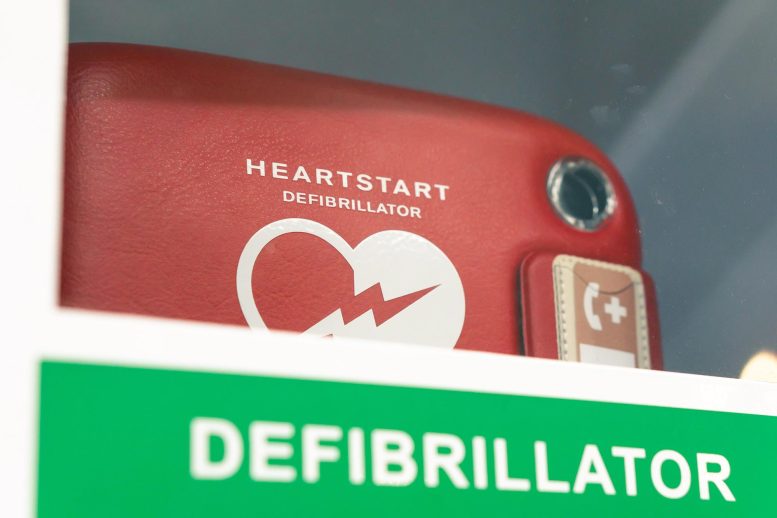
Using a defibrillator on a cardiac arrest victim improves 30-day survival even when the ambulance response times are as short as two minutes. This revelation comes from research shared at the European Society of Cardiology’s ESC Congress 2023.[1]
Most sudden cardiac arrests take place within communities A cardiac arrhythmia, called ventricular fibrillation, causes the heart to cease pumping and blood flow stops. If blood flow is not restored quickly, the individual passes out and dies within 10 to 20 minutes. Members of the public can help by calling an ambulance and performing chest compressions (called cardiopulmonary resuscitation; CPR) while asking someone else to find a defibrillator. The defibrillator is then used to give a high-energy electric shock which restarts the heart.
Insights From the Study
Study author Dr. Mathias Hindborg of Nordsjaellands Hospital, Hilleroed, Denmark stated: “When a person collapses from sudden cardiac arrest, the most effective way a bystander can help is to perform CPR and use an automated external defibrillator (AED).[2] Previous studies have investigated the best location for AEDs but there is little information on how ambulance response times might impact placement. Therefore, we examined the effect of AED use on survival according to ambulance response times.”
The study used data from the Danish Cardiac Arrest Registry on out-of-hospital cardiac arrests that occurred from 2016 through 2020. Information was collected on age, sex, location, bystander defibrillation and CPR, ambulance response time, and survival at 30 days after the cardiac arrest. The study only included adults with a cardiac arrest that was witnessed, who received CPR from a bystander, and where an ambulance arrived in 25 minutes or less.
The researchers compared the probability of survival between patients who had been defibrillated by a bystander prior to the ambulance’s arrival and those who had not. The difference was measured for eight different intervals of ambulance response time. The analyses were adjusted for factors that could influence the relationship including age, sex, place of arrest (public/private), and other medical conditions such as prior heart attack or stroke.
Findings and Implications
The study included 7,471 adults with a bystander witnessed out-of-hospital cardiac arrest who received CPR before an ambulance arrived. Of those, 14.7% (1,098/7,471) received bystander defibrillation before the arrival of an ambulance and 85.3% (6,373/7,471) did not. Some 44.5% (489/1,098) of patients survived to 30 days when bystander defibrillation was performed compared with 18.8% (1,200/6,373) when no bystander defibrillation was performed.
Patients receiving bystander defibrillation were more likely to survive to 30 days compared to those who did not receive bystander defibrillation for all intervals of ambulance arrival time except 0 to 2 minutes, where the increase did not reach statistical significance. Compared with no defibrillation, the likelihood of survival with bystander defibrillation was 37% higher when the ambulance arrived in 2-4 minutes, 55% higher for arrival in 4-6 minutes, and approximately two-fold higher for the remaining intervals studied, with relative risks of 2.23 for 6-8 minutes, 1.99 for 8-10 minutes, 1.89 for 10-12 minutes, 1.86 for 12-15 minutes and 1.98 for 15 to 25 minutes.
Dr. Hindborg said: “All patients in the study received CPR, and the results show the added benefit of bystander defibrillation on survival. The greatest positive impact of bystander defibrillation on the probability of survival was achieved when the ambulance took six to eight minutes to reach the scene. The findings indicate that when resources are limited, defibrillators should be located in areas where ambulance response times are likely to be more than six minutes.”
He concluded: “Anyone can help resuscitate a person suffering a cardiac arrest, be it by performing CPR, retrieving or using an AED, or even purchasing an AED for their workplace, community or household. Defibrillation saves lives and we can’t have too many AEDs in the community, but if we need to prioritize the locations, this study can help in that process.”
References:
- The abstract “Bystander defibrillation increases 30-day survival even with short emergency medical service response time” will be presented during the session Innovations in public health and health economics (5) which takes place on Monday, August 28, from 17:15 to 18:00 CEST at Station 8.
- “European Resuscitation Council Guidelines 2021: Basic Life Support” by Theresa M. Olasveengen, Federico Semeraro, Giuseppe Ristagno, Maaret Castren, Anthony Handley, Artem Kuzovlev, Koenraad G. Monsieurs, Violetta Raffay, Michael Smyth, Jasmeet Soar, Hildigunnur Svavarsdottir and Gavin D. Perkins, 24 March 2023, Resuscitation.
DOI: 10.1016/j.resuscitation.2021.02.009
Never miss a breakthrough: Join the SciTechDaily newsletter.
Follow us on Google and Google News.