
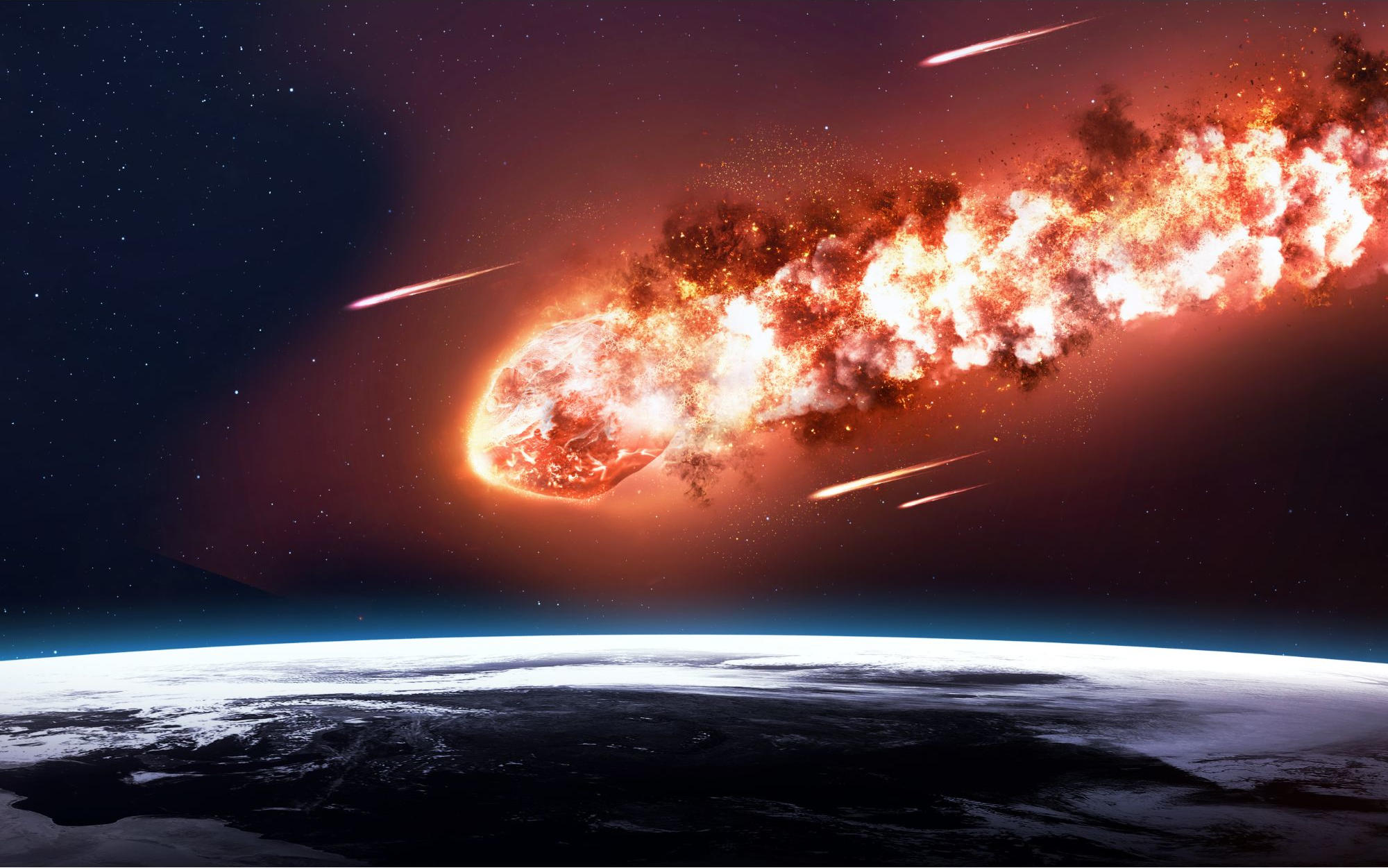
New evidence supports the hypothesis that a fragmented comet triggered a dramatic climate change 12,800 years ago, with findings across the U.S. indicating the occurrence of powerful “touchdown” airbursts without forming craters.
Researchers are further strengthening the case for the Younger Dryas Impact hypothesis, which suggests that a fragmented comet collided with Earth’s atmosphere around 12,800 years ago. This event is believed to have triggered a significant climatic shift, abruptly halting the planet’s warming trend and plunging it into a near-glacial period known as the Younger Dryas.
Now, UC Santa Barbara emeritus professor James Kennett and colleagues report the presence of proxies associated with the cosmic airburst distributed over several separate sites in the eastern United States (New Jersey, Maryland, and South Carolina), materials indicative of the force and temperature involved in such an event, including platinum, microspherules, meltglass and shock-fractured quartz. The study appears in ScienceOpen’s journal Airbursts and Cratering.
“What we’ve found is that the pressures and temperatures were not characteristic of major crater-forming impacts but were consistent with so-called ‘touchdown’ airbursts that don’t form much in the way of craters,” Kennett said.

The Earth is bombarded every day by tons of celestial debris, in the form of tiny dust particles. On the other end of the scale are the extremely rare and cataclysmic impacts like the Chicxulub event that 65 million years ago caused the extinction of dinosaurs and other species. Its 150-kilometer-wide (93 miles) impact crater can be found in the Yucatán Peninsula in Mexico.
Somewhere in between are the impacts that don’t leave craters on the Earth’s surface but are nevertheless destructive. The shockwave from the 1908 Tunguska event knocked down 2,150 square kilometers (830 square miles) of forest, as the roughly 40-meter (130 ft) diameter asteroid collided with the atmosphere almost 10 kilometers (6 miles) above the Siberian taiga.
The comet thought to be responsible for the Younger Dryas cooling episode is estimated to have been 100 kilometers wide (62 miles) — much larger than the Tunguska object, and fragmented into thousands of pieces. The sediment layer associated with the airburst stretches across much of the northern hemisphere, but can also be found in locations south of the equator. This layer contains unusually high levels of rare materials associated with cosmic impacts, such as iridium and platinum, and materials formed under high pressures and temperatures, such as magnetic microspherules (cooled-down metallic droplets), meltglass, and nanodiamonds.
Shocked quartz and amorphous silica
The researchers are particularly interested in the presence of shocked quartz, indicated by a pattern of lines, called lamellae, that shows stress great enough to deform the crystal structure of quartz, a very hard material. This “crème de la crème” of cosmic impact evidence is present in impact craters, however, linking shocked quartz to cosmic airbursts has proven to be more of a challenge.
“In the extreme form, such as when an asteroid hammers into the Earth’s surface, all the fractures are very parallel,” Kennett explained. In the realm of cosmic airbursts, different variables are present in the realm of cosmic airbursts. “When you think about it, the pressures and temperatures that produce these fractures will vary depending on the density, entry angle, altitude of the impact, and the impactor’s size.
“What we found — and this is what is characteristic of the impact layer, called the Younger Dryas Boundary — is that although we do occasionally see in the quartz grains examples of the ‘traditional’ shocked quartz with parallel fractures, we mostly see grains that are not parallel,” he said. These fractures are seen in an irregular, web-like pattern of intersecting, meandering lines and surface and subsurface fissures, in contrast to the parallel and planar deformations of impact-associated shocked quartz found at craters. These subparallel and subplanar deformations are due in large part to the relatively lower pressures caused by explosions that occur above the ground, the researchers assert, as opposed to impacts that make contact with the Earth.
What these sediments do share with the shocked quartz at crater sites is the presence of amorphous silica — melted glass — in these fractures. And that, the researchers say, is evidence of the combination of pressure and high temperatures (greater than 2000 degrees Celsius) that could have come from a low-altitude bolide airburst. Similarly, fractured quartz grains and meltglass have been found in more present-day samples of above ground explosions, such as at the Trinity atomic bomb test site in New Mexico. The roughly 20-kiloton bomb was detonated atop a 30.5-meter (100-foot) tower.
These lower-pressure shocked quartz grains join a growing suite of impact proxies that together make a case for a fragmented comet that not only caused widespread burning, but also abrupt climatic change that resulted in the extinctions of 35 genera of megafauna in North America, such as the mammoths and giant ground sloths, and led to the collapse of a flourishing human culture called Clovis, according to the researchers.
“There’s a whole range of different shocked quartz, so we have to make a well-documented case that they are indeed significant for interpreting cosmic impact, even though they’re not reflecting a traditional major crater-forming event,” Kennett said. “These are from very-low-altitude ‘touchdown’ airbursts almost certainly associated with cometary impact.”
Reference: “Platinum, shock-fractured quartz, microspherules, and meltglass widely distributed in Eastern USA at the Younger Dryas onset (12.8 ka)” by Christopher R. Moore, Malcolm A. LeCompte, James P. Kennett, Mark J. Brooks, Richard B. Firestone, Andrew H. Ivester, Terry A. Ferguson, Chad S. Lane, Kimberly A. Duernberger, James K. Feathers, Charles B. Mooney, Victor Adedeji, Dale Batchelor, Michael Salmon, Kurt A. Langworthy, Joshua J. Razink, Valerie Brogden, Brian van Devener, Jesus Paulo Perez, Randy Polson, Michael Martínez-Colón, Barrett N. Rock, Marc D. Young, Gunther Kletetschka, Ted E. Bunch and Allen West, 8 May 2024, Airbursts and Cratering Impacts.
DOI: 10.14293/ACI.2024.0003
Never miss a breakthrough: Join the SciTechDaily newsletter.
Follow us on Google and Google News.
3 Comments
The Younger Dryas Impact Theory has been around in one form or another for a long time. Some researchers claim they have found evidence to support it, and at least as many researchers have rejected it. There is too much in terms of study papers to rehash here, but I would recomend a
Wickipedia search for the YDIT and you will see just how much controversy (to put it mildly) there is about this. Whether you accept the impact theory or not, the idea that megafauna, which survived a glacial age for many thousands of years prior to YD, suddenly couldn’t handle a re-cooling of the of the climate after some warming post ice age makes little sense. I suspect extensive human hunting had as much to do with it as anything else.
Disappointed that the article generically and repeatedly labels the authors as “researchers.” Are they geologists, geophysicists, astronomers, or what? Scientists deserve to have their field of specialty recognized.
Dave (a geophysicist)
Great article. I appreciate reading updates on this research. It is a topic that seems to attract the ire of the consensus-settled scientific/archaeology communities. Bolide and volcanic eruption driven cataclysms have changed the course of evolution and human civilization with regularity. Any scientific or archaeologic theory that is closed to influence of such cataclysmic events is doomed to fall by the wayside. I remember being taught the theory that the extinction of mega-fauna species in North America was due to de-glaciation and hunting. The die off of the woolly species with glacial retreat made sense. Hunting driven extinctions continent-wide is/was ridiculous. The comet air-burst theory sure resolves a lot of archaeological, geological, and climatological issues. Including answering the continental extinction of mega-fauna. Just saying…..