
Close Menu
    Facebook X (Twitter) Instagram
    SciTechDaily
    • Biology
    • Chemistry
    • Earth
    • Health
    • Physics
    • Science
    • Space
    • Technology
    Facebook X (Twitter) Pinterest YouTube RSS
    SciTechDaily
    Home»Space»Short-Period Binary Stars Tend to Merge Into Single Star
    Space

    Short-Period Binary Stars Tend to Merge Into Single Star

    By SciTechDailySeptember 26, 2012No Comments2 Mins Read
    Facebook Twitter Pinterest Telegram LinkedIn WhatsApp Email Reddit
    Share
    Facebook Twitter LinkedIn Pinterest Telegram Email Reddit
    sirius-b
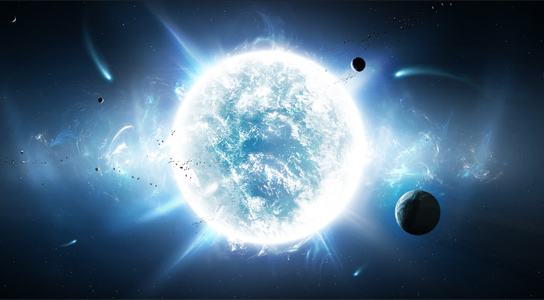
    Short-period binary stars have a tendency to merge into a single star over time.

    A computer simulation suggests that there are many single stars that were born as two separate suns, which eventually merged into a single star during the first million years of their existence.

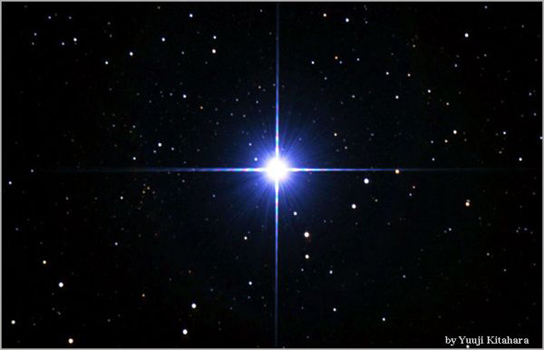
    The scientists published their findings in the journal Astronomy and Astrophysics. Double stars, like Sirius, are quite common. Studies of star-forming regions suggest that binary stars start off with a uniform distribution of orbital periods – the number of binaries younger than a few million years that orbit each other every 1–10 years, 10–100 years, 100–1,000 years, and so on, is about the same, – but older binaries show a different pattern. They have an average orbital period of roughly 200 years, and both shorter, as well as longer periods, are rarer.
    sirius

    This scarcity with orbital periods is easy to explain. In order to have a long orbital period, the stars themselves must be further apart. At such great distances, the stars don’t experience much of each other’s gravity, so the gravitational tug of a passing star can disrupt the binary system.

    In order to explain where the shorter period binaries went, German astronomers simulated a star cluster resembling one in the Orion Nebula. The stars interact with the gas within the cluster and modify the stars’ orbits, causing them to spiral toward each other until they merge into a single star.

    This result is plausible but hard to prove. The same gas and dust that causes the closer binaries to merge also prevents them from being visible from Earth. Astronomers must use IR radiation, which penetrates the dust, but often requires space-based observatories.

    Reference: “Towards the field binary population: influence of orbital decay on close binaries” by C. Korntreff, T. Kaczmarek and S. Pfalzner, 10 July 2012, Astronomy and Astrophysics.
    DOI: 10.1051/0004-6361/201118019

    Never miss a breakthrough: Join the SciTechDaily newsletter.
    Follow us on Google and Google News.

    Astronomy Astrophysics Binary Star Popular
    Share. Facebook Twitter Pinterest LinkedIn Email Reddit

    Related Articles

    Astronomers Capture Rare Image of a Real-Life “Tatooine” Orbiting Two Suns

    Astronomers Stunned by Bizarre Three-Planet System That Rewrites the Rules of Space

    It Shouldn’t Exist: Astronomers Discover a Planet Orbiting the “Wrong Way”

    New Habitable Zone Planet Found in Unusual Star System

    The Seven-Year Photobomb: Astronomers Discover Source of Distant Star’s Unusual Dimming

    The Evolving Volatile Chemistry of Protoplanetary Disks

    How Fast Is the Universe Expanding? Measuring Cosmic Expansion With Radio Astronomy and Gravitational Waves

    Astronomers Discover a New Class of Binary Stars

    Researchers Reveal New Method for Studying Binary Star Systems

    Leave A Reply Cancel Reply

    • Facebook
    • Twitter
    • Pinterest
    • YouTube

    Don't Miss a Discovery

    Subscribe for the Latest in Science & Tech!

    Trending News

    Monster Storms on Jupiter Unleash Lightning Beyond Anything on Earth

    Scientists Create “Liquid Gears” That Spin Without Touching

    The Simple Habit That Could Help Prevent Cancer

    Millions Take These IBS Drugs, But a New Study Finds Serious Risks

    Scientists Unlock Hidden Secrets of 2,300-Year-Old Mummies Using Cutting-Edge CT Scanner

    Bread Might Be Making You Gain Weight Even Without Eating More Calories

    Scientists Discover Massive Magma Reservoir Beneath Tuscany

    Europe’s Most Active Volcano Just Got Stranger – Here’s Why Scientists Are Rethinking It

    Follow SciTechDaily
    • Facebook
    • Twitter
    • YouTube
    • Pinterest
    • Newsletter
    • RSS
    SciTech News
    • Biology News
    • Chemistry News
    • Earth News
    • Health News
    • Physics News
    • Science News
    • Space News
    • Technology News
    Recent Posts
    • Scientists Were Wrong About This Strange “Rule-Breaking” Particle
    • Webb Space Telescope Uncovers Unexpected Ice Clouds on a Jupiter-Like World
    • 289-Million-Year-Old Reptile Mummy Reveals Origin of Human Breathing System
    • New Brain Discovery Challenges Long-Held Theory of Teenage Brain Development
    • Sharks Are Overheating as Warming Oceans Push Them to the Edge
    Copyright © 1998 - 2026 SciTechDaily. All Rights Reserved.
    • Science News
    • About
    • Contact
    • Editorial Board
    • Privacy Policy
    • Terms of Use

    Type above and press Enter to search. Press Esc to cancel.