
Close Menu
    Facebook X (Twitter) Instagram
    SciTechDaily
    • Biology
    • Chemistry
    • Earth
    • Health
    • Physics
    • Science
    • Space
    • Technology
    Facebook X (Twitter) Pinterest YouTube RSS
    SciTechDaily
    Home»Technology»Shutting the Nano-Gate: Breakthrough May Lead to Single-Molecule Sensors and Cheaper Genomic Sequencing
    Technology

    Shutting the Nano-Gate: Breakthrough May Lead to Single-Molecule Sensors and Cheaper Genomic Sequencing

    By Osaka UniversityMarch 12, 2021No Comments3 Mins Read
    Facebook Twitter Pinterest Telegram LinkedIn WhatsApp Email Reddit
    Share
    Facebook Twitter LinkedIn Pinterest Telegram Email Reddit
    Nanopore Electrical Tweezer
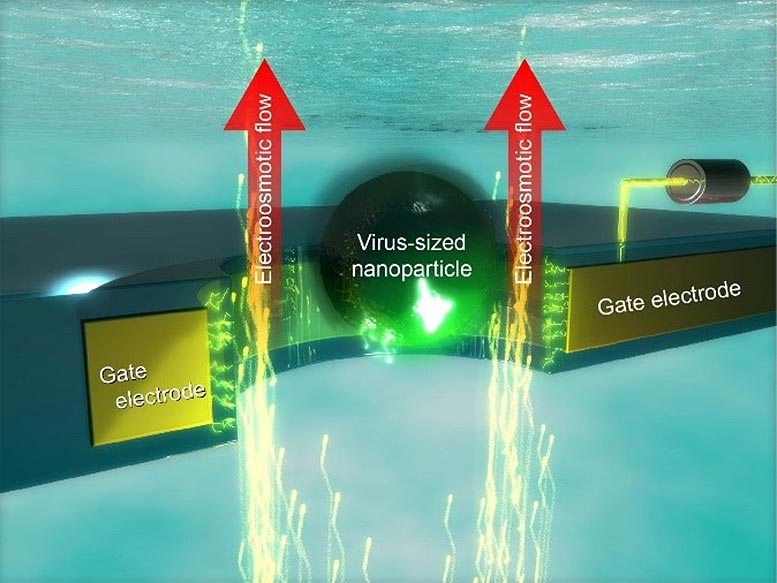
    Nanopore electrical tweezer for trapping and manipulating nano-objects in water. Credit: Osaka University

    Researchers at Osaka University create voltage-controlled nanopores that can trap particles as they try to pass through, which may lead to single-molecule sensors, along with cheaper and faster genomic sequencing.

    Scientists from the Institute of Scientific and Industrial Research at Osaka University fabricated nanopores in silicon dioxide, that were only 300 nm in diameter surrounded by electrodes. These nanopores could prevent particles from entering just by applying a voltage, which may permit the development of sensors that can detect very small concentrations of target molecules, as well as next-generation DNA sequencing technology.

    Nanopores are tiny holes that are wide enough for just a single molecule or particle to pass through. The motion of nanoparticles through these holes can usually be detected as an electrical signal, which makes them a promising platform for novel single-particle sensors. However, control of the motion of the particles has been a challenge so far.

    Voltage-Driven Nanoparticle Control

    Scientists at Osaka University used integrated nanoelectromechanical systems technology to produce solid-state nanopores, only 300 nm wide, with circular platinum gate electrodes surrounding the openings that can prevent nanoparticles from passing through. This is accomplished by selecting the correct voltage that pulls ions in the solution to create a countervailing flow that blocks the entry of the nanoparticle.

    “Single-nanoparticle motions could be controlled via the voltage applied to the surrounding gate electrode, when we fine-tuned the electroosmotic flow via the surface electric potential,” first author Makusu Tsutsui says. After the particle has been trapped at the nanopore opening, a subtle force imbalance between the electrophoretic attraction and the hydrodynamic drag can then be created. At that time, the particles can be pulled in extremely slowly, which may allow long polymers, like DNA, to be threaded through at the correct speed for sequencing.

    “The present method can not only enable better sensing accuracy of sub-micrometer objects, such as viruses, but also provides a method for protein structural analysis,” senior author Tomoji Kawai says. While nanopores have already been used to determine the identity of various target molecules based on the current generated, the technology demonstrated in this project may allow for wider range of analytes to be tested this way. For example, small molecules, such as proteins and micro-RNA segments that need to be pulled in at a very controlled speed, may also be detected.

    Reference: “Field effect control of translocation dynamics in surround-gate nanopores” by Makusu Tsutsui, Sou Ryuzaki, Kazumichi Yokota, Yuhui He, Takashi Washio, Kaoru Tamada and Tomoji Kawai, 12 March 2021, Communications Materials.
    DOI: 10.1038/s43246-021-00132-3

    Funding: Japan Society for the Promotion of Science, Japan Science and Technology Agency, Cabinet Office (Government of Japan).

    Never miss a breakthrough: Join the SciTechDaily newsletter.
    Follow us on Google and Google News.

    Biochemistry Biophysics Genetics Molecular Physics Nanotechnology University of Osaka
    Share. Facebook Twitter Pinterest LinkedIn Email Reddit

    Related Articles

    Researchers Develop “Nanopore-Tal” Technology That Enables Cells To Talk to Computers

    Nanodiamond Sensors Created That Can Act As Both Heat Sources and Thermometers

    Sorting Out Viruses With Machine Learning: AI-Powered Nanotechnology May Lead to New Rapid COVID-19 Tests

    Microdevice Simultaneously Measures Biophysical Properties and Position of Single Cells

    Human Cells Made Magnetic With Engineered Protein Crystals

    DNA2 Molecule Helps Repair Chromosome Rearrangements Linked to Cancer

    UCLA Nanoscientists Develop a Better Way to Remove Pollutants from Water

    A Cost-Effective Fabrication Method for Micro-Scale Graphene-Based Supercapacitors

    New Nano-Scale Device Can Weigh Individual Molecules

    Leave A Reply Cancel Reply

    • Facebook
    • Twitter
    • Pinterest
    • YouTube

    Don't Miss a Discovery

    Subscribe for the Latest in Science & Tech!

    Trending News

    Scientists Warn That This Common Pet Fish Can Wreck Entire Ecosystems

    Scientists Make Breakthrough in Turning Plastic Trash Into Clean Fuel Using Sunlight

    This Popular Supplement May Interfere With Cancer Treatment, Scientists Warn

    Scientists Finally Solved One of Water’s Biggest Mysteries

    Could This New Weight-Loss Pill Disrupt the Entire Market? Here’s What You Should Know About Orforglipron

    Earth’s Crust Is Tearing Open in Africa, and It Could Form a New Ocean

    Breakthrough Bowel Cancer Trial Leaves Patients Cancer-Free for Nearly 3 Years

    Natural Compound Shows Powerful Potential Against Rheumatoid Arthritis

    Follow SciTechDaily
    • Facebook
    • Twitter
    • YouTube
    • Pinterest
    • Newsletter
    • RSS
    SciTech News
    • Biology News
    • Chemistry News
    • Earth News
    • Health News
    • Physics News
    • Science News
    • Space News
    • Technology News
    Recent Posts
    • Scientists Uncover Fatal Weakness in “Zombie Cells” Linked to Cancer
    • World-First Study Reveals Human Hearts Can Regenerate After a Heart Attack
    • Why Your Dreams Feel So Real Sometimes and So Strange Other Times
    • Scientists Debunk 100-Year-Old Belief About Brain Cells, Rewriting Textbooks
    • This Simple Home Device May Boost Brain Power in Adults Over 40
    Copyright © 1998 - 2026 SciTechDaily. All Rights Reserved.
    • Science News
    • About
    • Contact
    • Editorial Board
    • Privacy Policy
    • Terms of Use

    Type above and press Enter to search. Press Esc to cancel.