
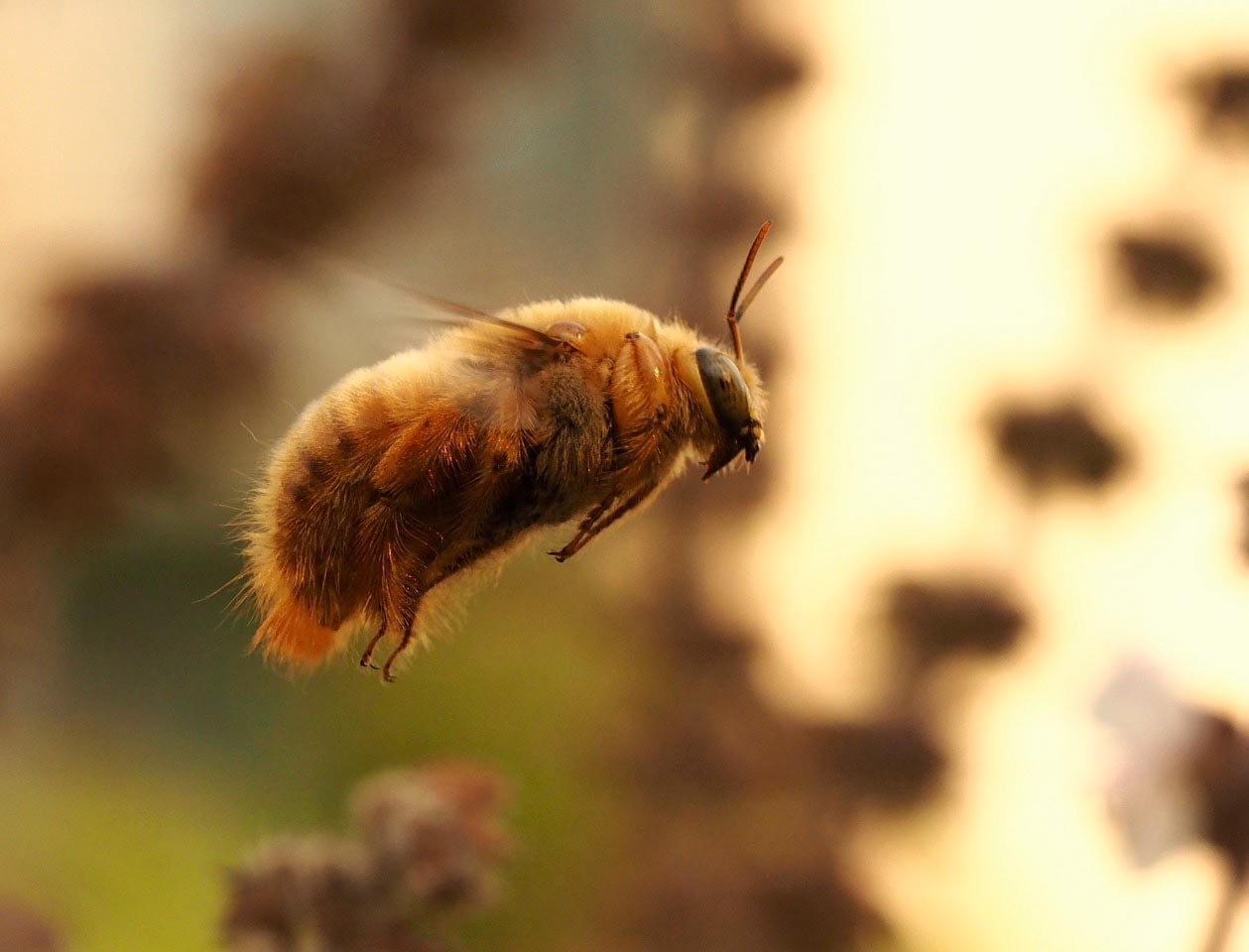
New research adds solid evidence to the suspicion that steep declines in America’s wild bee populations stem in large part from the use of pesticides. USC Dornsife scientists say saving the crucial pollinators requires new approaches to managing pesky insects.
Whether you’re strolling through a garden, wandering a park, or simply enjoying an open space in the United States, you’re likely to notice bees buzzing about the flowers. While honeybees, imported from Europe in the 17th century to produce honey, are the most recognizable, they aren’t the only bees at work. If you’re a keen observer, you might spot some of the thousands of less familiar, native bee species that call these spaces home.
Native wild bees play a crucial ecological role, ensuring the survival and reproduction of countless plant species — including many agricultural crops — by spreading pollen as they forage for food. Unfortunately, their numbers seem to be declining, and despite experts suggesting multiple causes, the exact reason remains a mystery.
Pesticides and Bee Decline
A new study published in Nature Sustainability sheds light on one potential cause: pesticide use. The research reveals a stark decline in the number of wild bee sightings, with appearances of some species dropping as much as 56% in areas of high pesticide use compared to areas with no pesticide use.
The study points to pesticides as a significant factor in wild bee decline and suggests that alternative pest control methods, such as those proposed by the U.S. Environmental Protection Agency, could reduce the damage.
Investigating Bee Population Declines
Loss of wild bees could disrupt entire ecosystems, affecting not just plants but also the wildlife that depend on those plants for food and habitat. The multibillion-dollar agricultural industry could also suffer; wild bees, alongside honeybees, play a crucial role in pollinating three-quarters of food crops and nearly 90% of flowering plant species.
Recognizing the urgent threat posed by bee population declines, Laura Melissa Guzman of the USC Dornsife College of Letters, Arts and Sciences, along with an international team of researchers, set out to investigate the impact of pesticides on wild bees. They also examined the effects of agricultural practices and how the presence of honeybee colonies might influence wild bee populations.
Analyzing Data on Bee Sightings
Guzman, Gabilan Assistant Professor of Biological Sciences and Quantitative and Computational Biology, and the team inspected museum records, ecological surveys, and community science data collected between 1996 and 2015 from across the contiguous United States.
Using advanced computational methods, they sifted through more than 200,000 unique observations of over 1,000 species — representing one-third of all known bee species in the U.S. — to assess how frequently different species were observed in various locations.
In addition, they analyzed data from several government sources, such as the U.S. Geological Survey’s National Land Cover Database and Pesticide National Synthesis Project. The former tracks U.S. land cover types (crop, urban, forest, wetland, etc.) with snapshots taken every two to three years from 2001 to 2016, while the latter provides detailed data on pesticide use by county from 1992 to 2021.
By integrating these resources, the researchers correlated factors such as land use, pesticide application, honeybee colony presence, and types of agricultural crops with wild bee sightings over the past two to three decades.
Pesticides: A Major Culprit
The research provides compelling evidence that pesticide use is a major contributor to the declining numbers of wild bees. The study found a strong correlation between pesticide use and fewer wild bee sightings, suggesting a direct link between pesticide exposure and bee population declines.
Some scientists have speculated that certain crops might adversely affect wild bees. However, Guzman and the team uncovered evidence to the contrary. Among crops frequented by pollinators, they found just as many wild bees in counties with a lot of agriculture versus a little.
The Surprising Impact of Honeybee Colonies
Interestingly, the study hinted that the presence of colonies of honeybees, an invasive species, had almost no effect on wild bee populations, despite some evidence to the contrary. The researchers caution, however, that they need more detailed data and further study to confirm this conclusion.
“While our calculations are sophisticated, much of the spatial and temporal data is coarse,” Guzman said. “We plan to refine our analysis and fill in the gaps as much as possible.”
Advocating for Integrated Pest Management
The researchers view their findings as compelling evidence that alternative pest control strategies, such as integrated pest management, are essential for conserving these crucial pollinators.
Integrated pest management involves controlling pests by using natural predators, modifying practices to reduce pest establishment, and using traps, barriers, and other physical means, with pesticide use reserved as a last resort.
The team also emphasizes the need for more long-term studies that collect data on more localized bee populations over extended periods. “We need to combine these large-scale studies that span continents with field experiments that expose bees to chemicals over longer periods and under natural conditions to get a clearer picture of how these chemicals affect bees,” Guzman said.
The Need for Better Pesticide Risk Assessment
The current study builds on work published earlier this year by Guzman and scientists from Washington State University and Canada’s Université Laval. That study found that ecological risk assessments (ERAs) underestimate pesticide threats to wild bees and other pollinators.
Currently, ERAs measure pesticide effects on honeybees, often in lab studies, then extrapolate those findings to native bee species. However, Guzman and her colleagues revealed that current ERAs vary wildly — as much as a million-fold — when estimating how lethal pesticides are just to honeybees. And many wild bees are even more sensitive to pesticides, compounding the problem, the research showed.
“When we only focus on the western honeybee, we’re ignoring the unique responses of other wild bee species to pesticide exposure,” Guzman said, calling for regulatory agencies, scientists, and policymakers to rethink ERA methods.
“More data and analysis on the long-term effects of pesticides will help guide these efforts to the benefit of all pollinators, including wild bees,” Guzman said.
Reference: “Impact of pesticide use on wild bee distributions across the United States” by Laura Melissa Guzman, Elizabeth Elle, Lora A. Morandin, Neil S. Cobb, Paige R. Chesshire, Lindsie M. McCabe, Alice Hughes, Michael Orr and Leithen K. M’Gonigle, 27 August 2024, Nature Sustainability.
DOI: 10.1038/s41893-024-01413-8
In addition to corresponding author Guzman, study authors include Elizabeth Elle and Leithen M’Gonigle of Simon Fraser University; Lora Morandin of the Pollinator Partnership; Neil Cobb of Biodiversity Outreach Network (BON); Paige Chesshire of BON and Northern Arizona University; Lindsie McCabe of the USDA-ARS Pollinating Insects Research Unit; Alice Hughes of the University of Hong Kong; and Michael Orr of State Museum of Natural History Stuttgart.
Funding: U.S. National Science Foundation, USC Dornsife, Simon Fraser University, Natural Sciences and Engineering Research Council of Canada, Liber Ero Fellowship Program
Never miss a breakthrough: Join the SciTechDaily newsletter.
Follow us on Google and Google News.
2 Comments
No mention of Varo Mites? Other parasites? No mention of climate change impacts on flora tha sustains Bees? No mention of habitat destruction? Why not allow the CRP acres to be bee friendly in addition to restoring class 1 and 2 crop lands?
Great read guys and keep it coming – by Rodentagon https://rodentagon.co.uk