
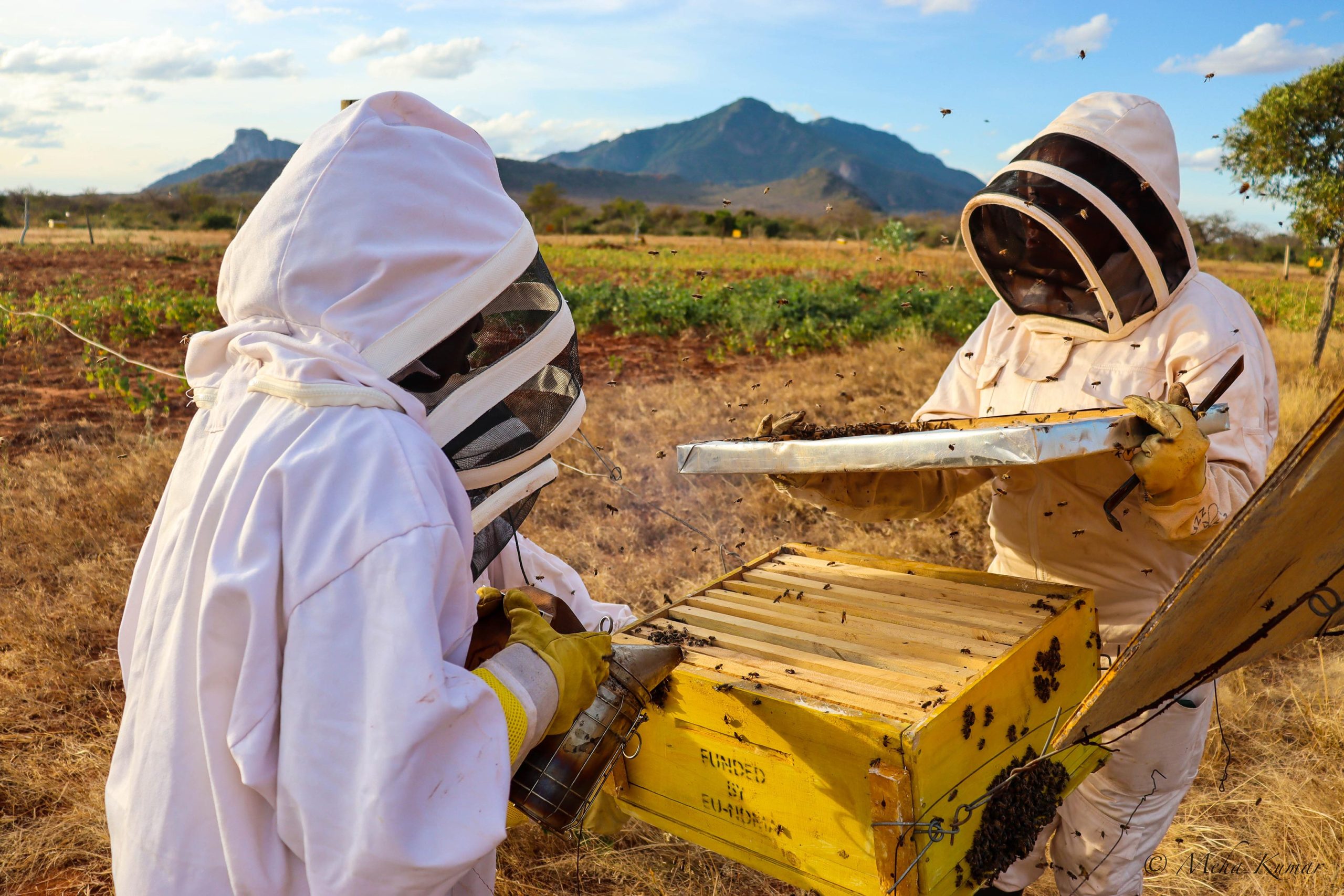
A groundbreaking nine-year study found that elephants approaching small-scale farms in Kenya avoid beehive fences with live honey bees up to 86% of the time during peak crop seasons. This natural deterrent has helped reduce human-elephant conflict for local farmers while also boosting their income.
Key findings include:
- Beehive fences are a proven success in reducing human-elephant conflict in Africa.
- Savannah elephants avoid beehive fences housing live honey bees up to 86% of the time during peak crop seasons.
- Across all seasons and the entire study period, the fences deterred an annual average of 76% of 3,999 elephants that approached the study farms in Kenya.
- The study offers promising insights into using nature-based solutions to protect both livelihoods and wildlife.
- Increased habitat disturbance or more frequent droughts, however, could reduce the effectiveness of beehive fences as a natural elephant deterrent in the future.
Beehive Fences in Kenya
Published today (October 29) in the journal Conservation Science and Practice, a new study provides promising evidence that nature-based solutions, such as beehive fences, can protect both farmers’ livelihoods and local wildlife. Conducted by the research charity Save the Elephants (STE) in partnership with the Wildlife Research and Training Institute (WRTI), Kenya Wildlife Service (KWS), and the University of Oxford, the study highlights the potential of bees as natural deterrents.
However, researchers warn that continued habitat loss and recurring droughts may compromise the long-term effectiveness of these beehive barriers.

Population Growth and Habitat Shrinking
Kenya’s rapid human population growth—up 59.4% between 2000 and 2020—has led to shrinking elephant habitats as settlements and infrastructure expand. With an urgent need for sustainable coexistence between people and elephants, Kenya Wildlife Service (KWS) is challenged to balance conservation with economic development. Save the Elephants’ Coexistence Program focuses on keeping elephants safely away from subsistence farms to support this delicate balance.
Beehive fences, introduced in 2007 by STE and KWS, in partnership with the University of Oxford, offer an innovative approach. These fences consist of a series of live beehives strung together between posts, creating a physical, auditory, and olfactory deterrent to elephants. The elephants’ natural fear of being stung keeps them away, while the fences also benefit farmers by providing pollination services and generating income through honey and wax production.
Study Findings and Seasonal Impact Analysis
The study monitored 26 farms protected by beehive fences in two villages near Tsavo East National Park, and analyzed nearly 4,000 incidents of elephant approaches. Elephants roam freely in and out of the park throughout the year as they look for mates, food and water, but can be attracted by the smell and nutritional richness of agricultural crops.
During six peak crop-growing seasons (November to January 2014-2020), 3,027 elephants approached the farms and the beehive fences successfully deterred an annual average of 86.3% of elephants from raiding crops. Across all seasons and the entire study period, including a drought, the fences deterred an annual average of 76% of elephants.

Economic Impact During Environmental Challenges
However, challenges such as the drought—which reduced hive occupation by 75% during 2017 —negatively impacted honey production and profits both during the drought and for three years after. Despite this climatic shock, the 365 beehives used in the study produced one ton of honey, sold for $2,250.
Dr. Lucy King from Save the Elephants and the University of Oxford’s Department of Biology, who led the study, highlighted the effectiveness of beehive fences but warned of future risks. “Beehive fences are very effective at reducing up to 86.3% of elephant raids when the crops in the farms are at their most attractive,” she said, “but our results also warn that increased habitat disturbance or more frequent droughts could reduce the effectiveness of this nature-based coexistence method.”
Dr. Patrick Omondi, Director Wildlife Research and Training Institute, emphasized the importance of continued research and funding for sustainable solutions. “Kenya is facing increasing challenges with human-elephant conflict, and solutions like beehive fences empower communities to manage their own farm protection,” he said. “We need more research and support for nature-based solutions to help our communities live better alongside wildlife.”
Previous Research on Elephants and Bees
Previous research by Save the Elephants, KWS, and the University of Oxford in partnership with bioacoustician scientists from Disney’s Animal Kingdom® has shown that elephants respond strongly to bees, running away from disturbed bee sounds and exhibiting behaviors such as head-shaking, dusting, and rumbling to warn others. While elephants’ thick skin usually protects them, disturbed honey bees target sensitive areas like the eyes, mouth, and trunk, where their stings cause discomfort. This natural fear of bees has been harnessed as a practical tool to keep elephants away from farms, helping to promote coexistence between humans and wildlife. To date over 14,000 beehives have been hung as elephant deterrents in 97 sites across Africa and Asia.
Reference: “Impact of drought and development on the effectiveness of beehive fences as elephant deterrents over 9 years in Kenya” by Lucy E. King, Lydia Tiller, Emmanuel Mwambingu, Esther Serem, Hesron Nzumu, Gloria Mugo, Naiya Raja, Ewan Brennan, Derick Kisiang’ani Wanjala, Victor Ndombi, Kennedy Leneuyia, Harry Williams, Fredrick Lala, Frank Pope and Iain Douglas-Hamilton, 29 October 2024, Conservation Science and Practice.
DOI: 10.1111/csp2.13242
Never miss a breakthrough: Join the SciTechDaily newsletter.
Follow us on Google and Google News.
1 Comment
“Kenya’s rapid human population growth—up 59.4% between 2000 and 2020.” Hey, Elon, worried about people having fewer children. Wise up!
It’s only the people who should be having children who are not. Get it?