
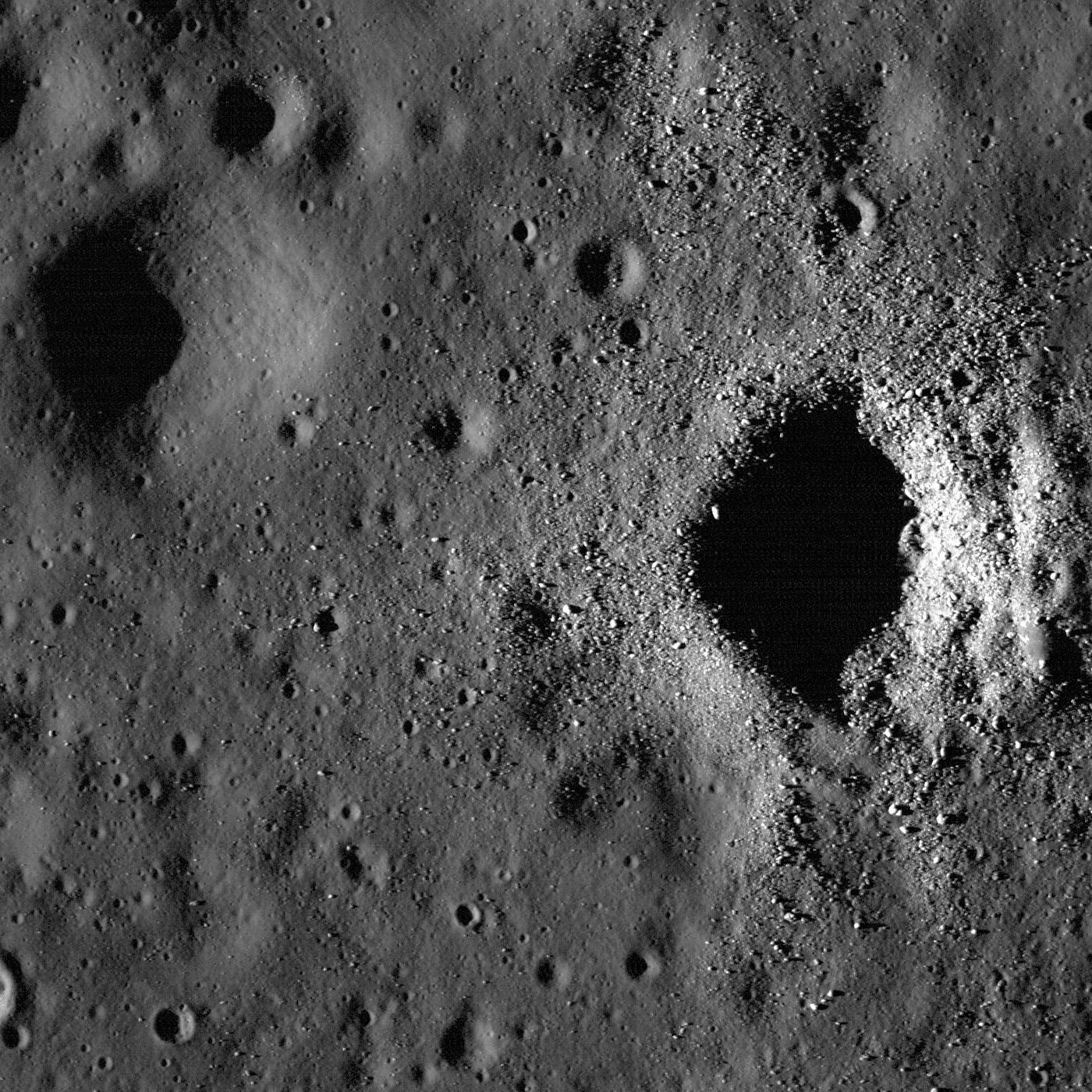
The lunar sample returned by China’s 2020 lunar mission contained minerals that provide clues to their origin.
Earth’s moon achieved its Swiss cheese appearance from celestial objects crashing into its surface, forming impact craters. But craters weren’t all that was left behind; the intense pressure and temperature of such a collision also impacts the rocks and dust covering the lunar surface, known as regolith, altering its mineral composition and structure. Analyzing the resulting minerals provides modern researchers clues to the moon’s past.
Chang’e-5’s Lunar Sample Analysis
China’s Chang’e-5, the first lunar sample return mission since the Soviet Union’s Luna 24 in 1976, delivered 1.73 kilograms of regolith from the Oceanus Procellarum, a plane named for its vast size. The sample landed with Chang’e-5 (CE-5) in late 2020 and included a new mineral, Changesite-(Y), as well as a perplexing combination of silica minerals.
In Matter and Radiation at Extremes, an AIP Publishing journal, researchers from the Chinese Academy of Sciences compared CE-5’s material composition to other lunar and Martian regolith samples. They examined potential causes and origins for the lunar sample’s unique makeup.
Impact Metamorphism and Lunar Minerals
Asteroids and comets collide with the moon at extreme velocities, causing impact (shock) metamorphism in the lunar rocks. This temperature and pressure change occurs rapidly and has distinctive features, including the formation of silica polymorphs like stishovite and seifertite, which are chemically identical to quartz but have different crystalline structures.
“Although the lunar surface is covered by tens of thousands of impact craters, high-pressure minerals are uncommon in lunar samples,” said author Wei Du. “One of the possible explanations for this is that most high-pressure minerals are unstable at high temperatures. Therefore, those formed during impact could have experienced a retrograde process.”
However, a silica fragment in the CE-5 sample contains both stishovite and seifertite, minerals that theoretically only coexist at much higher pressures than the sample seemingly experienced.
The authors determined that seifertite exists as the phase between stishovite and a third silica polymorph, α-cristobalite, also present in the sample.
“In other words, seifertite could form from α-cristobalite during the compressing process, and some of the sample transformed to stishovite during the subsequent temperature-increasing process,” said Du.
The Significance of Chang’e-5’s Findings
This mission also returned a new lunar mineral, Changesite-(Y), a phosphate mineral characterized by colorless, transparent columnar crystals.
The researchers estimated the peak pressure (11-40 GPa) and impact duration (0.1-1.0 second) of the collision that shaped the sample. Combining that information with shock wave models, they estimated the resulting crater to be anywhere from 3 to 32 kilometers wide, depending on the impact angle.
Remote observations show that distant ejecta in CE-5 regolith mainly come from four impact craters, and the Aristarchus crater is the youngest among the four distant craters. Because seifertite and stishovite are easily disturbed by thermal metamorphism, they inferred the silica fragment likely originated from the collision that formed the Aristarchus crater.
This sample return mission demonstrated the power of modern analysis and how it can help uncover the history of celestial bodies.
Reference: “High-pressure minerals and new lunar mineral changesite-(Y) in Chang’e-5 regolith” by Jing Yang and Wei Du, 6 February 2024, Matter and Radiation at Extremes.
DOI: 10.1063/5.0148784
Never miss a breakthrough: Join the SciTechDaily newsletter.
Follow us on Google and Google News.