

Microprocessor-scale transistors detect and respond to biological states and the environment.
Your phone may have more than 15 billion tiny transistors packed into its microprocessor chips. The transistors are made of silicon, metals like gold and copper, and insulators that together take an electric current and convert it to 1s and 0s to communicate information and store it. The transistor materials are inorganic, basically derived from rock and metal.
But what if you could make these fundamental electronic components part biological, able to respond directly to the environment and change like living tissue?
Tufts University’s Innovative Research
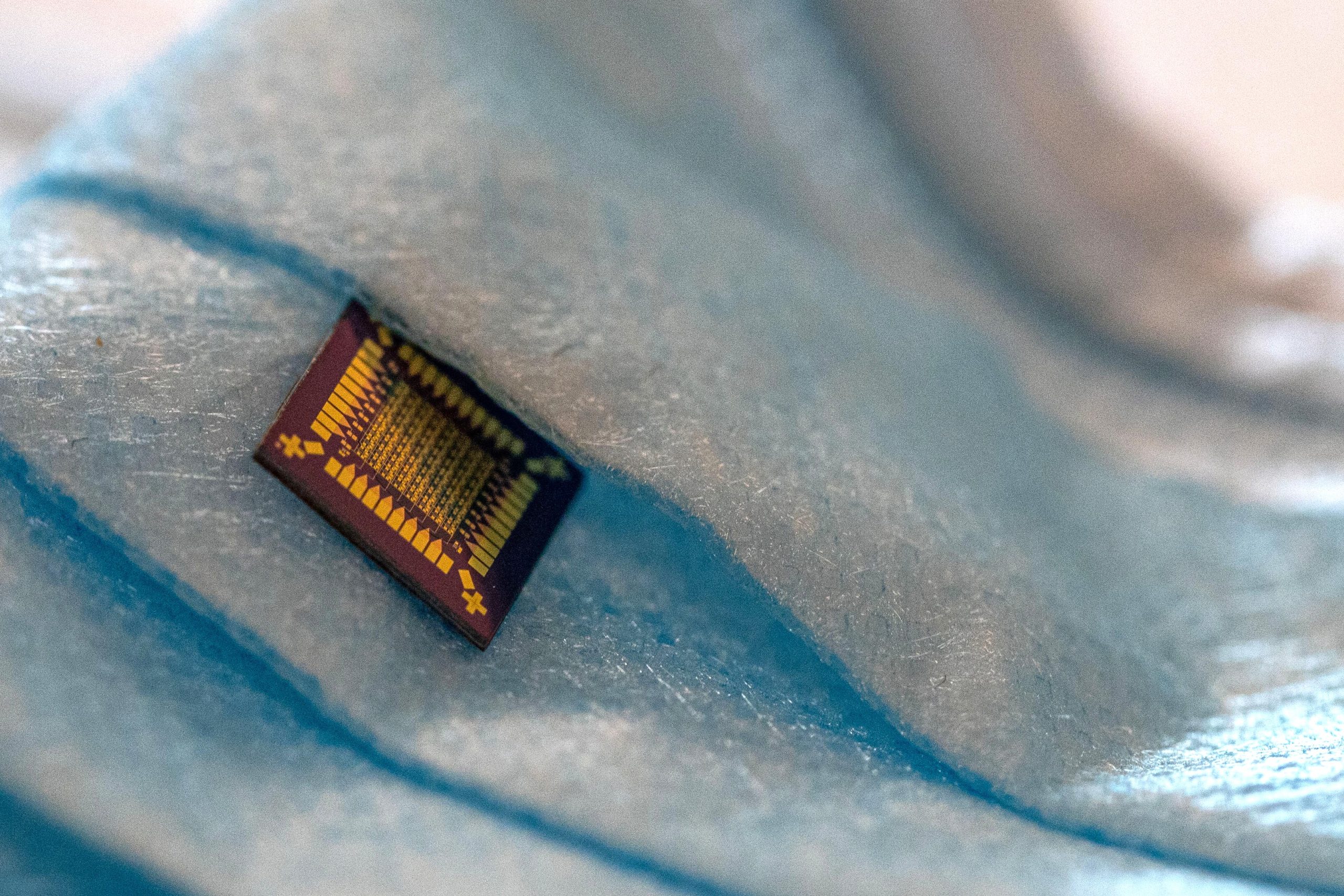
This is what a team at Tufts University Silklab did when they created transistors replacing the insulating material with biological silk. They recently reported their findings in the scientific journal Advanced Materials.
Silk fibroin—the structural protein of silk fibers—can be precisely deposited onto surfaces and easily modified with other chemical and biological molecules to change its properties. Silk functionalized in this manner can pick up and detect a wide range of components from the body or environment.
Advancements in Health Monitoring
The team’s first demonstration of a prototype device used the hybrid transistors to make a highly sensitive and ultrafast breath sensor, detecting changes in humidity. Further modifications of the silk layer could enable devices to detect some cardiovascular and pulmonary diseases, as well as sleep apnea, or pick up carbon dioxide levels and other gases and molecules in the breath that might provide diagnostic information. Used with blood plasma, they could potentially provide information on levels of oxygenation and glucose, circulating antibodies, and more.
Prior to the development of the hybrid transistors, the Silklab, led by Fiorenzo Omenetto, the Frank C. Doble Professor of Engineering, had already used fibroin to make bioactive inks for fabrics that can detect changes in the environment or on the body, sensing tattoos that can be placed under the skin or on the teeth to monitor health and diet, and sensors that can be printed on any surface to detect pathogens like the virus responsible for COVID19.
Understanding Hybrid Transistor Functionality
A transistor is simply an electrical switch, with a metal electrical lead coming in and another going out. In between the leads is the semiconductor material, so-called because it’s not able to conduct electricity unless coaxed.
Another source of electrical input called a gate is separated from everything else by an insulator. The gate acts as the “key” to turn the transistor on and off. It triggers the on-state when a threshold voltage – which we will call “1” – creates an electric field across the insulator, priming electron movement in the semiconductor and starting the flow of current through the leads.
In a biological hybrid transistor, a silk layer is used as the insulator, and when it absorbs moisture, it acts like a gel carrying whatever ions (electrically charged molecules) are contained within. The gate triggers the on-state by rearranging ions in the silk gel. By changing the ionic composition in the silk, the transistor operation changes, allowing it to be triggered by any gate value between zero and one.
The Future of Computing and Biology Integration
“You could imagine creating circuits that make use of information that is not represented by the discrete binary levels used in digital computing, but can process variable information as in analog computing, with the variation caused by changing what’s inside the silk insulator,” said Omenetto. “This opens up the possibility of introducing biology into computing within modern microprocessors,” said Omenetto. Of course, the most powerful known biological computer is the brain, which processes information with variable levels of chemical and electrical signals.
The technical challenge in creating hybrid biological transistors was to achieve silk processing at the nanoscale, down to 10nm or less than 1/10000th the diameter of a human hair. “Having achieved that, we can now make hybrid transistors with the same fabrication processes that are used for commercial chip manufacturing,” said Beom Joon Kim, postdoctoral researcher at the School of Engineering. “This means you can make a billion of these with capabilities available today.”
Having billions of transistor nodes with connections reconfigured by biological processes in the silk could lead to microprocessors which could act like the neural networks used in AI. “Looking ahead, one could imagine have integrated circuits that train themselves, respond to environmental signals, and record memory directly in the transistors rather than sending it to separate storage,” said Omenetto.
Devices detecting and responding to more complex biological states, as well as large-scale analog and neuromorphic computing are yet to be created. Omenetto is optimistic for future opportunities. “This opens up a new way of thinking about the interface between electronics and biology, with many important fundamental discoveries and applications ahead.”
Reference: “Bimodal Gating Mechanism in Hybrid Thin-Film Transistors Based on Dynamically Reconfigurable Nanoscale Biopolymer Interfaces” by Beom Joon Kim, Giorgio Ernesto Bonacchini, Nicholas A. Ostrovsky-Snider and Fiorenzo G. Omenetto, 28 August 2023, Advanced Materials.
DOI: 10.1002/adma.202302062
Never miss a breakthrough: Join the SciTechDaily newsletter.
Follow us on Google and Google News.