
Close Menu
    Facebook X (Twitter) Instagram
    SciTechDaily
    • Biology
    • Chemistry
    • Earth
    • Health
    • Physics
    • Science
    • Space
    • Technology
    Facebook X (Twitter) Pinterest YouTube RSS
    SciTechDaily
    Home»Space»New Simulation Shows What Happens When the Milky Way and Andromeda Galaxies Collide
    Space

    New Simulation Shows What Happens When the Milky Way and Andromeda Galaxies Collide

    By Pete Wheeler (ICRAR / The University of Western Australia)February 20, 2018No Comments3 Mins Read
    Facebook Twitter Pinterest Telegram LinkedIn WhatsApp Email Reddit
    Share
    Facebook Twitter LinkedIn Pinterest Telegram Email Reddit
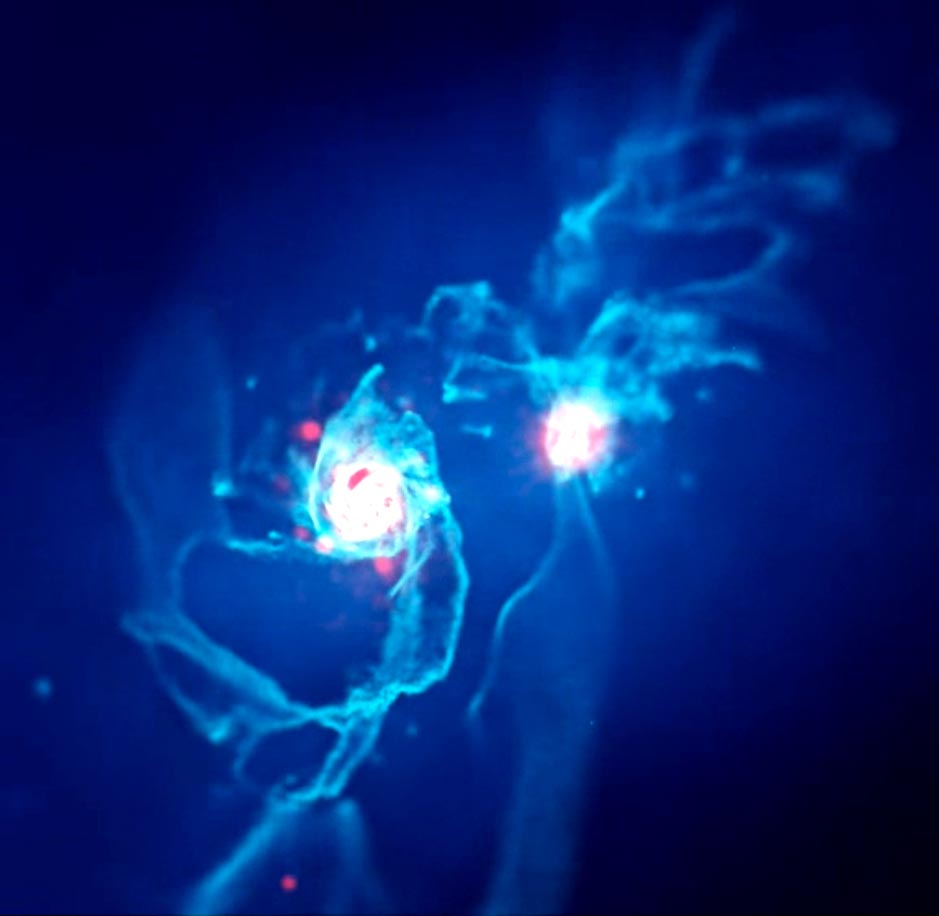
    Milky Way and Andromeda During Merger
    The Milky Way and Andromeda during the merger—a close up. Credit: ICRAR

    Astronomers have discovered that our nearest big neighbor, the Andromeda galaxy, is roughly the same size as the Milky Way. It had been thought that Andromeda was two to three times the size of the Milky Way, and that our own galaxy would ultimately be engulfed by our bigger neighbor.

    But the latest research, published today, evens the score between the two galaxies. It found the weight of the Andromeda is 800 billion times heavier than the Sun, on par with the Milky Way.

    Astrophysicist Dr. Prajwal Kafle, from The University of Western Australia node of the International Centre for Radio Astronomy Research, said the study used a new technique to measure the speed required to escape a galaxy. “When a rocket is launched into space, it is thrown out with a speed of 11km/s to overcome the Earth’s gravitational pull,” he said.

    “Our home galaxy, the Milky Way, is over a trillion times heavier than our tiny planet Earth so to escape its gravitational pull we have to launch with a speed of 550km/s. We used this technique to tie down the mass of Andromeda.”


    In about 5 billion years time, nearby massive galaxy Andromeda will merge with our own galaxy, the Milky Way. There haven’t been any large mergers with our galaxy recently, but we can see the remnants of galaxies that have previously been snacked on by the Milky Way. We’re also going to eat two nearby dwarf galaxies, the Large and Small Magellanic Clouds sometime in the future. This simulation shows what will happen when the Milky Way and Andromeda get closer together and then collide, and then finally come together once more to merge into an even bigger galaxy.

    Dr. Kafle said the research suggests scientists previously overestimated the amount of dark matter in the Andromeda galaxy. “By examining the orbits of high-speed stars, we discovered that this galaxy has far less dark matter than previously thought, and only a third of that uncovered in previous observations,” he said.

    The Milky Way and Andromeda are two giant spiral galaxies in our local Universe, and light takes a cosmologically tiny two million years to get between them. With Andromeda no longer considered the Milky Way’s big brother, new simulations are needed to find out what will happen when the two galaxies eventually collide.
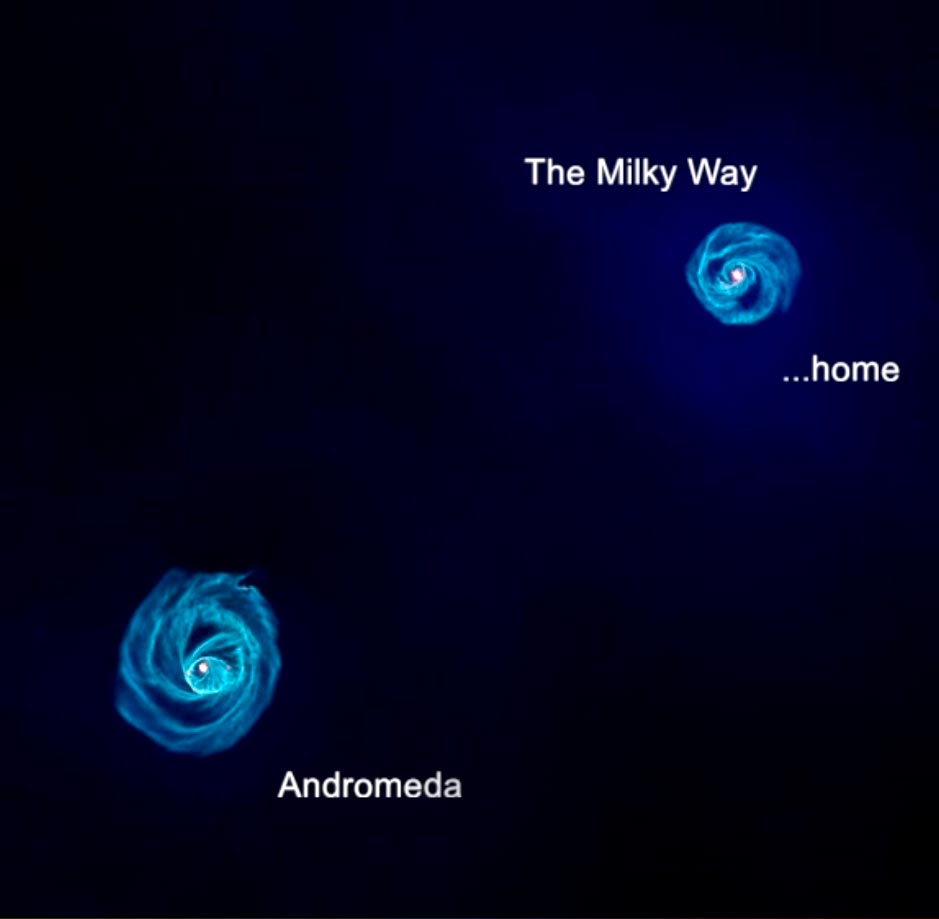
    Milky Way and Andromeda Prior to Merger
    The Milky Way and Andromeda prior to the merger. Credit: ICRAR

    Dr. Kafle used a similar technique to revise down the weight of the Milky Way in 2014, and said the latest finding had big implications for our understanding of our nearest galactic neighbors.

    “It completely transforms our understanding of the local group,” he said. “We had thought there was one biggest galaxy and our own Milky Way was slightly smaller but that scenario has now completely changed. It’s really exciting that we’ve been able to come up with a new method and suddenly 50 years of collective understanding of the local group has been turned on its head.”

    University of Sydney astrophysicist Professor Geraint Lewis said it was exciting to be at a time when the data was getting so good.

    “We can put this gravitational arms race to rest,” he said.

    Reference: “The need for speed: escape velocity and dynamical mass measurements of the Andromeda galaxy” by Prajwal R Kafle, Sanjib Sharma, Geraint F Lewis, Aaron S G Robotham and Simon P Driver, 10 January 2018, NMRAS.
    DOI: 10.1093/mnras/sty082
    PDF

    Never miss a breakthrough: Join the SciTechDaily newsletter.
    Follow us on Google and Google News.

    Astronomy Cosmology Galaxy Evolution International Centre for Radio Astronomy Research (ICRAR) University of Western Australia
    Share. Facebook Twitter Pinterest LinkedIn Email Reddit

    Related Articles

    Astronomers Just Reconstructed a Galaxy’s 12-Billion-Year History

    Ancient Dusty Galaxies Discovered at the Edge of the Universe Rewrite Cosmic History

    Massive Compact Galaxies with Star-Driven High-Velocity Outflows

    New Research Shows Early Galaxies Grew Massive Through Collisions

    Simulations Shed Light on the Formation of Stars in the Earliest Galaxies

    Uniform Heavy Element Distribution Points to Early Cosmic ‘Seeding’

    Study Suggest Spiral Galaxies Are Larger Than Previously Thought

    New Planck Data Challenges Our Understanding of the Universe

    New Model May Rule Out the Presence of Dark Matter

    Leave A Reply Cancel Reply

    • Facebook
    • Twitter
    • Pinterest
    • YouTube

    Don't Miss a Discovery

    Subscribe for the Latest in Science & Tech!

    Trending News

    Mezcal “Worm” in a Bottle Mystery: DNA Testing Reveals a Surprise

    New Research Reveals That Your Morning Coffee Activates an Ancient Longevity Switch

    This Is What Makes You Irresistible to Mosquitoes

    Shockingly Powerful Giant Octopuses Ruled the Seas 100 Million Years Ago

    Scientists Stunned by New Organic Molecules Found on Mars

    Rewriting Dinosaur Evolution: Scientists Unearth Remarkable 150-Million-Year-Old Stegosaur Skull

    Omega-3 Supplements Linked to Cognitive Decline in Surprising New Study

    First-of-Its-Kind Discovery: Homer’s Iliad Found Embedded in a 1,600-Year-Old Egyptian Mummy

    Follow SciTechDaily
    • Facebook
    • Twitter
    • YouTube
    • Pinterest
    • Newsletter
    • RSS
    SciTech News
    • Biology News
    • Chemistry News
    • Earth News
    • Health News
    • Physics News
    • Science News
    • Space News
    • Technology News
    Recent Posts
    • New Research Challenges Long-Held Beliefs About How the Brain Makes Decisions
    • Breakthrough Technology Reveals New Treatment Targets for Cancer
    • Scientists Discover New Way To Make Drug-Resistant Cancer Treatable Again
    • This Simple Exercise Trick Builds Muscle With Less Effort, Study Finds
    • Middle Age Is Becoming a Breaking Point in America, Study Reveals
    Copyright © 1998 - 2026 SciTechDaily. All Rights Reserved.
    • Science News
    • About
    • Contact
    • Editorial Board
    • Privacy Policy
    • Terms of Use

    Type above and press Enter to search. Press Esc to cancel.