
Close Menu
    Facebook X (Twitter) Instagram
    SciTechDaily
    • Biology
    • Chemistry
    • Earth
    • Health
    • Physics
    • Science
    • Space
    • Technology
    Facebook X (Twitter) Pinterest YouTube RSS
    SciTechDaily
    Home»Science»SISSA Paper “Sums Up” the Details of Irregularities of Space Time
    Science

    SISSA Paper “Sums Up” the Details of Irregularities of Space Time

    By Scuola Internazionale Superiore di Studi AvanzatiDecember 26, 2013No Comments4 Mins Read
    Facebook Twitter Pinterest Telegram LinkedIn WhatsApp Email Reddit
    Share
    Facebook Twitter LinkedIn Pinterest Telegram Email Reddit
    Paper Reviews Research on the Grain of Space Time
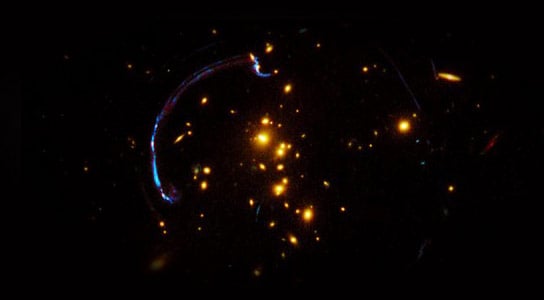
    Stefano Liberati’s 2013 paper in Classical and Quantum Gravity, selected as one of the 2013 Highlight papers, systematically reviews methods for testing Einstein’s Special Relativity, including at high energies. These tests are crucial, as deviations may imply a granular, non-continuous nature of space-time. Credit: NASA; ESA; J. Rigby (NASA Goddard Space Flight Center); and K. Sharon (Kavli Institutefor Cosmological Physics, University of Chicago)

    In a review paper, Stefano Liberati provides a systematic overview of the experiments and observations that can be exploited to investigate deviations from Special Relativity.

    A paper by Stefano Liberati from SISSA has been selected as one of the 2013 Highlight papers (the best papers of the year) of the journal Classical and Quantum Gravity. The paper is a systematic review of the methods devised by scientists since the 90s to test Einstein’s laws of Special Relativity, up to the highest observable energies. These types of tests are important: deviations from Special Relativity could in fact indicate that space time is not continuous but grainy.

    Smooth” or grainy? Is space time continuous or is it made up of very fine (10 -35 meters on the “Planck scale”) but discrete grains, if we look at it very close up? If the latter were true, scientists think, this would lead to deviations from the theory of special relativity formulated by Albert Einstein more than 100 years ago. In some theoretical scenarios, the “non continuity” of space time implies violations to the invariance of the physical laws under the so called Lorentz transformations (which establish that physical laws are the same for all inertial reference frames that are at the basis of special relativity). Since the 90s physicists have devised several methods (often based on phenomena connected to high energy astrophysics) to test these deviations from standard physics. Stefano Liberati, coordinator of the Astroparticle Physics group of the International School for Advanced Studies (SISSA) of Trieste, recently published a systematic review to present the state of the art in this field and the constraints that can be placed on the various models that predict violations to Special Relativity.

    The paper is an invited Topic Review published in the journal Classical and Quantum Gravity. This journal periodically asks leading world experts to “sum up” what is known in a specific field of study. The review has now been selected as one of the journal’s Highlight papers for 2013.

    “Physicists have been wondering about the nature of space time for years. We’ve been asking ourselves whether it is continuous at all scales, as we perceive it in our daily experience, or whether at very small sizes it presents an irregular grain that we, in our direct experience, are unable to perceive,” explains Liberati. “Imagine looking at a slab of marble from some distance: it will probably seem to have a uniform texture. However, on closer inspection, for example, using a powerful microscope, you can see that the marble is porous and irregular.”

    “In a certain sense physicists have been trying to do something similar with space time: to find something that acts as a microscope to find out whether at very small length scales there is indeed some irregularity. In my paper I presented a systematic overview of the experiments and observations that can be exploited to investigate the existence of these irregularities. Special relativity is one of the cornerstones of modern physics and as such it is very important to test its validity, insofar as current observations allow us.”

    Reference: “Tests of Lorentz invariance: a 2013 update” by S Liberati, 7 June 2013, Classical and Quantum Gravity.
    DOI: 10.1088/0264-9381/30/13/133001
    arXiv:1304.5795 

    Never miss a breakthrough: Join the SciTechDaily newsletter.
    Follow us on Google and Google News.

    Astrophysics Popular SISSA Spacetime
    Share. Facebook Twitter Pinterest LinkedIn Email Reddit

    Related Articles

    Space Interferometer Constellation To Reveal Elusive Gravitational Wave Sources and Unravel the Universe

    Statistical Analysis Shows Unexpected Interaction Between Dark Matter and Ordinary Matter

    Milky Way Could Be a “Galactic Transport System”

    New Exoplanet-Hunting Facility (NGTS) Achieves First Light

    The Reinterpretation of Cold Dark Matter as a Bose-Einstein Condensate

    NASA Supercomputer Simulation Shows Neutron Stars Ripping Each Other Apart to Form a Black Hole

    CfA Astronomers Create First Realistic Virtual Universe

    A New Hypothesis on the Nature of Black Holes

    Scientists Believe Humans Will One Day Colonize the Universe

    Leave A Reply Cancel Reply

    • Facebook
    • Twitter
    • Pinterest
    • YouTube

    Don't Miss a Discovery

    Subscribe for the Latest in Science & Tech!

    Trending News

    Breakthrough Bowel Cancer Trial Leaves Patients Cancer-Free for Nearly 3 Years

    Natural Compound Shows Powerful Potential Against Rheumatoid Arthritis

    100,000-Year-Old Neanderthal Fossils in Poland Reveal Unexpected Genetic Connections

    Simple “Gut Reset” May Prevent Weight Gain After Ozempic or Wegovy

    2.8 Days to Disaster: Scientists Warn Low Earth Orbit Could Suddenly Collapse

    Common Food Compound Shows Surprising Power Against Superbugs

    5 Simple Ways To Remember More and Forget Less

    The Atomic Gap That Could Cost the Semiconductor Industry Billions

    Follow SciTechDaily
    • Facebook
    • Twitter
    • YouTube
    • Pinterest
    • Newsletter
    • RSS
    SciTech News
    • Biology News
    • Chemistry News
    • Earth News
    • Health News
    • Physics News
    • Science News
    • Space News
    • Technology News
    Recent Posts
    • Scientists Print Artificial Neurons That Can Talk to the Brain
    • Bowel and Ovarian Cancers Are Dramatically Rising in Young Adults and Scientists Aren’t Sure Why
    • Alzheimer’s May Begin Decades Earlier Than You Think, New Mayo Clinic Study Finds
    • The Hidden Risk of Taking Breaks From Weight-Loss Drugs Like Ozempic
    • Total Solar Eclipse Made Cities Go Eerily Quiet Beneath the Surface
    Copyright © 1998 - 2026 SciTechDaily. All Rights Reserved.
    • Science News
    • About
    • Contact
    • Editorial Board
    • Privacy Policy
    • Terms of Use

    Type above and press Enter to search. Press Esc to cancel.