
Close Menu
    Facebook X (Twitter) Instagram
    SciTechDaily
    • Biology
    • Chemistry
    • Earth
    • Health
    • Physics
    • Science
    • Space
    • Technology
    Facebook X (Twitter) Pinterest YouTube RSS
    SciTechDaily
    Home»Space»Size Doesn’t Matter: How Deadly a Meteorite Impact Is Depends on Rock Composition
    Space

    Size Doesn’t Matter: How Deadly a Meteorite Impact Is Depends on Rock Composition

    By University of LiverpoolJanuary 2, 20222 Comments3 Mins Read
    Facebook Twitter Pinterest Telegram LinkedIn WhatsApp Email Reddit
    Share
    Facebook Twitter LinkedIn Pinterest Telegram Email Reddit
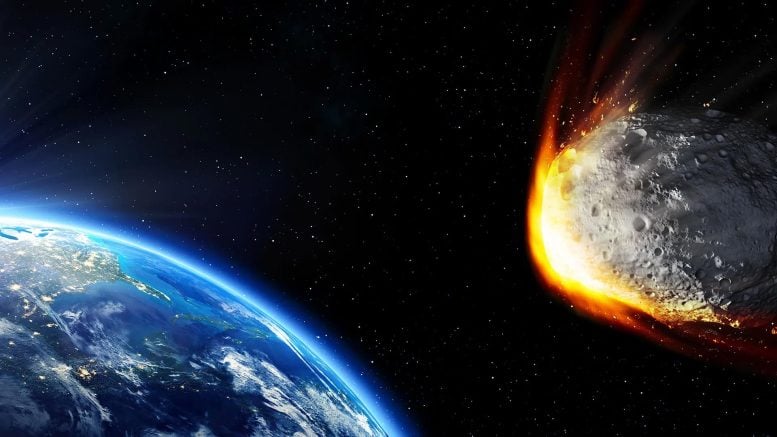
    Asteroid Approaching Earth
    Findings from a new geological study indicate that meteorite impacts into rocks containing potassium feldspar, regardless of the meteorite’s size, have historically led to mass extinctions by affecting cloud behavior and increasing solar heating which changes the global climate.

    A study shows that meteorite impacts on potassium feldspar-rich rocks, rather than impact size, correlate with mass extinctions due to induced climate changes from altered cloud dynamics.

    New research has found that the mineralogy of the rocks that a meteorite hits, rather than the size of the impact, determines how deadly an impact it will have.

    The earth has been bombarded by meteorites throughout its long history. Meteorite impacts generate atmospheric dust and cover the Earth’s surface with debris and have long been considered as a trigger of mass extinctions through Earth’s history.

    Why Some Meteorites Cause Mass Extinctions While Others Do Not

    A multidisciplinary research team from the University of Liverpool and the Instituto Tecnológico y de Energías Renovables, Tenerife with expertise in paleontology, asteroid stratigraphy, mineralogy, cloud microphysics, and climate modeling, sought to explore why some meteorites have caused mass extinctions, for example the K/Pg Chixulclub impact that killed off dinosaurs, yet many which are larger in size have not.

    They analyzed 44 impacts over the past 600 million years using a new method: assessing the mineral content of the dust ejected into the atmosphere upon impact.

    Their findings, published in the Journal of the Geological Society of London, reveal that meteorites that hit rocks rich in potassium feldspar (a common and rather benign mineral) always correspond with a mass extinction episode, irrespective of size.

    How Potassium Feldspar Alters Cloud Dynamics and Triggers Warming

    Potassium feldspar is non-toxic. However, it is a powerful ice-nucleating mineral aerosol that strongly affects cloud dynamics, which makes them let through more solar radiation. This in turn warms up the planet and changes the climate.  The atmosphere also becomes more sensitive to warming from greenhouse gas emissions, such as large volcanic eruptions.

    Liverpool sedimentologist, Dr. Chris Stevenson, from the University’s School of Earth, Ocean and Ecological Sciences co-authored the study.

    He said: “For decades scientists have puzzled over why some meteorites cause mass extinctions, and others, even really big ones, don’t.

    “It’s surprising when we put together the data: life carried on as normal during the 4th largest impact with a crater diameter of ~48 km (30 mi), whereas an impact half the size was associated with a mass extinction only 5 million years ago.

    “Many kill mechanisms have been proposed, such as large volcanic eruptions, but just like meteorites, these don’t always correlate with mass extinctions.

    “Using this new method for assessing the mineral content of the meteorite ejecta blankets, we show that every time a meteorite, big or small, hits rocks rich in potassium feldspar it correlates with a mass extinction event.

    This opens up a whole new avenue of research: what exactly kills off life during these episodes, and how long do the potassium feldspar effects last? Until now, only meteorites have changed the aerosol regime of the climate. However, present-day human activities represent a similar mechanism with increasing emissions of mineral aerosols into the atmosphere.”

    Reference: “Meteorites that produce K-feldspar-rich ejecta blankets correspond to mass extinctions” by M. J. Pankhurst, C. J. Stevenson and B. C. Coldwell, 1 December 2021, Journal of the Geological Society of London.
    DOI: 10.1144/jgs2021-055

    Never miss a breakthrough: Join the SciTechDaily newsletter.
    Follow us on Google and Google News.

    Asteroid Geology Meteorites Planetary Defense Popular University of Liverpool
    Share. Facebook Twitter Pinterest LinkedIn Email Reddit

    Related Articles

    The Stunning Meteor Shower That Has Scientists Worried

    We Asked a NASA Expert: When Was the Last Time an Asteroid Hit Earth? [Video]

    Earth’s Meteorite Impacts Tracked Over Past 500 Million Years

    Vesta Meteorites Discovered on Asteroid Bennu by NASA’s OSIRIS-REx Spacecraft

    Asteroid Deflection Planetary Defense Mission Target: “Dimorphos”

    NASA Double Asteroid Redirection Test: First Planetary Defense Mission Target Gets a New Name

    Planetary Defense Researchers Simulate Earth-Bound Asteroid Deflection

    Martian Meteorites Yield Clues to the Planet’s Early Atmosphere

    “Hidden Flux” of Material May Help Explain Earth’s Origins

    2 Comments

    1. layne on January 4, 2022 7:08 am

      are there diamond meteors.

      Reply
      • Jurrubin on January 4, 2022 2:03 pm

        Theoritically, yes. See story below.
        https://www.businessinsider.com/diamond-meteorite-missing-planet-solar-system-2018-4

        Reply
    Leave A Reply Cancel Reply

    • Facebook
    • Twitter
    • Pinterest
    • YouTube

    Don't Miss a Discovery

    Subscribe for the Latest in Science & Tech!

    Trending News

    Scientists Just Discovered a Hidden Freshwater World Beneath the Great Salt Lake

    Why Your Daily Shower Could Be Worsening the Water Crisis

    Scientists Discover New “Magic Mushroom” Species That Rewrites Evolutionary History

    Mystery Deepens: Astrophysicists Say Dark Matter May Not Be One Thing

    Your BMI Might Be Wrong: Study Finds Millions Are Misclassified

    A Simple Blood Test Could Predict Dementia Risk 25 Years Early

    3.5-Billion-Year-Old Rocks Rewrite the Story of Plate Tectonics

    Why Aging Lungs Turn Mild Infections Into Life-Threatening Illness

    Follow SciTechDaily
    • Facebook
    • Twitter
    • YouTube
    • Pinterest
    • Newsletter
    • RSS
    SciTech News
    • Biology News
    • Chemistry News
    • Earth News
    • Health News
    • Physics News
    • Science News
    • Space News
    • Technology News
    Recent Posts
    • This Alga Rewrites the Rules of Photosynthesis To Survive in the Dark
    • Are Humans Naturally Violent? Scientists Challenge Long-Held Assumptions
    • Scientists Say This Popular Food Could Help Your Body Get Rid of Microplastics
    • Scientists Build Five-in-One “Super Molecule” for Next-Gen Electronics
    • Physicists Discover Magnetic Mechanism That Challenges a 300-Year-Old Law of Friction
    Copyright © 1998 - 2026 SciTechDaily. All Rights Reserved.
    • Science News
    • About
    • Contact
    • Editorial Board
    • Privacy Policy
    • Terms of Use

    Type above and press Enter to search. Press Esc to cancel.