
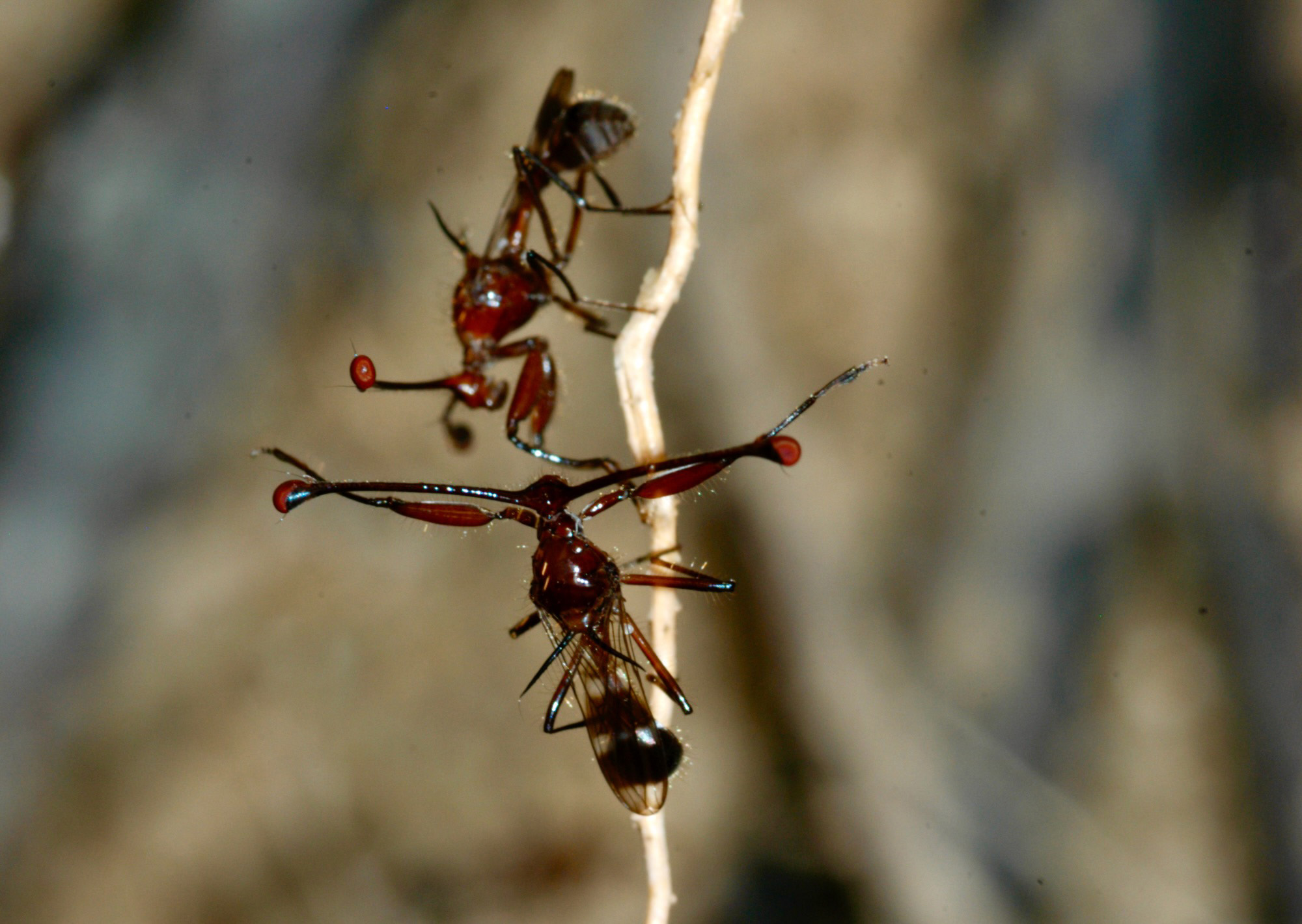
Male stalk-eyed flies with longer eyestalks are more appealing to females and more intimidating to rival males. However, males with a genetic variant that results in shorter eyestalks tend to be more aggressive fighters.
In stalk-eyed flies, males with longer eyestalks have an advantage in attracting females, as females tend to prefer them. These males also face less competition from other males for access to mates. However, some males carry a version of the X chromosome that results in shorter eyestalks. Scientists studying why this mutation persists, despite sexual selection favoring longer eyestalks, have found that males with shorter eyestalks may compensate by being more aggressive.
“It’s the first time I’m aware of that there’s evidence of a link between a selfish gene and aggressive behavior,” said Dr Josephine Reinhardt of the State University of New York — Geneseo, corresponding author of the article in Frontiers in Ethology. “These driving X chromosomes are pretty interesting because they are an example of how parts of our genetic code aren’t necessarily working together, but have their own selfish interests. This is an extreme example, but simply carrying one of these selfish chromosomes impacts so many parts of these animals’ biology, even their behavior.”
Swipe left?
There are two different types of X chromosomes present in stalk-eyed flies. The X chromosome carrying the mutation for short eyestalks is a meiotic driver: it carries alleles which are over-represented in a male’s sperm, meaning it’s much more likely to be passed on.
“The driving X chromosome has a huge natural advantage because it passes itself on more than the fair 50-50 ‘coin flip’ rule of genetics that most of us learned in high school biology,” explained Reinhardt. “Up to 100% of a male’s offspring end up inheriting the X and therefore are female. Because of this, we might assume the X will keep increasing in the population and even cause extinction. Since that hasn’t happened, we’re interested in understanding what other traits could counteract that advantage.”
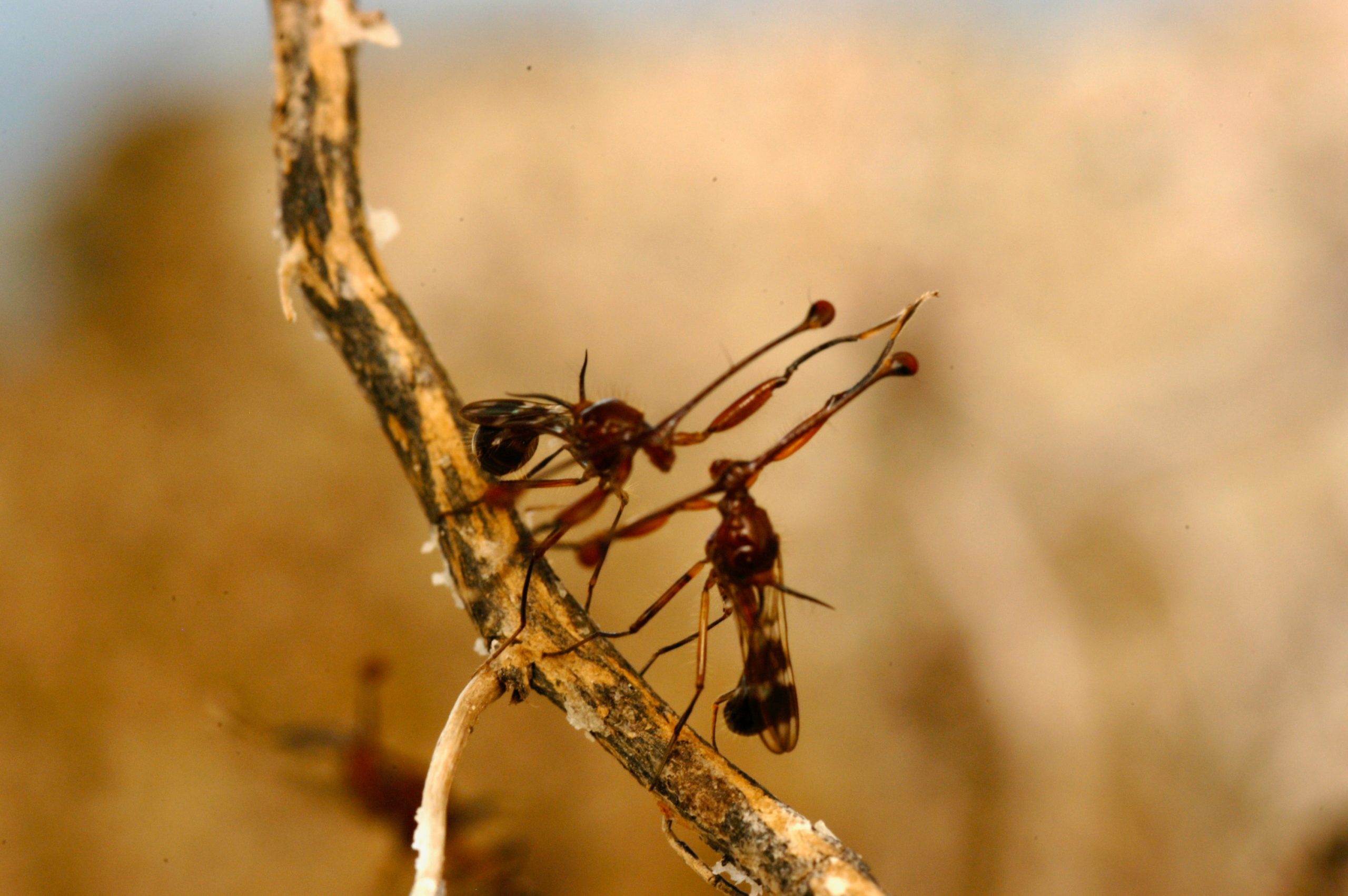
Male stalk-eyed flies defend access to mates by intimidating displays and fighting. To test whether flies carrying the driving X are more aggressive, the scientists used populations of flies carrying either type of X. Flies display more aggression against flies with similarly-sized eyestalks, so the researchers matched up competitors with similar eyestalks, then filmed their contests and analyzed their behavior.
They found not only that fighting behaviors were more common when the two flies were closely matched in eyestalk size, but that these behaviors were more commonly seen in males with the driving X. Males that used more of these fighting behaviors were more likely to win contests. The scientists also observed that males with the driving X chromosome were more likely to win if they engaged in more fighting than displaying.
“When fighters are mismatched, fights tend to end quickly, with the smaller male retreating,” Reinhardt said. “When a male with the driving X chromosome is fighting a male with similar-sized eyestalks, he is more aggressive. But because driving X males are on average smaller, it is likely still a disadvantage.”
Flying high
This could explain why the flies with short eyestalks were able to mate. Longer eyestalks signal a larger body size and more dangerous opponent, which is why flies with shorter eyestalks usually retreat from contests. If males with the driving X chromosome are more aggressive or don’t accurately assess the threat from other males, these males could choose to compete with males with longer eyestalks, bringing themselves into contact with the females initially attracted to their opponent.
Although this extra aggression could be dangerous, it could also help the flies get mating opportunities they otherwise wouldn’t. However, it can’t fully counterbalance sexual selection. Modeling of the spread of the driving X suggests that this could explain why it hasn’t taken over: females still prefer males with longer eyestalks, keeping the variant’s frequency low.
“I would say that this study is an initial finding,” cautioned Reinhardt. “A larger study might be done in which we specifically test for the increase in high-intensity behavior that we saw here in a larger sample. In addition, this is a laboratory study, so it is not totally clear how well it would apply to field behavior. Finally, females were not tested. If the driving X chromosome directly increases aggression that might impact females — whereas if it’s an indirect effect to do with the eyestalk size, it might not.”
Reference: “Stalk-eyed flies carrying a driving X chromosome compensate by increasing fight intensity” by Kimberly A. Paczolt, Macy E. Pritchard, Gabrielle T. Welsh, Gerald S. Wilkinson and Josephine A. Reinhardt, 22 August 2024, Frontiers in Ethology.
DOI: 10.3389/fetho.2024.1461681
Funding: U.S. National Science Foundation, National Institute of Health, Research Foundation for The State University of New York, Geneseo Foundation
Never miss a breakthrough: Join the SciTechDaily newsletter.
Follow us on Google and Google News.