
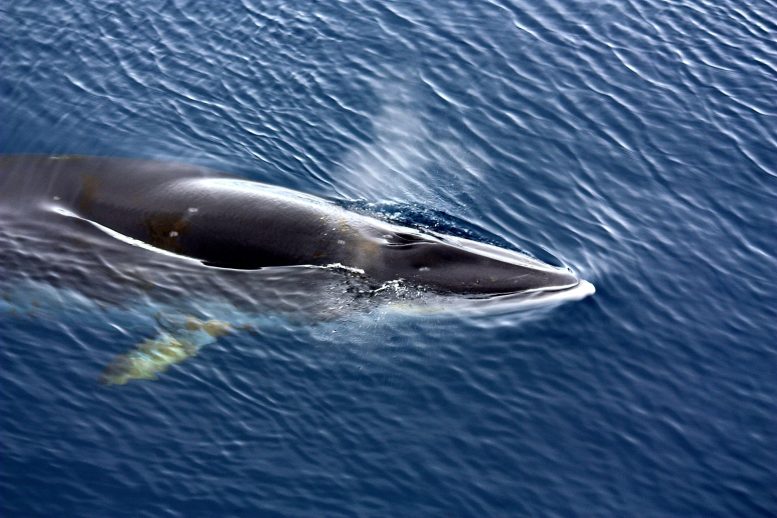
Minke whales are as small as a lunge-feeding baleen whale can be.
Research on the feeding behavior of Antarctic minke whales found that a smaller whale could not capture enough food to survive using the lunge-feeding strategy of baleen whales.
A new study of Antarctic minke whales reveals a minimum size limit for whales employing the highly efficient “lunge-feeding” strategy that enabled the blue whale to become the largest animal on Earth.
Lunge feeding whales accelerate toward a patch of prey, engulf a huge volume of water, and then filter out the prey through the baleen plates in their mouths. This strategy is used by the largest group of baleen whales, known as rorquals, which includes blue, fin, humpback, and minke whales.
Baleen whales, also known as mysticetes, are a type of marine mammal that have a comb-like structure called baleen plates in their upper jaw instead of teeth. They use these baleen plates to filter out small prey, such as krill and plankton, from the water as they swim with their mouths open. Besides for minke whales, other xamples of baleen whales include humpback whales, blue whales, and gray whales.
The ability to engulf large amounts of prey-laden water is essential to making this feeding strategy pay off, and the energy efficiency increases with larger body size. An 80-ton blue whale, for example, can engulf a water volume equivalent to 135% of its body mass, whereas a 5-ton minke whale can engulf a volume equal to 42% of its body mass.
The Minimum Size Threshold
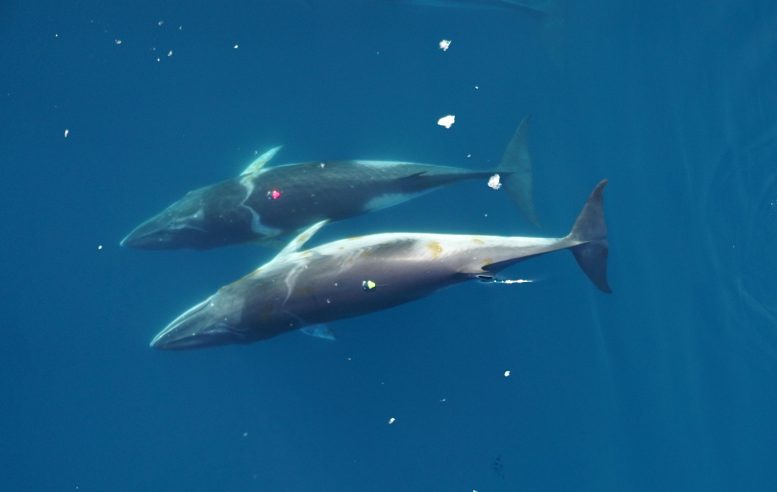
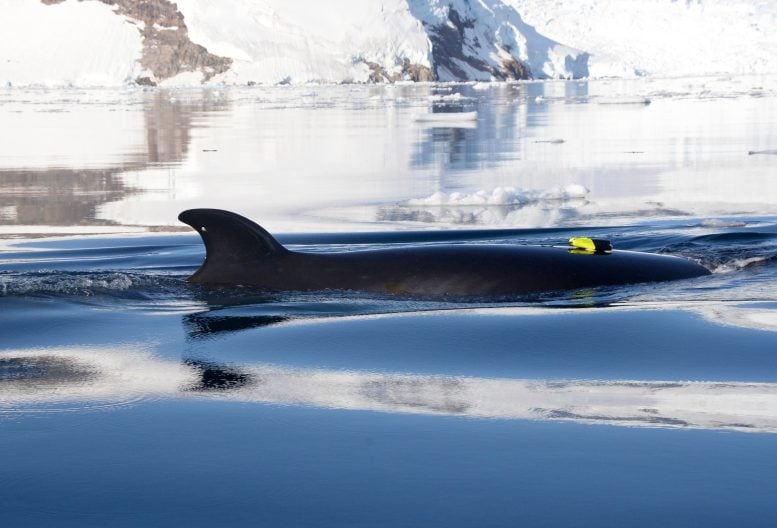
In the new study, published today, March 13, in the journal Nature Ecology & Evolution, researchers used noninvasive suction tags to observe 23 Antarctic minke whales in the waters off the West Antarctic Peninsula, tracking their daytime and nighttime foraging behavior as they fed on Antarctic krill. Data from previous studies of krill-feeding humpback whales and blue whales were used for comparison.
“When we calculate how much energy they use in foraging and what their overall intake should be based on their size, we find that minke whales are right at the threshold,” said first author David Cade, who led the study as a postdoctoral researcher at UC Santa Cruz and is now at Stanford’s Hopkins Marine Station. “Anything smaller than a minke could not achieve the foraging rates necessary to survive.”
Minke whales are not as well studied as other species of baleen whales, in part because they can be harder to find and tag.
“The data in this study represent more information on a poorly studied species than has ever been published previously and is helping us to better understand not only the species, but the role of baleen whales in marine ecosystems,” said coauthor Ari Friedlaender, professor of ocean sciences at UC Santa Cruz. “With so little known about this species that is being impacted by climate change, the more we understand their ecology and behavior the better we can protect them.”
The researchers observed remarkably high feeding rates for minke whales, especially at night, when they were often lunging every 15 seconds or so. Krill come to the surface at night and stay in the depths during the day, so daytime feeding requires deep dives, which are less efficient for smaller animals.
“During the day they feed at depths comparable to humpbacks and blue whales, but their foraging rates aren’t as high because they’re smaller,” Cade said. “Their nighttime feeding rates are two to five times the day rate.”
At night, the smaller, more maneuverable minke whales are well suited for pursuing small, scattered patches of krill at the surface. “When they’re surface feeding, they don’t have to hold their breath during dives and they can do lunges over and over again,” Cade said. “Only at night can they get the really high feeding rates they need.”
Evolutionary Insights into Baleen Whale Sizes
The study also addresses questions about the evolution of baleen whales and the origins of a feeding strategy that depends on large body size. Lunge feeding is thought to have arisen first in whales about the size of today’s Antarctic minke whales. This enabled the evolution of whales with gigantic body sizes, such as blue whales, during the past 5 million years when changing ocean conditions led to the formation of predictable regions with large prey patches that could be efficiently exploited by lunge-feeding whales.
“Minke whales represent one extreme, at the small end of the spectrum, for how filter feeding in ocean predators evolved,” Friedlaender said. “Understanding both the maximum and minimum size constraints on baleen whale size really helps us understand how this group of animals has evolved and how they affect and are impacted by marine ecosystems.”
Reference: “Minke whale feeding rate limitations suggest constraints on the minimum body size for engulfment filtration feeding” 13 March 2023, Nature Ecology & Evolution.
DOI: 10.1038/s41559-023-01993-2
In addition to Cade and Friedlaender, the coauthors of the paper include Shirel Kahane-Rapport, William Gough, and Jeremy Goldbogen at Hopkins Marine Station; K.C. Bierlich and David Johnston at Duke University; Jacob Linsky at UC Santa Cruz; and John Calambokidis at Cascadia Research Collective. This work was funded by the National Science Foundation and the Office of Naval Research.
Never miss a breakthrough: Join the SciTechDaily newsletter.
Follow us on Google and Google News.
2 Comments
“Research on the feeding behavior of Antarctic minke whales found that a smaller whale could not capture enough food to survive using the lunge-feeding strategy of baleen whales.”
Explain then how, after minke calves are weened, they manage to gather enough food to survive and grow to adulthood, where they finally meet the minimum size necessary to survive.
Oooo-kayy… the Japanese whalers have been killing minke whales for decades in the name of ‘scientific research’. So how come they didn’t know this?